Travel
The Silent Spires of the Elbe: Finding Romanticism in the Sandstone of Saxon Switzerland
Beyond the baroque splendor of Dresden lies a fractured kingdom of vertical stone and ancient mist. Saxon Switzerland National Park preserves a surreal landscape of eroded sandstone towers, where the echoes of Romantic-era painters still resonate through the deep canyons and across the historic Bastei Bridge.
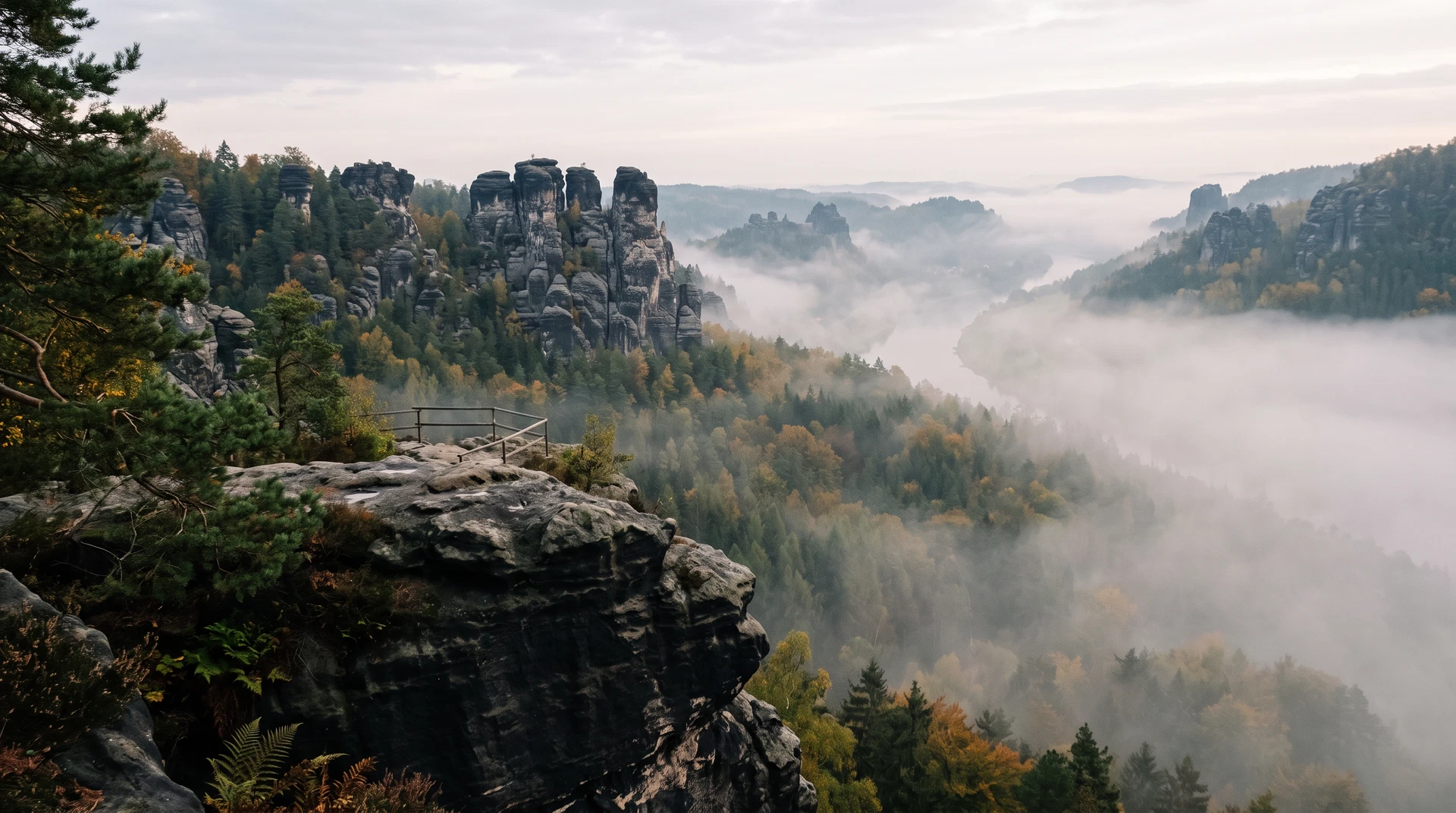
To arrive at the Bastei as the morning mist begins to lift is to witness the physical manifestation of a fever dream. The landscape of Saxon Switzerland does not roll; instead, it erupts. Massive, free-standing sandstone pillars rise abruptly from the valley floor, their surfaces weathered into vertical pleats that resemble fossilized cathedrals. This is the Elbe Sandstone Mountains, a geological anomaly where the slow violence of erosion has spent millennia carving a labyrinth of spires and deep, shadowed gorges that seem to defy gravity.
The story of this terrain began nearly one hundred million years ago, during the Cretaceous period, when a vast sea covered the region. As the waters receded, layers of sand were compressed into the blocky sandstone we see today. Since then, the elements have acted as a relentless sculptor. Rainwater and frost have exploited every fissure, widening them into the narrow 'clefts' that define the park’s interior. Walking through these passages, the air grows cooler as the sky narrows to a sliver of blue above, a reminder of the rock's fragile origins as seafloor sediment.
Central to the park’s identity is the Bastei rock formation, a jagged cluster of pinnacles that has drawn travelers for centuries. Spanning the gaps between these monoliths is the Bastei Bridge, a structure that feels as though it grew directly from the stone. Originally constructed of wood in 1824, it was replaced in 1851 by the current 76-meter-long sandstone version. Standing on its span, seven hundred feet above the winding Elbe River, the view is dizzying. The river below is a silver ribbon cutting through the green mantle of the valley, while the surrounding peaks stand like silent sentinels.
This place served as the definitive muse for the German Romantic movement. In the early 19th century, artists like Caspar David Friedrich wandered these trails, seeking a spiritual connection to nature that the industrializing world was beginning to lose. Friedrich’s iconic 'Wanderer above the Sea of Fog' was inspired by these very vistas, capturing the sublime tension between the individual and the vast wilderness. Even today, the atmosphere remains thick with that same Romantic melancholy, especially when the clouds hang low and the peaks appear to float on an ethereal sea, disconnected from the earth below.
For the modern adventurer, the park offers a unique and regulated climbing culture. With over 21,000 recognized routes and 1,100 free-standing peaks, it is a world-class destination for rock climbing, yet the rules are unlike anywhere else. To protect the fragile sandstone, the use of chalk is strictly prohibited, as are chemical aids and metal protection gear like bolts. Climbers must rely on traditional techniques, often using knotted slings wedged into cracks for protection. This 'Saxon style' demands a deep respect for the rock and a willingness to accept the inherent risks of a landscape returning to sand.
Beyond the vertical challenges, the park’s core zone is a sanctuary where strict stewardship ensures that the human footprint remains light. Visitors must stay on marked trails to protect the sensitive mosses, lichens, and rare bird species that call these crags home. The Peregrine falcon, once nearly extinct, has made a remarkable recovery here, nesting on the inaccessible ledges of the sandstone towers. The forest is a mix of spruce, pine, and beech, though recent years have seen the park service allow natural processes to take over, leaving fallen trees to decay in a cycle of renewal.
The park’s reach extends beyond the German border, merging seamlessly into the Bohemian Switzerland National Park in the Czech Republic. This transboundary cooperation is vital for the preservation of the entire region, allowing wildlife to move freely across political lines. Hikers can traverse the 'Malerweg' or Painter’s Way, a 112-kilometer trail that follows the paths once trod by Romantic artists. The trail winds through the most scenic parts, offering a slow-motion immersion into geology and history. Each turn reveals a new perspective: a hidden waterfall, a ruined medieval castle, or a sudden opening to the Elbe valley.
Practicality in this wilderness is surprisingly accessible, thanks to the efficient infrastructure. A short S-Bahn ride from Dresden brings you to the doorstep of the park, with the historic Kirnitzschtal tram providing a nostalgic journey deep into the woods. Yet, despite this ease, the park retains a sense of profound isolation. Once you step away from the primary viewpoints of the Bastei, the crowds thin, and the only sound is the wind whistling through the sandstone needles. It is a place that demands patience, a reminder that the most spectacular landscapes are often those that require us to slow down and look closely.
As evening approaches, the light changes, casting long shadows across the canyon walls and turning the grey sandstone into a warm amber. The Bastei Bridge, usually bustling, returns to a state of quiet dignity. It is in these moments that one truly understands the wistful allure of Saxon Switzerland. It is a landscape that feels both ancient and ephemeral, a collection of stone monuments being slowly reclaimed by the elements. To visit is to stand at the intersection of art and geology, witnessing a masterpiece of nature that continues to inspire awe in anyone who wanders among its silent spires.