Travel
The shifting silts and silent reed beds of the Danube Delta
Where the great river finally meets the Black Sea, a vast labyrinth of waterways and ancient reed beds creates a sanctuary for millions of birds. In the Danube Delta, life moves to the rhythm of the tides and the quiet dip of a Lipovan fisherman's oar.
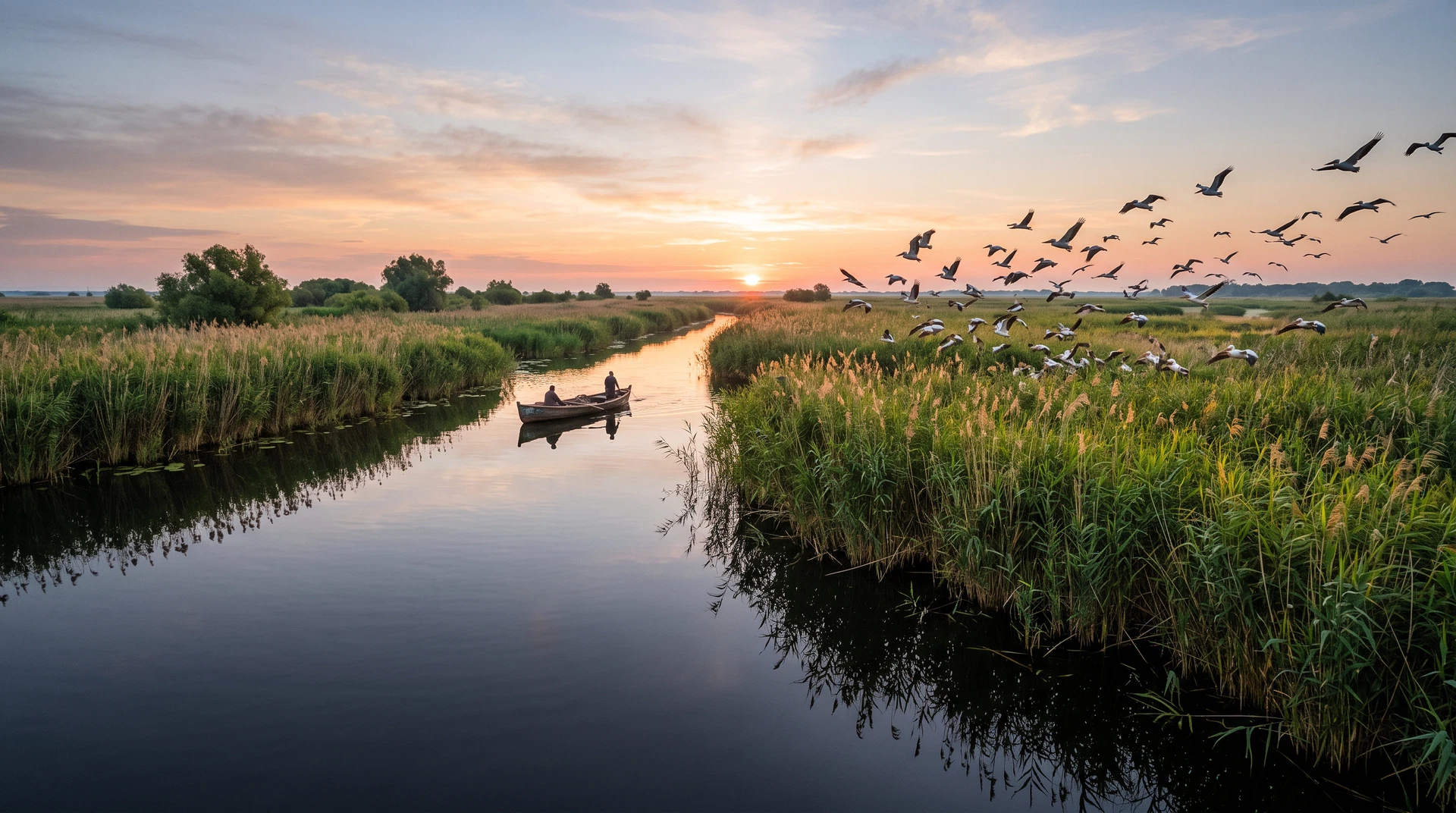
At the edge of the European continent, the Danube River finally surrenders its momentum to the Black Sea after traversing ten nations. This is not a sudden collision but a slow, sprawling dissolution into the Danube Delta Biosphere Reserve. Here, the map ceases to be a reliable guide, replaced by a fluid landscape of shifting sandbars and narrow channels that appear and disappear with the seasons. To enter this realm is to step back into a version of Europe that has largely vanished—a place where the water dictates the terms of existence and the silence is heavy with the weight of ancient silt.
The scale of this wilderness is difficult to comprehend from the low vantage point of a boat. The delta contains the world’s largest continuous expanse of reed beds, covering a staggering 240,000 hectares. These are not merely patches of vegetation but a vast, golden-green ocean of reeds that ripples under the wind like a living thing. Navigating through these waterways, one feels the claustrophobic intimacy of the narrow channels, where the stalks rise high above the water line, blocking the horizon. It is a world within a world, a dense thicket providing the ultimate sanctuary for life to flourish undisturbed by the modern world.
For the birdwatcher, the delta is a pilgrimage site supporting over 300 species. The air is often thick with the prehistoric silhouettes of great white pelicans, but the smaller residents tell the most significant ecological story. The delta is home to 60% of the global population of pygmy cormorants, agile birds that dart through the reeds with practiced ease. Watching them dive into the dark waters is a reminder of the delta’s role as a critical nursery for avian life, where the abundance of fish and the safety of the reed beds create a perfect, albeit fragile, equilibrium.
What makes the Danube Delta unique is its status as a land that is never finished. While much of the world’s coastline is retreating, the delta is actively growing, expanding into the Black Sea by roughly 68 million tons of alluvia annually. This constant influx of river sediment means the landscape is in a state of perpetual revision. New islands emerge from the depths, and old channels are choked with silt, forcing the river to find new paths to the sea. It is a geological workshop where one can witness the raw power of a great river building a new frontier one grain of sand at a time.
Human presence in this watery labyrinth is sparse and specialized. The traditional Lipovan fishing villages remain accessible only by water, their brightly painted blue-and-white houses standing as lonely outposts amidst the reeds. The Lipovans, descendants of Russian Old Believers who fled religious persecution centuries ago, have maintained a way of life inextricably linked to the river. Their narrow wooden boats, traditionally rowed with long oars, are the primary means of transport. To visit these villages is to encounter a community that has found a way to thrive in harmony with the river’s unpredictable whims and the shifting currents of the delta.
Navigating this maze requires more than just a map; it requires an intimate understanding of the water’s language. The waterway network is so complex that travelers can easily find themselves lost in a dead-end channel or grounded on a hidden sandbar. This is why the use of licensed guides is a necessity for both safety and preservation. These guides act as translators for the landscape, identifying the subtle signs of a nesting site or the hidden entrance to a secluded lake. They ensure that the human presence remains a quiet observation rather than a disruptive intrusion, maintaining the delicate boundary between visitor and wilderness.
The protection of this environment is a serious undertaking managed by the Biosphere Reserve Authority. Visitors must secure official permits before entering the reserve, a process that underscores the fragility of the ecosystem. These regulations are designed to prevent the degradation of nesting sites and to manage the impact of tourism on the delta’s sensitive habitats. It is a necessary friction, a reminder that the privilege of witnessing such beauty comes with a responsibility to leave it unchanged. The permits ensure that the pygmy cormorants and the ancient reed beds will continue to thrive long after the visitor has returned to the mainland.
As the sun sets over the delta, the landscape undergoes a dramatic transformation. The golden hour turns the reed beds into a field of fire, and the water reflects the deep purples of the Romanian sky. The sounds of the delta change—the daytime chatter of birds gives way to the rhythmic chorus of frogs and the soft splash of a jumping fish. The air carries the scent of damp earth and decaying vegetation, a primal smell that speaks of life and renewal. It is in these moments of transition that the delta’s wistful character is most apparent, a place belonging more to the past than the present.
Ultimately, the Danube Delta is a place of profound endurance. Despite the pressures of the modern world and the environmental challenges facing the river that feeds it, the delta remains Europe’s best-preserved wetland. It is a testament to the resilience of nature when given the space to breathe. To travel here is to accept a slower pace, to yield to the rhythm of the water, and to acknowledge that there are still places where the wild holds sway. It is a landscape that demands respect, offers solitude, and rewards the patient observer with a glimpse into the heart of a wild frontier.