Travel
The Silent Spires of Thessaly: Finding Spiritual Elevation Among the Floating Monasteries of Meteora
Rising dramatically from the Greek plains, the sandstone pillars of Meteora support centuries-old Byzantine monasteries that seem to hover between earth and sky. This UNESCO World Heritage site offers a rare convergence of geological wonder and enduring spiritual devotion, where ancient frescoes and monastic silence transcend time.
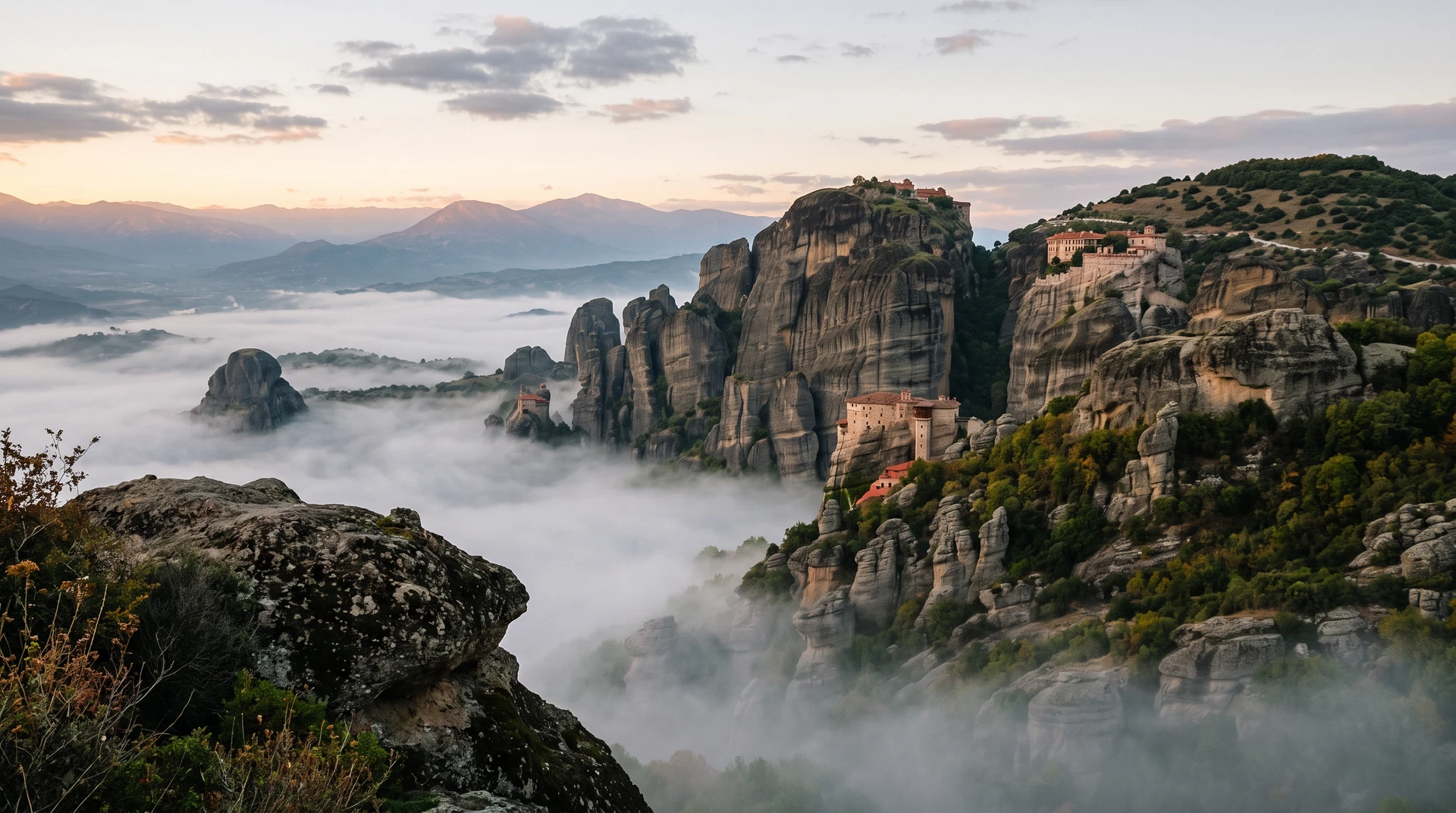
The morning mist clings to the valley floor near Kalabaka, obscuring the base of the massive sandstone monoliths until they appear to be floating, detached from the terrestrial world. This is Meteora, a name that translates literally to "suspended in the air," and the sensation of weightlessness is a physical reality. As the sun rises over the Thessaly plain, the gray conglomerate towers catch the light, revealing a landscape that feels like a fever dream of a Renaissance painter. Here, the vertical world dominates, and the horizontal concerns of the valley below dissolve into the hazy distance.
These pillars are the result of sixty million years of geological labor. Once the bed of a prehistoric sea, the region was sculpted by tectonic shifts and the relentless erosion of wind and water, leaving behind these smooth, vertical giants. The rock itself is a conglomerate of sandstone and pebbles, a texture that looks like a giant’s mortar work. Walking among them, one feels the weight of deep time, a scale of existence that makes the human presence here seem both fragile and audacious. It is a terrain that demands a specific kind of navigation, looking upward rather than forward.
It was this isolation that drew the first hermits to these heights in the 11th century. Seeking a refuge from the world and a closer proximity to the divine, they inhabited the natural fissures and caves of the rock faces. By the 14th century, these solitary retreats evolved into organized monastic communities. At the peak of its influence, twenty-four monasteries were perched atop these inaccessible summits, forming a "heavenly city" that served as a bastion of Orthodox culture. Today, only six remain active, their red-tiled roofs and stone walls blending seamlessly into the natural contours of the peaks.
The sheer logistics of constructing these edifices defy modern comprehension. Every stone, every beam of timber, and every drop of water had to be hauled up the vertical cliffs using systems of ropes, nets, and retractable wooden ladders. The monks spoke of the nets being replaced only "when the Lord let them break," a testament to a faith that superseded any concern for gravity. Even the frescoes that adorn the interior walls, masterpieces of post-Byzantine art, were painted in these high-altitude sanctuaries, brought to life by artists who worked in the dim light of oil lamps while the wind howled outside.
Access has changed since the days of the windlasses and nets, but the ascent remains a physical prayer. Modern visitors now climb stairs carved directly into the stone or traverse narrow bridges that span dizzying chasms. Each step upward is a transition from the noise of the world to a more disciplined silence. The air grows thinner and cooler, and the perspective shifts; the cars in the parking lots below shrink to the size of beetles, and the expansive horizon of the Pindus Mountains begins to unfold. It is a journey that requires stamina, but the reward is a sense of clarity.
Inside the monasteries, the atmosphere is heavy with the scent of beeswax and incense. The *katholikon*, or main church, of each community is a treasury of spiritual history. Here, photography is strictly forbidden, a rule that protects both the ancient frescoes and the sanctity of the space. The walls are covered from floor to ceiling with depictions of saints and biblical scenes, their gold leaf shimmering in the candlelight. These images have witnessed centuries of liturgy, surviving wars and occupations, and they continue to serve as the focal point for the monks and nuns who still call these heights home.
Stewardship of such a site is a delicate balance between welcoming the world and preserving a sacred way of life. Visitors must adhere to a strict modesty code—long skirts for women and trousers for men—a gesture of respect that bridges the gap between the tourist and the pilgrim. While the monasteries are open, they remain active religious houses. You might see a monk tending a small garden on a ledge that drops off into nothingness, or hear the rhythmic striking of the *talanton*, the wooden beam used to call the community to prayer. Meteora is not a museum, but a living tradition.
Beyond the monastic walls, the landscape offers its own quiet revelations. The hiking trails that wind through the base of the pillars allow for a different perspective on the scale of the formations. From below, the monasteries look like eagle’s nests, precarious and proud. The local flora, adapted to the rocky soil, clings to the crevices, while large birds of prey circle the thermals between the peaks. In the late afternoon, the shadows of the pillars stretch across the valley, painting the landscape in shades of deep purple and gold as the rocks begin to cool.
Meteora’s designation as a UNESCO Mixed Heritage property acknowledges this inseparable bond between the natural and the man-made. The geological uniqueness of the sandstone forest is the only reason the monasteries exist in this form, and the monasteries are what give the rocks their profound cultural resonance. It is a place where the verticality of the earth meets the verticality of the spirit. The endurance of the conglomerate stone mirrors the endurance of the faith that has occupied it for seven centuries, creating a sanctuary that feels as permanent as the mountains themselves.