Travel
The Vertical Reefs of the Alps Where Ancient Oceans Rise to Touch the Sky
High above the valleys of Northern Italy, the Dolomites stand as a testament to deep time, where Mesozoic carbonate platforms have transformed into jagged limestone spires. These fossilized atolls offer a dramatic landscape of verticality, requiring both reverence and careful planning to navigate their protected, soaring heights.
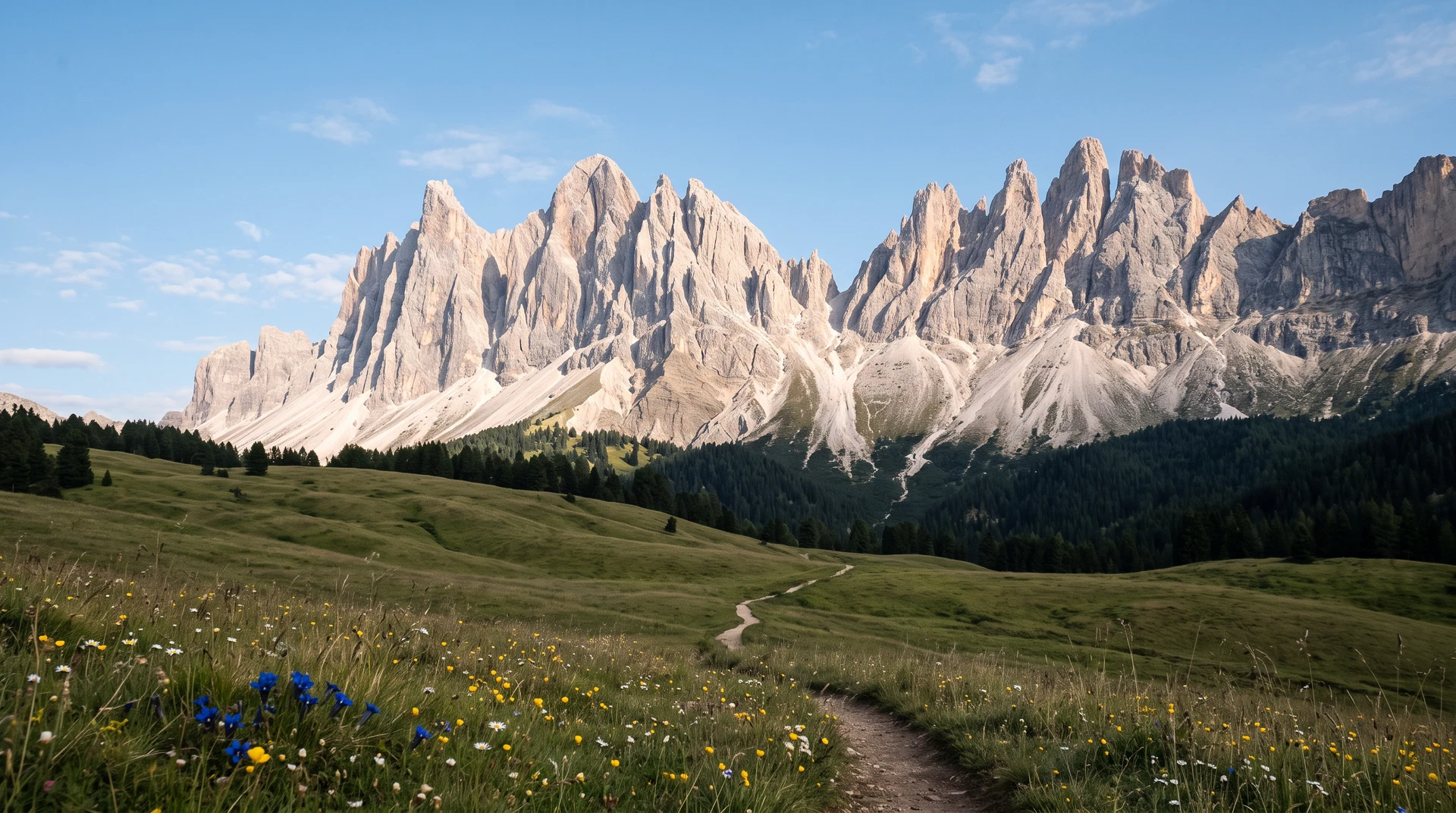
When the sun descends behind the jagged teeth of the Northern Alps, the Enrosadira washes the pale limestone in burning orange and deep violet. This daily phenomenon reminds visitors that these mountains are unlike their granite neighbors. Here, the rock feels lighter and more complex, defying terrestrial geology with vertical walls that rise abruptly from emerald meadows. To stand in their shadow is to witness a landscape where the earth has been folded and thrust upward, yet it retains the delicate textures of the sea floor from which it was born millions of years ago.
The Dolomites' true wonder lies in their origin as ancient coral reefs. During the Mesozoic era, this region was submerged beneath the Tethys Sea, where carbonate platforms flourished for eons. These biological structures were eventually hoisted into the sky by tectonic collisions, transforming vibrant underwater atolls into soaring alpine peaks. Walking these trails is effectively trekking across a fossilized ocean floor. The magnesium-rich limestone, known as dolomite, preserves an intricate history of life before the continents took their modern shape, making every scree slope a potential archive of prehistoric existence.
Spanning 141,903 hectares, this UNESCO-listed site comprises nine distinct mountain systems across five Italian provinces. This creates a diverse tapestry of peaks, from the fortress-like blocks of the Sella Group to the slender pinnacles of the Tre Cime di Lavaredo. Each system offers a unique perspective on the region’s geological heritage, united by dramatic verticality. With eighteen peaks exceeding 3,000 meters, the scale is staggering. It is difficult to comprehend the landscape's magnitude until standing at the base of a rock face that stretches 1,500 meters straight up into the high-altitude blue.
This verticality is the most defining characteristic of the Dolomites. Unlike the long, sloping ridges of other ranges, these peaks are famous for their sheer, clean drops. These massive walls have made the region a legendary destination for mountaineers, but even for those on level ground, the visual impact is profound. The contrast between horizontal alpine pastures and vertical limestone spires creates a sense of perpetual drama. It is a landscape of extremes, where the soft ringing of cowbells in the valley provides a gentle soundtrack to the silent, imposing presence of rock cathedrals.
Beyond aesthetics, the Dolomites serve as one of the world’s best-preserved Mesozoic carbonate platform systems. Researchers study the rich fossil records embedded within the stone, providing a window into the evolution of marine life. This preservation allows for a detailed reconstruction of ancient environments, from water depth to prehistoric temperatures. For visitors, this scientific importance adds intellectual depth to the physical beauty of the trails. Every jagged ridge and deep gorge is a chapter in a story spanning hundreds of millions of years, told in the language of stone, shadow, and deep time.
Navigating this protected landscape requires a shift in mindset, especially during peak seasons. To protect the fragile environment and manage popularity, several areas enforce strict daily visitor caps and restricted vehicle access. This is not a place for spontaneous motorized exploration; it demands commitment to public shuttle systems and advanced reservations. By limiting cars on narrow mountain passes, authorities preserve the silence and air quality that make the Dolomites special. It is a practical necessity ensuring the very beauty people come to see remains untarnished for the future generations of travelers.
The experience is as much about atmosphere as geology. The air is crisp and thin, carrying scents of pine and drying grass. Because the mountains are fragmented, the valleys between them have developed distinct characters influenced by the intersection of Italian and Germanic cultures. This blending is evident in the mountain huts, or rifugi, which offer sanctuary and hearty meals. These huts are often perched in seemingly impossible locations, clinging to cliff edges or nestled in high-altitude basins, providing a vital link between the wildness of the peaks and the comfort of human civilization.
Stewardship is a central theme of any visit. The UNESCO status is a mandate for conservation, encouraging visitors to move with a light touch. Travelers must adhere to mountain etiquette and respect seasonal closures designed to protect local wildlife. The fragility of the limestone means trails are subject to erosion and constant change. By following designated paths and supporting local efforts, travelers become part of the ongoing balance between human adventure and the earth’s need for protection. It is a shared responsibility to ensure these fossilized reefs endure in their magnificent, soaring state.
Standing on a high plateau, looking out over a sea of peaks rippling toward the horizon, the sense of deep time becomes palpable. The Dolomites remind us that the world is in a state of constant, slow-motion transformation. What was once a seabed is now a summit; what is now a solid wall will eventually be worn down by wind and ice. There is a profound peace in this realization, a quietness that settles over the soul as shadows lengthen. To visit is to step into the slow, rhythmic heartbeat of the planet itself.
Ultimately, the Dolomites remain evocative because they represent the intersection of the ethereal and the monumental. They are mountains that feel dreamed into existence, yet they are grounded in the physical reality of carbonate rock and tectonic force. Whether watching the first light hit the Marmolada or following a winding trail through the Val di Funes, the impact is the same. You are a guest in an ancient, vertical world, a witness to the enduring power of nature to create something that is both terrifyingly vast and heartbreakingly beautiful.