Travel
The Granite Sentinels of the North: Finding Solace in Norway’s Ancient Lofoten Archipelago
High above the Arctic Circle, the Lofoten Islands rise like a jagged obsidian wall from the churning Norwegian Sea. Here, ancient Precambrian peaks shadow traditional red cabins, where the scent of drying stockfish and the pull of legendary maelstroms tell a story of survival and stark, windswept beauty.
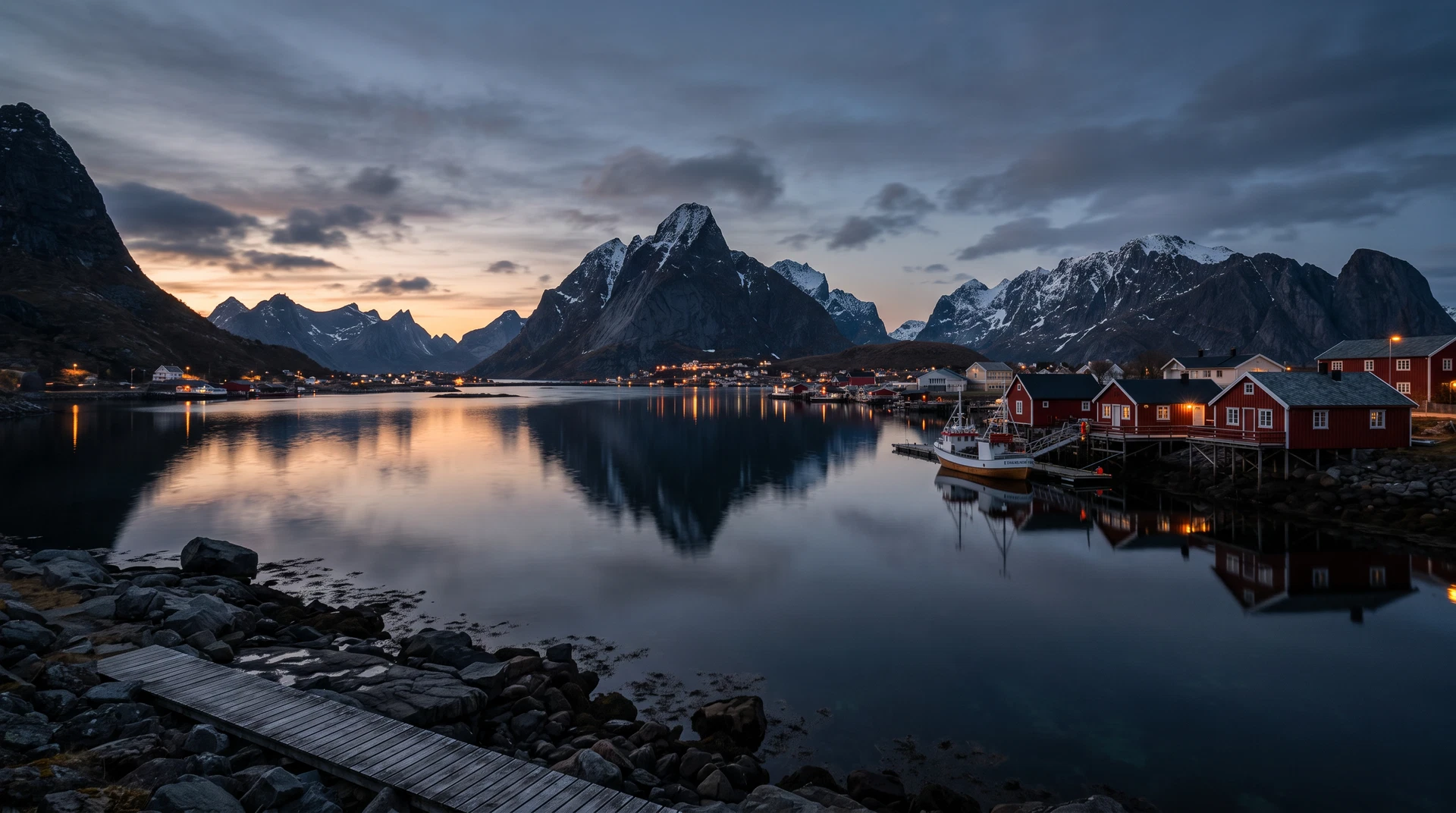
The approach to Lofoten is less a journey and more an awakening. As the ferry clears the Vestfjorden, the horizon erupts into a wall of granite known as the Lofoten Wall. These summits, sharp enough to tear the low-hanging clouds, are the Precambrian bones of the earth, belonging to the Lofoten Eruptive Province. There is a weight to the silence here, broken only by the rhythmic slap of the tide against the wooden pilings. It is a landscape that demands a specific kind of attention—one that looks past the immediate drama of the peaks to the subtle shifts in the Arctic light that paint the rock in shades of violet and bruised gold.
To walk upon these islands is to step onto some of the oldest rock on the planet. The geological history of the archipelago is etched into every vertical face and glacial cirque. These mountains have endured the grinding of ice and the scouring of the North Atlantic for billions of years. There is a profound sense of permanence in the stone, a stillness that contrasts with the volatile sea surrounding it. For the traveler, this creates a strange, grounding effect. In a world that feels transient, the unyielding nature of the Lofoten granite offers a rare perspective on time. One does not simply visit these islands; one submits to their scale, feeling the immense pressure of history that has shaped every jagged ridge.
Nestled at the feet of these giants are the rorbuer—iconic red fishing cabins that provide a splash of color against the monochromatic stone. Originally built to house seasonal fishermen, many are now preserved as lodgings for those seeking a connection to the islands' maritime past. Inside, the smell of salt and old wood lingers, a reminder of the generations who sought shelter from the biting Arctic wind. These cabins are not merely picturesque; they are functional relics of a way of life that remains the heartbeat of the archipelago. Life here has always been dictated by the sea, a relationship both nourishing and perilous, defined by the seasons of the fish and the whims of the weather.
The air in Lofoten carries a sharp aroma that defines the spring months: the scent of drying cod. Along the shores of villages like Reine, massive wooden racks groan under the weight of thousands of fish. This is the global hub for stockfish, where spawning Northeast Atlantic cod are hung to cure in the salty sea air. No salt or smoke is used; the wind and sun do the work, a process virtually unchanged since the Viking Age. It is a visceral, sensory experience that grounds the traveler in the practical reality of the islands. This is not a museum, but a working landscape where the ancient trade of the sea continues to thrive under the watchful eye of the peaks.
Beyond the calm harbors lies the Moskenstraumen, one of the world's most powerful open-ocean maelstroms. This swirling vortex, created by the meeting of powerful tides and the unique underwater topography, has long haunted the imaginations of sailors and writers. It is the very "Maelström" that Edgar Allan Poe and Jules Verne described with chilling detail. To stand on the shore and watch the water churn is to feel the raw, untamed power of the ocean. It serves as a humbling reminder that despite our modern comforts, we are still subject to the primordial forces of the natural world, a theme that resonates deeply throughout the archipelago’s folklore and literature.
During the summer, the sun refuses to set, hovering just above the horizon in a perpetual state of golden hour. This midnight sun transforms the landscape into a dreamscape where time loses its meaning. The light is soft and ethereal, making the emerald waters of the fjords appear almost translucent. It is a time for late-night hikes up to the summits, where the view extends across the sea to the distant mainland. The absence of darkness brings a restless energy, a sense that the day never truly ends. For the observant traveler, these hours offer a chance to witness the archipelago in its most intimate state, when the world is bathed in a light borrowed from another realm.
However, the beauty of Lofoten is as fragile as it is formidable. The Lofoten Code of Conduct is a necessary framework for preservation. It mandates using designated campsites and strictly prohibits disturbing local wildlife or leaving waste in the delicate Arctic environment. The mosses that cling to the thin soil are easily damaged, and the purity of the water is paramount. Stewardship here is a collective responsibility, a recognition that to enjoy this wilderness is to commit to its protection. The goal is to leave no trace, ensuring the islands remain as wild and untainted for the next generation as they are today.
As the boat eventually pulls away, leaving the red cabins and the drying racks behind, the Lofoten Wall begins to recede into the mist. There is a lingering wistfulness in the departure, a feeling of having touched something essential and ancient. The islands do not give up their secrets easily; they require a willingness to endure the cold and the smell of the sea. But for those who listen to the stories told by the granite and the tides, the reward is a profound sense of connection to the earth’s most raw expressions. Lofoten remains a sanctuary of stone and spirit, where the modern world feels distant and the ancient rhythms of the North still hold sway.