Travel
The Vertical Solitude of the North Atlantic: Navigating the Fog and Fjords of the Faroe Islands
Scattered across the volatile Northeast Atlantic, the eighteen volcanic islands of the Faroese archipelago offer a raw encounter with nature’s grandeur. Here, ancient Norse traditions and a modern "coolcation" sensibility converge, inviting travelers to navigate a landscape defined by dramatic cliffs and deep-rooted maritime heritage.
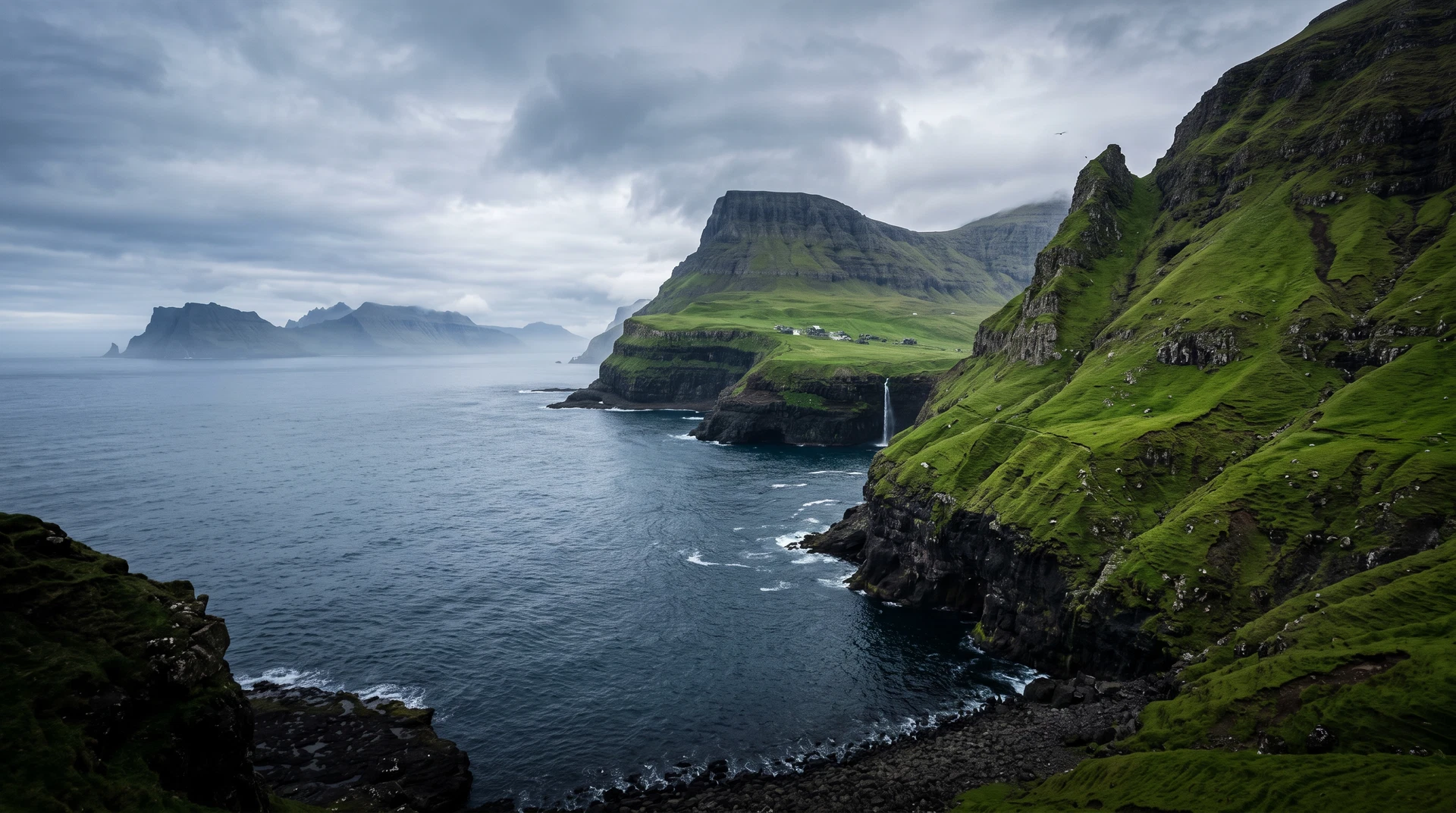
To arrive in the Faroe Islands is to witness the slow dissolution of the horizon. As the aircraft descends through a dense, pearlescent veil of North Atlantic mist, the world below resolves into shades of emerald and charcoal. These eighteen volcanic peaks, thrust upward by ancient tectonic forces, appear like a series of jagged, green-clad cathedrals rising against the swell. There is an immediate sense of scale that humbles the observer; the cliffs do not merely meet the water, they plummet into it, their basalt faces scarred by millennia of salt spray. The air, heavy with the scent of brine and damp earth, carries the weight of a place that has remained stubbornly itself despite the shifting tides of the outside world.
Geologically, the islands are a testament to the endurance of basalt. Formed during the Paleogene period, the archipelago is a layered cake of volcanic history, where each horizontal band represents a different era of cooling lava. This verticality defines the Faroese experience, creating a landscape where the distance between two points is rarely measured in a straight line but in the steepness of the climb or the depth of the fjord. The islands—ranging from finger-like Streymoy to the rugged southern Suðuroy—are connected by a shared geography of isolation. It is a terrain that demands respect, where the weather can shift from brilliant sunlight to a blinding whiteout in minutes, earning the archipelago its enduring moniker as the 'land of maybe.'
The human history of these islands is as resilient as the landscape. Settled by Norse explorers over a millennium ago, the Faroe Islands have maintained a distinct cultural identity bridging ancient seafaring traditions and modern life. Since 1948, the islands have functioned as a self-governing territory within the Kingdom of Denmark, a status allowing the Faroese to preserve their unique language and social structures. Walking through the narrow, grass-roofed streets of Tórshavn’s old town, Tinganes, one feels the continuity of time. The red-painted wooden buildings, some serving as the seat of government for centuries, stand as silent witnesses to a people who have successfully navigated the complexities of autonomy in a remote corner of the globe.
Life in the Faroes is inextricably linked to the sea. The economy, once dependent on the whims of the North Atlantic, is now a sophisticated engine driven by high-tech fisheries and aquaculture. Salmon from these frigid, oxygen-rich waters is prized globally, and the sight of circular sea-pens tucked into sheltered fjords is as common as the islands’ namesake inhabitants: the sheep. Fisheries remain the backbone of the community, providing the economic stability that allows these remote outposts to thrive. Even with modern processing plants and global export networks, the traditional harvest of the sea continues to inform the Faroese rhythm, ensuring that the connection to the water remains both practical and spiritual.
Recently, the islands have emerged as a premier destination for the 'coolcation'—a travel trend seeking refuge from southern heat in the crisp air of the North. This influx of interest has brought new vitality, but it is a growth managed with characteristic pragmatism. The infrastructure is a marvel of engineering, with subsea tunnels carved through rock and bridges spanning narrow sounds, yet the feeling of being at the edge of the world remains intact. Visitors are drawn not by the promise of luxury, but by the raw, unscripted drama of the environment—the sight of a puffin colony nesting on a sheer cliff face or the sound of a waterfall plunging directly into the sea at Múlafossur.
This visibility has necessitated a proactive approach to environmental stewardship. The Faroese government and local communities have implemented 'Please Visit Responsibly' guidelines to protect fragile ecosystems. One of the most innovative efforts is the annual 'Closed for Maintenance' initiative, where major tourist sites are shuttered for a weekend, allowing volunteers to repair paths and build cairns. Travelers are encouraged to stay on marked trails, a rule about both safety and conservation. The thin layer of soil clinging to these volcanic rocks is easily eroded, and the islands’ commitment to preservation ensures that the wild beauty remains for future generations.
To walk the Faroese hills is to enter a sensory dialogue with the elements. The wind is a constant companion, sometimes a gentle whisper through the long grass and other times a roaring force that makes the very cliffs seem to tremble. The islands are home to a staggering array of birdlife, from storm petrels to iconic Atlantic puffins, whose colorful beaks provide a stark contrast to the moody greys of the basalt. There is a profound silence in the interior, a quiet broken only by the bleating of sheep or the distant thunder of the surf. It is a place that invites contemplation, forcing the traveler to slow down and match their pace to the natural world, rather than the frantic schedule of modern life.
Ultimately, the Faroe Islands offer a rare glimpse into a world where nature still holds the upper hand. It is a destination that does not cater to the visitor, but rather invites them to witness a way of life that is both ancient and contemporary. Whether standing on the edge of a fjord or sharing a meal of fermented lamb in a local home, one is struck by the quiet confidence of the Faroese people. They have turned a cluster of remote, wind-swept rocks into a thriving society without losing the soul of their heritage. In the vertical solitude of the North Atlantic, the Faroe Islands stand as a reminder that the most profound journeys are often those that lead us to the very edges of the map.