Planetary geology
A single dark rock is changing how a distant world is read.
The Martian meteorite NWA 7034, known as Black Beauty, serves as a complex geological archive, revealing billions of years of the Red Planet's evolution and providing the first ground-truth for its ancient, water-rich crust.
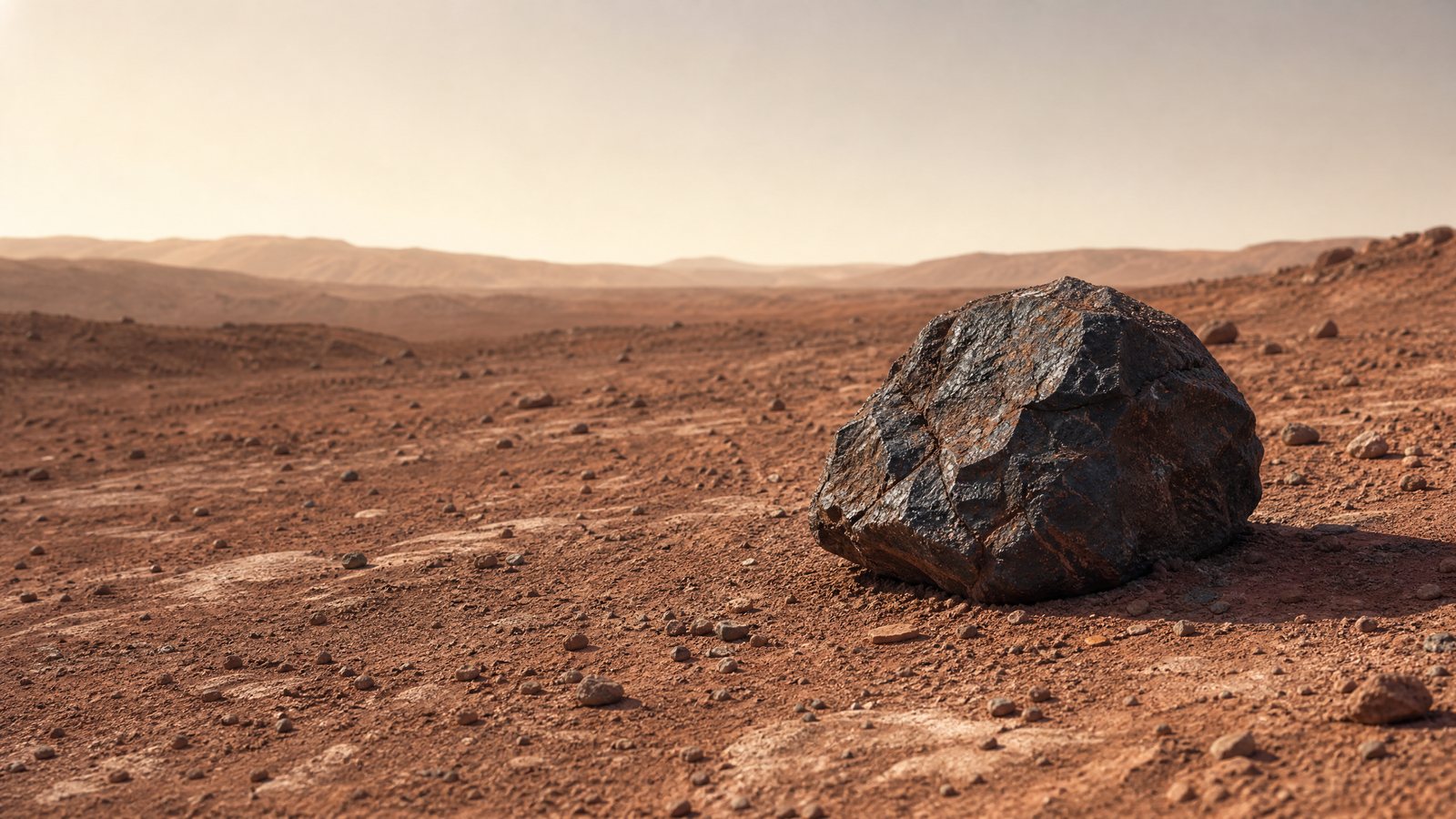
The discovery of the Martian meteorite Northwest Africa (NWA) 7034, known as Black Beauty, has fundamentally altered the trajectory of planetary geology by providing a direct physical link to the Red Planet's most ancient history. Unlike the vast majority of Martian meteorites recovered on Earth, which typically represent relatively young volcanic flows from specific regions, Black Beauty is a complex polymict breccia—a geological mosaic composed of diverse rock fragments, minerals, and glass fused together by the violent energy of planetary impacts. This unique composition makes it a portable library of the Martian crust, containing records that span nearly the entire geological timeline of the planet. For researchers, this single dark stone represents a rare opportunity to study the evolution of a distant world without the logistical complexity of a sample return mission, serving as a vital precursor to the future exploration of the solar system.
The physical characteristics of NWA 7034 distinguish it immediately from the Shergottite, Nakhlite, and Chassignite (SNC) groups that make up most other Martian meteorites. While SNC meteorites are typically igneous rocks that crystallized from cooling lava, Black Beauty is a sedimentary-like accumulation of crustal material that has undergone multiple cycles of fragmentation and re-solidification. This brecciated nature is indicative of the intense bombardment that characterized the early solar system, a period when the surfaces of planets were constantly reshaped by asteroid and comet impacts. By analyzing the individual clasts within the meteorite, geologists have identified a range of rock types that were previously unknown to exist on Mars, suggesting that the planet’s early crust was far more geochemically diverse and complex than the relatively uniform basaltic surfaces observed by orbital satellites and rovers.
One of the most transformative revelations provided by Black Beauty concerns the history of water on the Martian surface. Geochemical analysis of the meteorite revealed a water content ten times higher than that of any other known Martian sample, with concentrations reaching six thousand parts per million. This water is not present as liquid but is bound within the crystalline structure of the rock's minerals, providing a chemical fingerprint of the ancient Martian atmosphere and hydrosphere. The isotopic signature of this water suggests that it originated from a vast reservoir that interacted with the crust during the planet's infancy, supporting the hypothesis that early Mars was a much warmer and wetter world than the frozen desert of today. This discovery has forced a significant revision of climate models, indicating that liquid water may have persisted on the surface for hundreds of millions of years longer than previously estimated.
The temporal record preserved within NWA 7034 is remarkable, with some of its constituent minerals dating back approximately 4.4 billion years. This age places the formation of these fragments in the Noachian period, the earliest era of Martian history, which corresponds to the Hadean eon on Earth—a time from which very few terrestrial rocks have survived. The presence of zircon crystals within the meteorite has allowed scientists to perform precise uranium-lead dating, revealing that the Martian crust had already solidified and differentiated into a complex structure within the first 100 million years of the planet's formation. This rapid cooling and crustal development suggest that Mars followed a distinct evolutionary path compared to Earth, providing a crucial comparison point for understanding how rocky planets develop their primary geological features and potential habitability.
Beyond its age and water content, Black Beauty has provided unprecedented insights into the geochemical diversity of the Martian interior. The meteorite contains a variety of rare minerals and trace elements that indicate a complex history of volcanic activity and hydrothermal alteration. For instance, the detection of specific iron and magnesium isotopes suggests that the Martian mantle underwent significant changes in its chemical composition, driven by the cooling of the planet's core and the cessation of its global magnetic field. These findings challenge the traditional view of Mars as a geologically "simple" world dominated by a single type of volcanism, instead revealing a planet with a rich and varied internal life that was capable of producing a wide array of geological phenomena similar to those found on Earth.
In a landmark achievement for planetary science, researchers recently utilized advanced machine learning algorithms and high-resolution orbital data to pinpoint the exact origin of NWA 7034 on the Martian surface. By comparing the spectral signatures of the meteorite with millions of impact craters across the planet, the team traced the rock back to the Karratha crater, located within the ancient, heavily cratered southern highlands. This discovery marks the first time a specific meteorite has been linked to a precise location on another planet, providing the essential "ground-truth" required to calibrate orbital observations. Knowing the geological context of the sample allows scientists to interpret the data from satellite missions with far greater accuracy, turning the meteorite into a Rosetta Stone for reading the history of an entire hemisphere.
The ability to link a physical sample to a specific geological region has profound implications for the future of planetary exploration. It validates the use of remote sensing technologies to map the composition of distant worlds and provides a baseline for the selection of landing sites for future rover and human missions. The data extracted from Black Beauty has already influenced the mission objectives for current explorers like the Perseverance rover, which is actively collecting samples in Jezero Crater for eventual return to Earth. By understanding the complexity of the ancient crust through NWA 7034, scientists can better identify the types of rocks most likely to preserve signs of past microbial life, ensuring that future missions are targeted toward the most scientifically promising areas of the planet.
As we stand on the threshold of a new era of sample return missions, the legacy of Black Beauty serves as a powerful reminder of the value of individual geological specimens. This single dark rock has proven that even a small fragment of a distant world can hold the secrets of an entire planet's evolution, from its violent birth to the loss of its oceans and the cooling of its core. By meticulously reading the layers of NWA 7034, we are not only learning about the history of Mars but also gaining a deeper understanding of the processes that shape all rocky planets in our solar system and beyond. The story of Black Beauty proves that the most profound discoveries often begin with a single, unexpected stone found in the sands of our own world.