Learn
The Long Patience Inside a Pearl
A pearl is not a tiny treasure waiting in an oyster. It is a record of living tissue, mineral layers, skilled cultivation, coastal water, and an amount of time that cannot be hurried.
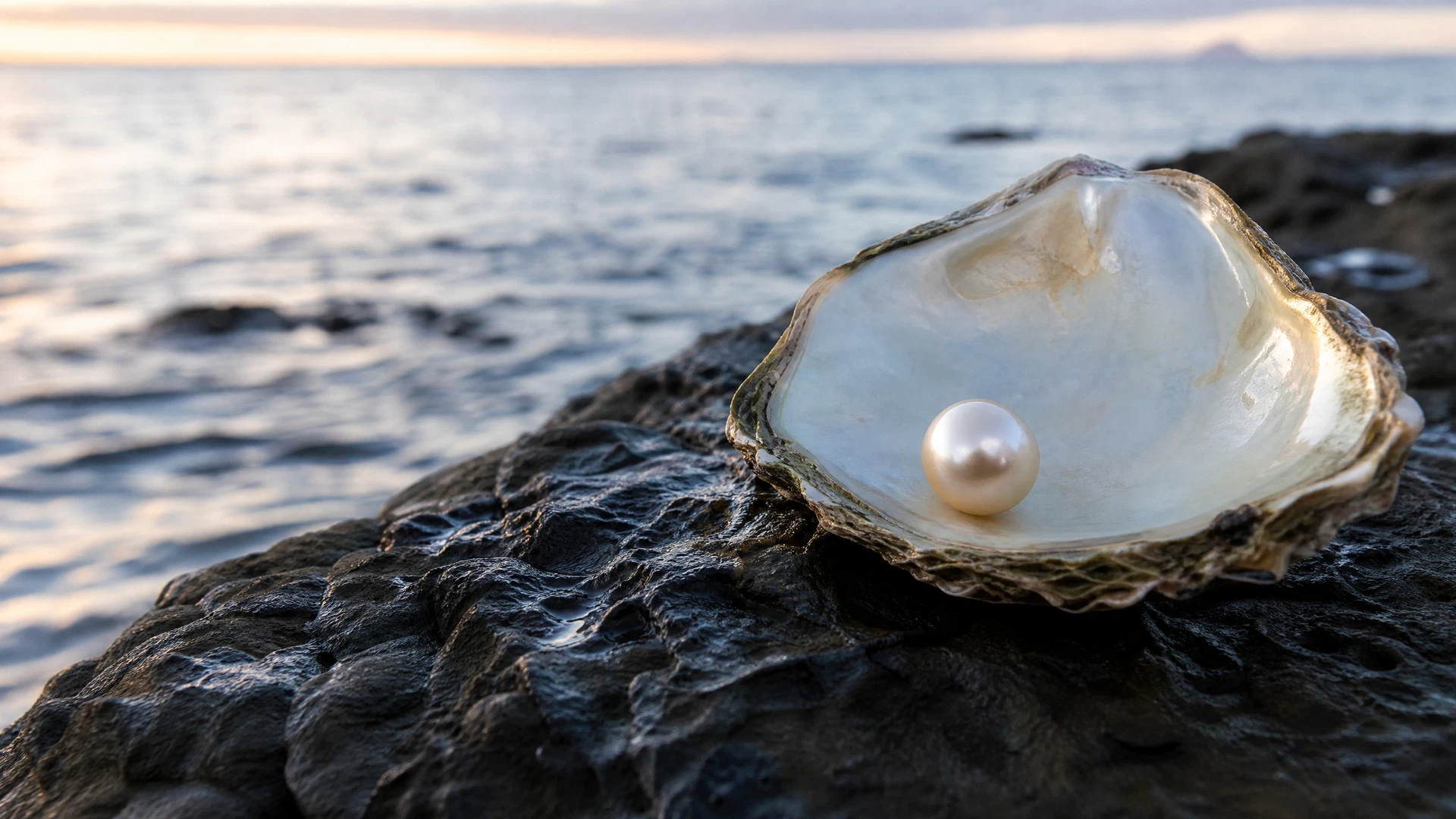
A pearl asks to be looked at slowly. It seems, at first, like the most finished thing imaginable: a cool round surface, a small moon of colour, an object that fits in the hollow of a hand. Yet the surface is the last visible layer of a much longer event. Before there is shine, there is a mollusc living in moving water. Before there is a strand in a jewellery box, there are tides, microscopic food in suspension, a shell’s inner lining, and a body responding to a disruption. The pearl is a compact object, but the conditions behind it are ecological, biological, and patiently local. Its beauty comes partly from refusing the speed we usually associate with luxury.
Pearls can form in several kinds of mollusc, including oysters and freshwater mussels. What they share is an ability to produce shell material. The familiar luminous kind is nacreous: layer upon layer of mineral and organic material arranged by living tissue. Nacre is often called mother-of-pearl, a phrase that has made its way from science into decoration and back again. It is not paint on a bead. Its glow comes from structure. Fine layers handle light differently, so a pearl can appear creamy, silvery, rose-tinted, greenish, or dark without behaving like a coloured stone. Change the angle of the light and the surface seems to rearrange itself.
The old story says a grain of sand enters an oyster and is coated until a pearl appears. It is memorable, but too neat to carry much of the truth. In nature, pearl formation is tied to shell-producing cells ending up where they can build a small enclosed sac. A parasite, damage, or other disturbance may be part of that chain. The animal responds with material it already knows how to make. A pearl is therefore less like a manufactured bead than a biological construction project carried out in miniature. It begins with living cells, and it remains dependent on the health of the animal that made it.
Natural pearls are uncommon precisely because the required sequence is not routine. A wild mollusc must live long enough, make the right kind of pearl sac, deposit enough nacre, and then be found. For most of history, their rarity was part of their power. Divers and coastal communities worked in difficult waters for a chance rather than a guarantee. A single fine pearl could travel far beyond the place where it formed, carried through merchant networks and eventually into courtly dress, religious objects, heirlooms, and portraits. The bead was portable; the labour and risk behind it were not.
Cultured pearls changed the scale of that chance without making the animal irrelevant. In many saltwater systems, trained technicians place a small shell-based nucleus together with a minute piece of mantle tissue into a host oyster. The procedure is often described as nucleation or grafting. It requires precision, but it is only the beginning. The tissue forms the pearl sac that will lay down nacre. The oyster must recover, feed, remain in suitable water, and keep the nucleus. Some oysters reject it; some pearls emerge irregularly; some are harvested with a surface or thickness that does not meet a farm’s needs. Cultivation creates an opportunity, not a production-line certainty.
This is why a pearl farm is better understood as a working relationship with a lagoon, bay, river, or coastal inlet. Lines, baskets, panels, and cages may be visible above the water, but much of the work is unseen. Farmers monitor water conditions, attend to stock, clean equipment, move animals when necessary, and wait through weather. Oysters filter food from the water column. Their bodies are therefore tied to plankton, current, temperature, and water quality. A farm can look tranquil from shore while demanding constant observation. The craft is not simply inserting a nucleus; it is helping an animal keep doing its own difficult work.
Pearl origins are as varied as the waters that support their molluscs. Akoya pearls are closely associated with Japanese coastal cultivation. South Sea pearls are grown in tropical marine regions, including waters around Australia and Southeast Asia. Dark pearls associated with black-lipped oysters have deep connections to French Polynesia and other Pacific settings. Freshwater pearls come from mussels and can be cultivated in lakes and rivers, often through a different approach to the starting tissue. These labels are not merely shades on a display card. They point toward particular species, water conditions, traditions of husbandry, and histories of exchange.
For centuries, pearls gathered distant meanings as they moved. They could signify wealth because they were difficult to obtain, but they also became symbols of tears, the moon, the sea, purity, mourning, and ceremony. Such meanings do not belong to one culture, and they have shifted over time. That instability is worth keeping in view. A pearl’s cultural life is never only about the oyster. It is about the hands that traded, wore, gifted, sorted, drilled, copied, and valued it. When cultured production widened access in the twentieth century, it did not erase older associations. It gave them new audiences and new forms.
The modern pearl is also an object of inspection. Gemologists can read clues that the naked eye cannot. X-ray images may reveal whether a pearl has a solid central nucleus or concentric structures without one. Other techniques can help distinguish saltwater from freshwater origins, assess treatments, or understand colour. At a more ordinary level, people respond to luster, surface, shape, size, and the way several pearls sit together in a strand. None of these qualities needs to become a ranking system for the story to be interesting. They are reminders that the same word—pearl—covers a wide family of materials, forms, and histories.
There is an environmental dimension to that variety. Shell-building animals are exposed to changes in the water around them. Rising temperature, acidification, pollution, sediment, disease, and powerful storms can alter the conditions in which they live. Aquaculture is not automatically gentle simply because it is underwater; its effects depend on place, practice, and management. At the same time, the life of a pearl oyster makes its dependence unusually visible. A beautiful object can draw attention toward the quality of a bay, the condition of a reef edge, or the quiet chemistry of a river. The pearl’s value begins long before anyone decides to wear it.
The word origin can therefore mean more than the country printed on a label. It can describe the species that supplied the nacre, the waters in which it grew, the people who tended it, and the route by which it travelled afterward. Two pearls may be close in size but carry utterly different geographies. One may speak of a warm lagoon and a black-lipped oyster; another of a freshwater mussel in a managed lake. Even the familiar idea of a matching strand involves a small act of translation: a human eye looking for correspondence among outcomes made separately by living bodies. The desire for sameness meets the reality of variation.
That variation is easy to lose when a pearl becomes shorthand for polish. Imperfections are often treated as faults, yet they can make the formation legible. A small ridge, a circle, a baroque contour, or a soft shift in colour describes a growth history rather than a failed imitation of a sphere. Farmers and makers have long developed languages for sorting, matching, and presenting such differences, while artists and wearers have sometimes preferred the oddities. The material rewards close attention because it does not perform exactly the same way twice. Its irregularity is not an interruption of the story; it is one of the story’s clearest sentences.
The pearl also belongs to a wider family of shell-made objects that have moved through homes and ceremonial life for millennia. Before a gemologist scans its interior or a technician handles a graft, someone notices sheen on a shell edge and decides it deserves another kind of attention. That response links coastal knowledge with design, trade with adornment, and private keepsakes with public display. It is tempting to treat pearls as detached from their landscapes once they have been drilled and set. But the material keeps returning us to water: its changing temperature, its food webs, its currents, and the small animals whose ordinary work makes the object possible.
To hold a pearl is to hold a pause in a moving system. Its smoothness conceals labour, but it also conceals duration: repeated deposits, filtered water, the persistence of a living creature, and a particular coast’s seasons. That is perhaps the most useful way to return to its shine. A pearl is not evidence that nature has made something flawless for us. It is evidence that life can make intricate structures from pressure, time, and care. The object is small enough to disappear into a pocket. The world that produces it is not.