Learn
The Quiet Breath of Gondwana
Deep within the mist-shrouded northwestern reaches of Tasmania lies Takayna, a sprawling wilderness where the ancient echoes of the Gondwanan supercontinent still resonate through the rustling leaves of myrtle beech trees and the silent, moss-draped corridors of the world’s largest cool temperate rainforest. This evocative exploration delves into the delicate equilibrium of a landscape defined by its resilient Palawa heritage and its winding, life-giving rivers, offering a wistful meditation on the profound necessity of preserving these primeval cathedrals of green against the encroaching shadows of modern extraction and the quiet, persistent erosion of the wild.
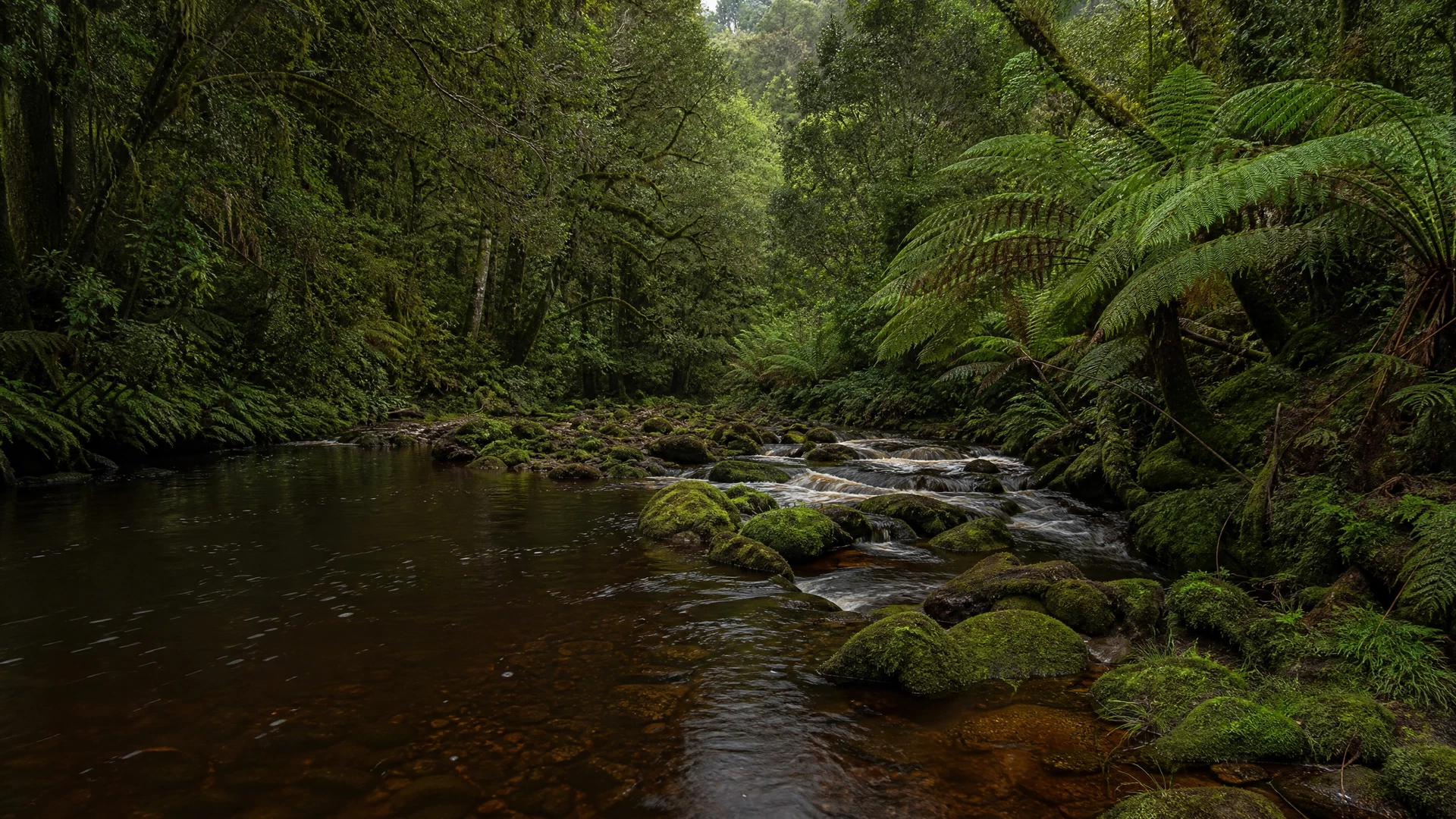
To enter Takayna is to step through a veil that separates the frantic rhythm of the twenty-first century from a slower, more deliberate heartbeat. As the paved roads of Tasmania’s northwest give way to the gravel arteries that pierce the forest’s edge, the air undergoes a sudden and profound transformation. It becomes heavy with the scent of damp earth, decaying leaf litter, and the sweet, sharp musk of leatherwood blossoms. The temperature drops, not merely as a matter of meteorology, but as a physical sensation of being submerged in a reservoir of ancient coolness. Here, the light does not fall; it filters, strained through a thousand layers of canopy until it reaches the forest floor as a soft, emerald twilight. It is a place that demands a certain kind of reverence, a silencing of the internal monologue to make room for the immense, collective presence of trees that have stood as silent witnesses to the slow drift of continents. In this threshold, the modern world feels like a fleeting dream, while the moss-draped silence of the Tarkine feels like the only enduring reality.
The trees here are not merely plants; they are lineages, living continuations of a story that began when the supercontinent of Gondwana was still a single, unbroken landmass. The myrtle beech, with its small, serrated leaves and trunks upholstered in a velvet of moss, is a direct descendant of the forests that once blanketed the southern hemisphere millions of years ago. To stand beneath their sprawling boughs is to touch a history that predates the rise of the Alps or the carving of the Grand Canyon. Beside them, the celery-top pine rises with a stoic, prehistoric elegance, its flattened branches a testament to an evolutionary path that chose resilience over rapid growth. These are not forests that were planted or managed; they are forests that have simply persisted, surviving the ice ages and the shifting of the poles. There is a profound wistfulness in the realization that while our human empires rise and fall in the blink of a geological eye, these trees have been quietly perfecting the art of existence, one slow ring at a time, in a world that has forgotten how to be still.
Life in Takayna is dictated by the movement of water, a complex network of veins that pulse with the dark, tannin-stained lifeblood of the rainforest. The Arthur and Pieman Rivers, along with their countless tributaries like the Savage and the Donaldson, are the architects of this landscape, carving deep, shadowed gorges through the ancient rock. The water here is the color of strong tea, darkened by the organic matter of the forest floor, and it moves with a deceptive, liquid grace that belies its immense power. In the quiet reaches, the surface reflects the towering tree ferns with such clarity that the world seems to double, creating a kaleidoscopic tunnel of green. Along the banks, the blackwood trees lean low, their branches dipping into the current as if to drink from the very history they helped create. The sound of the river is a constant, low-frequency hum, a reminder that in the Tarkine, nothing is ever truly static, yet everything is eternal. It is a landscape defined by the patient, persistent work of water, a slow carving of the earth that mirrors the slow growth of the forest above.
For the Palawa people, the traditional custodians of this land, Takayna is not a wilderness in the Western sense of an empty space, but a living, breathing cultural landscape woven with the threads of thousands of generations. Along the rugged coastline, where the forest meets the wild Southern Ocean, the shell middens stand as silent monuments to a way of life that existed in harmony with the tides and the seasons for over forty millennia. These are not merely piles of discarded shells; they are the records of communal meals, of stories told around fires, and of a deep, spiritual reciprocity with the land. The rock art hidden in the sea caves and the ancient hut depressions speak of a sophisticated understanding of the environment that modern science is only beginning to grasp. There is a poignant weight to this history, a sense of a culture that was nearly severed by the arrival of colonialism but which remains etched into the very stones and soil of the Tarkine. To walk here is to walk in the footsteps of ancestors, to feel the presence of a living heritage that refuses to be erased by the passage of time or the encroachment of industry.
The true magic of the Tarkine often lies in the miniature worlds flourishing at one’s feet. The forest floor is a riot of mosses and liverworts, a soft carpet absorbing the sound of every footstep. In autumn, fungi emerge in a surreal display, most notably the Mycena interrupta, tiny blue mushrooms like fallen scraps of the sky. They are essential decomposers turning death back into life, fueling the cycle of the rainforest. The intricate patterns of moss, colonizing every fallen log, create a sense of a world being slowly reclaimed by the green. There is a meditative quality to observing these small wonders, a reminder that the health of the giants above is linked to the vitality of the microscopic below. It is a lesson in humility, where profound complexities are hidden in plain sight, waiting for stillness to be revealed.
The inhabitants of this ancient realm move through the shadows with quiet purpose. The Tasmanian devil finds sanctuary in the dense undergrowth, its guttural cries a haunting reminder of the wildness that still thrives here. In clear streams, the giant freshwater crayfish—the largest in the world—crawls over rocky beds, a blue-armored relic of a bygone era. These creatures are the pulse of the Tarkine, living proof that this ecosystem is a functional whole. Yet, there is fragility; devils face disease, and crayfish are sensitive to changes in water quality. Their existence is a delicate thread in the forest’s tapestry, requiring the integrity of the whole to survive. To know they are there, even if unseen, is to feel the forest as a living, breathing entity, a sanctuary for species found nowhere else on Earth.
The wistfulness permeating the Tarkine reflects its precarious future. At the forest’s edges, silence is punctuated by the mechanical growl of chainsaws and mining trucks. The tension between the intrinsic value of wilderness and extractive demands is a wound running deep through the landscape. Every new road carved into the heart of the rainforest is a puncture in its armor, a gateway for invasive species and a fragmentation of ancient continuity. There is a profound sadness in the sight of a clear-felled coupe, where centuries of growth are reduced to a scarred wasteland in days. Once these ancient systems are dismantled, they cannot be simply restored; the complexity of a Gondwanan rainforest is a product of millions of years, not a commodity to be manufactured. The Tarkine stands at a crossroads, a remnant of the past forced to justify its existence in a world valuing only what is measurable.
One of the most profound qualities of Takayna is its silence, a rare commodity in an increasingly noisy world. It is a rich, textured quietude that seems to absorb the very concept of noise. Dense layers of moss and the thick canopy act as a natural acoustic buffer, dampening the wind and the distant sea. Within the forest, the only sounds are the drip of water, the call of a honeyeater, or the rustle of a wallaby. This acoustic purity has a transformative effect, stripping away the layers of digital distraction that define modern life. In the Tarkine, one can hear their own breath and the subtle language of the trees themselves. It is a sanctuary for the senses, where the noise of the world is replaced by the music of the earth, offering a rare opportunity to reconnect with fundamental rhythms.
The value of places like the Tarkine lies in what they give us simply by existing. In an era of climate uncertainty, these intact wilderness areas are anchors of our planet’s health, acting as carbon sinks and genetic reservoirs. Beyond these functions, there is an existential need for the wild. We need places that remind us of our smallness, challenging our delusions of mastery over the natural world. The Tarkine is a testament to the power of life to flourish without human intervention. To protect it is not just an act of environmentalism; it is an act of self-preservation, a recognition that our humanity is diminished when we allow the last truly wild places to be tamed. It is a reminder that we are part of a larger, more complex story that does not require our permission to continue.
As the sun begins to set over the rugged coastline, the forest seems to exhale, mist rising to meet the descending clouds. The light turns a deep purple, casting long shadows across ancient myrtle trunks. In this final hour, the weight of the forest’s history feels tangible, a presence lingering like a half-remembered dream. We leave the Tarkine with a lingering ache, a wistful awareness of how much we have to lose. The forest does not ask for admiration; it simply exists, a quiet, green heartbeat in a corner of the world that still remembers what it means to be ancient. Our responsibility is to listen and ensure that the quiet breath of Gondwana continues to flow through these valleys. In the end, the Tarkine is a gift of time, a rare chance to witness the world as it was, and perhaps, to imagine how it might still be if we have the courage to leave it alone.