Learn
The Silver Ghost in the Emerald Cathedral
Deep within the mist-veiled fjords of British Columbia, where the granite peaks of the Coast Mountains descend into the churning salt of the Pacific, lies the Great Bear Rainforest, a landscape defined not by the passage of hours but by the slow, rhythmic pulse of the tides and the seasonal return of the salmon that carry the lifeblood of the ocean into the dark heart of the woods. In this emerald cathedral where thousand-year-old cedars grow tall on the nitrogen of fish brought ashore by bears and wolves, the air remains thick with the scent of damp earth and the ghosts of a thousand spawning runs, serving as a profound reminder of the intricate, ancient interconnectedness that remains when the wild is allowed to simply be, undisturbed by the noise of the modern world.
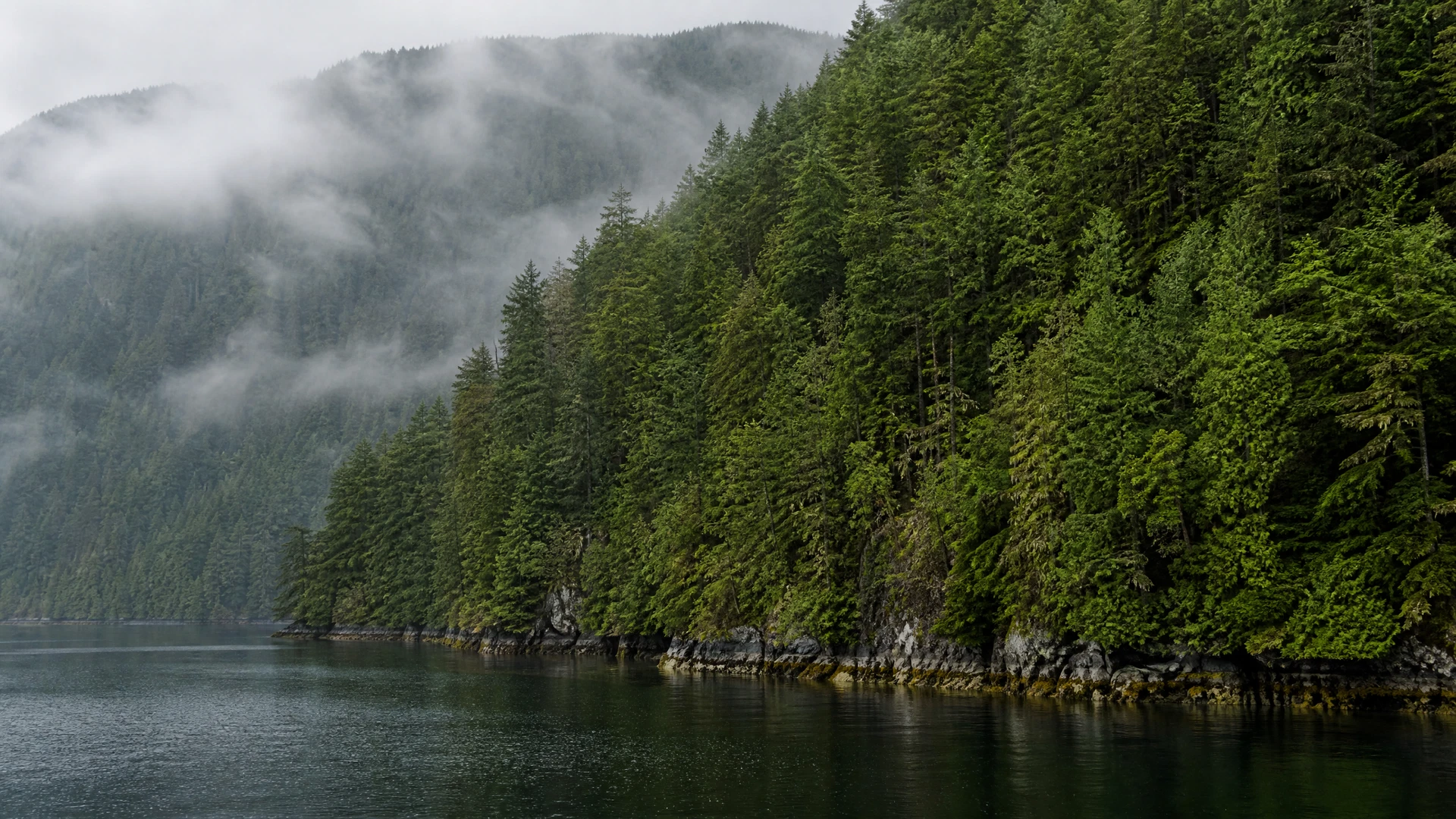
The rain here does not merely fall; it breathes. It arrives as a low-slung curtain of grey, drifting through the branches of Sitka spruce and western red cedar with a soft, pervasive sigh that muffles the world. In the Great Bear Rainforest of British Columbia, the atmosphere is a living thing, a heavy, moss-scented presence that clings to the skin and settles deep in the lungs. To walk among these trees is to enter a space where time has lost its edge, smoothed over by centuries of mist and the slow accumulation of lichen. There is a specific kind of silence that exists only in a place this old—a silence that is not an absence of sound, but a dense, vibrating layer of life. You can hear the drip of water from a hemlock bough, the distant, haunting cry of a loon, and the muffled thrum of the ocean against the jagged coastline, all woven together into a tapestry of sound that feels as ancient as the granite beneath your feet.
This is the largest intact coastal temperate rainforest on Earth, a narrow ribbon of green squeezed between the mountains and the sea, yet its importance far exceeds its physical boundaries. It is a land of extremes and subtleties, where the massive scale of the fjords is balanced by the delicate complexity of a single patch of lungwort. The trees themselves are giants, some having stood for over a thousand years, their trunks wide enough to hide a house and their canopies reaching toward a sky they rarely see through the clouds. They are the pillars of a cathedral that has no roof, only a shifting ceiling of fog. In their shade, a riot of life flourishes in the damp: ferns that uncoil like green springs, berries that glow like jewels in the dim light, and a layer of moss so thick it feels like walking on a cloud. Every inch of space is claimed by something growing, something reaching, something returning to the earth.
At the heart of this ecosystem is a miracle of migration that defies the simple categories of land and water. Every autumn, the rivers and streams that lace through the forest begin to boil with life as millions of Pacific salmon—Chinook, coho, sockeye, pink, and chum—return from the open ocean to the gravel beds of their birth. They arrive battered and silver, driven by an instinct so powerful it overrides the very will to survive. As they fight their way upstream against the current, leaping over waterfalls and dodging the reach of predators, they bring with them a gift from the deep sea. They are vessels of nutrients, carrying nitrogen and phosphorus gathered across thousands of miles of wandering. Their return is the forest’s Great Awakening, the moment when the energy of the Pacific is delivered directly to the roots of the trees.
The bears are the primary couriers of this oceanic wealth. Grizzlies and black bears congregate along the riverbanks, their presence announced by the snapping of branches and the heavy scent of wet fur. They fish with a focused intensity, pulling salmon from the rushing water and carrying them into the woods to eat in the relative safety of the shadows. Often, they consume only the richest parts—the brains and the skin—leaving the rest of the carcass to decay on the forest floor. This is not waste, but a vital act of distribution. The remains of the fish feed a vast array of scavengers, from eagles and ravens to beetles and slugs. Eventually, the nutrients sink into the soil, where they are taken up by the roots of the cedars and spruces. Scientists have found that trees near salmon streams grow faster and stronger, their rings recording the bounty of the sea in their very wood.
Among these shadows moves a creature that feels more like a myth than a biological reality. The Kermode bear, or spirit bear, is a rare subspecies of black bear born with a recessive gene that gives it a coat as white as the mountain snow. They are not albinos, but something else entirely—a ghost of the ice age, a pale shimmer against the deep green of the hemlocks. To see one is to feel the breath of the ancient world on your neck. They move with a strange, luminous grace, their white fur making them stand out to human eyes but providing a curious advantage in the water; to a salmon looking up from below, the white bear is less visible against the bright sky than a dark one. They are the keepers of the forest’s secrets, a living link to a time when the world was quieter and the ice was never far away.
The wolves of the Great Bear are equally unique, having adapted to a life that is as much marine as it is terrestrial. These coastal wolves are smaller than their inland cousins and are expert swimmers, capable of crossing miles of open water between islands in search of food. They do not hunt elk or deer with the same frequency as other packs; instead, they have become specialists of the shore. They forage for barnacles and clams at low tide, scavenge for whale carcasses washed up by the storms, and, during the spawning season, they too become fishers. There is a haunting beauty in the sight of a wolf standing on a kelp-strewn beach, its eyes fixed on the horizon, a predator that has learned to harmonize its hunger with the rhythms of the moon and the sea.
The human history of this coast is as deep and layered as the forest itself. For thousands of years, Indigenous communities have lived in partnership with the Great Bear, their cultures and identities inextricably tied to the salmon and the cedar. They are the original stewards of this land, practicing a form of management that is based on respect and reciprocity rather than extraction. To them, the forest is not a resource to be exploited, but a relative to be honored. The great longhouses, the towering totem poles, and the intricate cedar-bark weaving are all expressions of a worldview that recognizes no separation between the human and the natural. Their presence is felt in the way the forest is cared for, in the stories that echo through the fjords, and in the quiet resilience of communities that have weathered the storms of history.
As the world outside the Great Bear grows louder and more fragmented, the value of this intact wilderness becomes immeasurable. It is a place where the fundamental processes of life continue undisturbed, a refuge for species that have been pushed to the brink elsewhere. But it is also a fragile sanctuary. The salmon runs are not as robust as they once were, threatened by warming oceans and the degradation of habitat. The climate is shifting, bringing unpredictable weather patterns to a region that depends on the consistency of the rain. There is a wistfulness in the air, a sense that we are looking at something precious that could easily slip through our fingers if we are not careful. The forest reminds us that we are not masters of the Earth, but participants in a complex and delicate dance.
There is a specific time of day in the Great Bear, just as the sun begins to set behind the outer islands, when the light turns a bruised, ethereal purple. The mist rises from the valleys, curling around the tops of the trees like smoke, and the ocean turns to liquid lead. In this moment, the forest feels most like a dream. You realize that you are standing in a place that does not need you, a place that has its own logic and its own destiny. The trees will continue to grow, the salmon will continue to return, and the spirit bear will continue to wander the shadows, regardless of whether we are there to witness it. It is a humbling thought, and a deeply comforting one.
To leave the Great Bear Rainforest is to carry a piece of its damp, green soul with you. The smell of the cedar lingers in your clothes, and the sound of the rain stays in your ears long after you have returned to the pavement and the neon. It changes the way you look at the world, making the boundaries we draw between ourselves and nature seem thin and arbitrary. We are, all of us, built of the same stardust and salt as the salmon and the spruce. The Great Bear is not just a place on a map; it is a state of being, a reminder that there is still magic in the world, hidden in the mist and the moss, waiting for us to be quiet enough to hear it.
As the stars begin to poke through the clearing clouds, reflecting in the still waters of a sheltered cove, the forest settles into its nightly rhythm. The owls begin their watch, and the tide begins its slow, inexorable retreat. There is a profound sense of peace in the knowledge that this cycle will repeat tomorrow, and the day after, and for a thousand years to come, provided we have the wisdom to let it. The Great Bear Rainforest is a gift from the past to the future, a living testament to the beauty of a world left wild. In its ancient depths, we find not just trees and animals, but a reflection of our own capacity for wonder and our enduring hope for a world that remains whole.