Learn
The Geometry of the Fire Mountain
Rising from the verdant plains of Central Java, Mount Merapi stands as a paradox of geological fury and agricultural bounty, a sentinel whose restless heartbeat dictates the rhythm of life for millions, and in the shadow of its smoking peak, this Wistful Ink feature explores the delicate equilibrium between the sophisticated surveillance of modern volcanology and the ancient, spiritual reverence held by the communities that call its fertile slopes home. As scientists monitor the subtle tremors of the earth and villagers tend to their ash-enriched crops, a narrative emerges of resilience, tradition, and the quiet acceptance of a landscape that gives life as readily as it threatens to take it away, delving into the complex tapestry of risk and rebirth to examine how the memory of past eruptions shapes the evacuation strategies of the present while the enduring fertility of the young earth ensures that the bond between the people and their volatile neighbor remains unbroken, a testament to the human spirit's ability to flourish in the face of inevitable change.
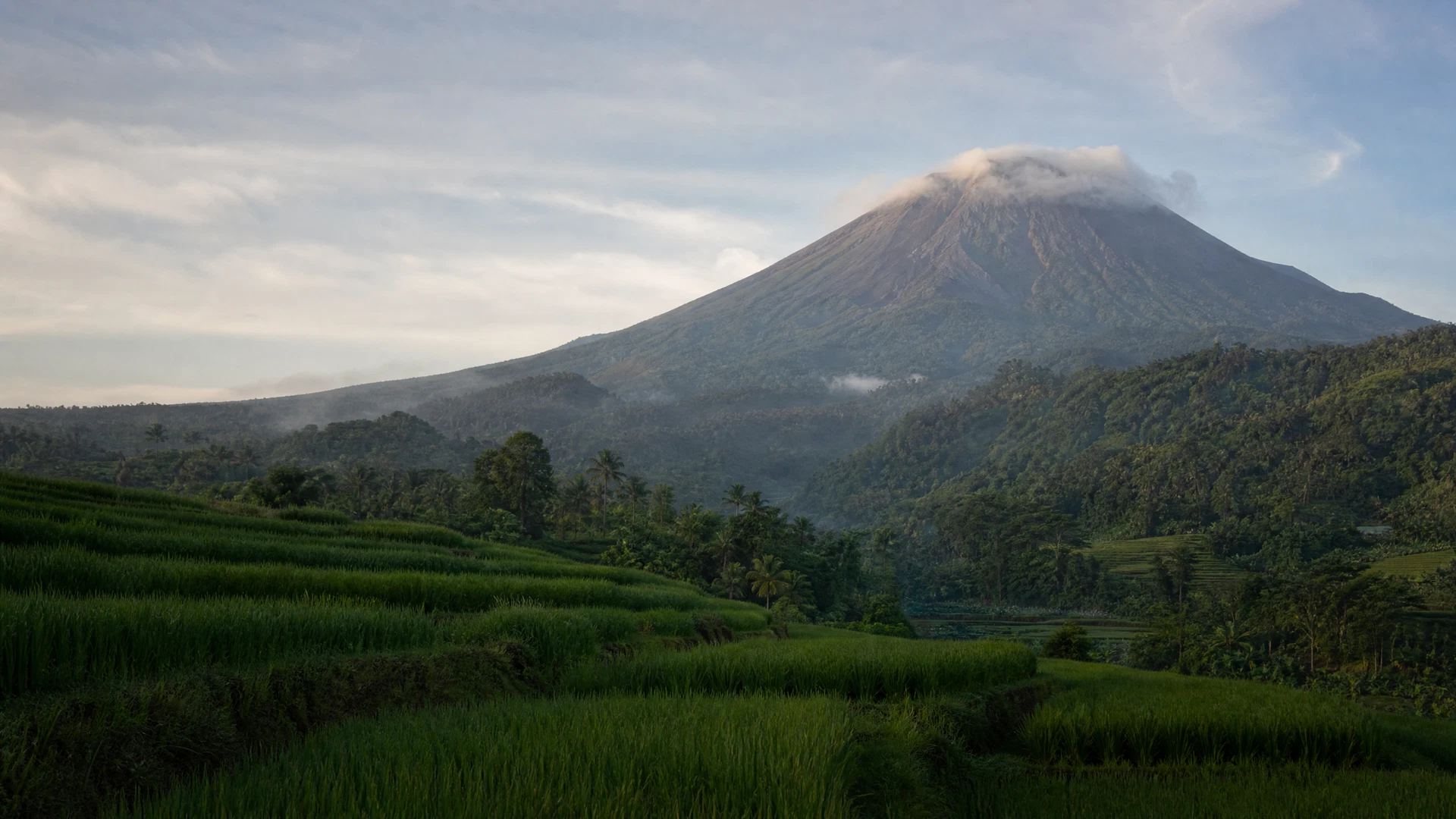
The morning light in Central Java softens the jagged edges of Mount Merapi, casting a deceptive serenity over the most active volcano in Indonesia. From Yogyakarta, the mountain is a constant companion, its summit often veiled in steam that whispers of the immense pressure beneath. For those on its flanks, Merapi—the "Mountain of Fire"—is less a landmark and more a living entity, a temperamental patriarch whose moods are studied with intense caution. The air is thick with damp earth and woodsmoke, masking the underlying sulfurous breath of the crater. It is a landscape defined by a profound duality, where the terrifying prospect of pyroclastic flows exists alongside the most productive farmland in the region, creating a life that is both precarious and extraordinarily rich.
In the quiet corridors of the volcanology center, the mountain’s heartbeat is translated into digital pulses. Here, monitoring is a perpetual vigil, a technological séance intended to predict the unpredictable. Tiltmeters detecting the slight swelling of the mountain and seismometers recording the tremors of rising magma provide a constant stream of data. The scientists manning these stations operate with a heavy responsibility, knowing their interpretations are the primary defense for thousands. It is a high-stakes game where a change in gas emissions or earthquake frequency can trigger a regional mobilization. Yet, despite the sophistication of the instruments, there remains an acknowledgment of the mountain’s inherent mystery, a recognition that the earth still holds secrets that no sensor can fully decode.
This scientific vigilance exists in a complex dance with spiritual traditions. For generations, the Jurukunci, or spiritual guardian, has been the bridge between the physical and metaphysical realms. The late Mbah Maridjan became a symbol of this connection when he chose to remain in his village during the catastrophic 2010 eruption, fulfilling his duty to the spirits even as the hot clouds descended. His house stands as a silent witness to the belief that the volcano is a sacred space inhabited by ancient entities. The annual Labuhan ceremony reinforces this bond, seeking to appease the mountain and ensure safety. It is a perspective that views the volcano not as an enemy, but as a powerful neighbor to be respected, an approach that often complicates official evacuation orders.
The paradox of Merapi is most visible in the vibrant green of its lower slopes, where the material that threatens life also sustains it. Volcanic ash is a geological gift, a dose of minerals that transforms the soil into "young earth." This fertility is why population density remains high despite frequent eruptions. Dairy farmers lead cattle through pastures once buried in gray debris, and coffee plantations thrive in the nutrient-rich highlands. Agriculture here is an intimate engagement with the volcano’s cycles. Farmers speak of "fertilizer from the sky," acknowledging that the ash fall ruining a current harvest is the foundation for future abundance. This resilience is born of a long-term perspective, a recognition that a human lifetime is but a brief moment between breaths of fire.
Evacuation planning is an exercise in logistical precision and social psychology, moving thousands in a matter of hours. The "Sister Village" program is a cornerstone, pairing high-risk communities with safer villages further down. This system builds on social ties, ensuring displaced villagers are welcomed by neighbors who understand their plight. Yet, the challenge remains immense. Narrow, winding roads and the reluctance of farmers to leave their animals can lead to dangerous delays. The memory of 2010, which claimed hundreds of lives, serves as both a warning and a blueprint. It taught the importance of early intervention and the need for communication that speaks both the language of science and the language of the community, bridging the gap between a technical alert and a neighborly warning.
When the eruption ends, the threat changes form. Monsoon rains bring lahars—cold mudflows of water and volcanic debris that roar down riverbeds with the force of a freight train. These flows are a reminder that the volcano’s influence extends far beyond its fire, reshaping the lowlands and threatening homes miles from the summit. The rivers flowing from Merapi are the lifelines of the region, but during the rainy season, they become volatile corridors of ash and stone. Monitoring stations use sensors to detect the vibrations of approaching lahars, providing precious minutes of warning to residents downstream. It is a lingering hazard that keeps the community in a state of heightened awareness long after the smoke has cleared, a testament to the volcano’s ability to dominate the landscape.
There is a specific silence that falls over the upper villages during periods of activity, a quiet presence of anticipation. In places like Kinahrejo, the ruins of homes destroyed by pyroclastic flows have been left as reminders of the mountain’s power. This transition from disaster to recovery is emblematic of the Javanese concept of nrimo—a graceful acceptance of fate combined with a practical determination to move forward. The villagers do not see themselves as victims, but as participants in the mountain's story. They rebuild with weary expertise, using the very stones the mountain threw at them to fashion new foundations. This relationship is not one of fear, but of a profound, wistful belonging, an understanding that their identity is inextricably linked to the fire mountain.
The landscape of Merapi is a palimpsest, where each new layer of ash partially obscures the one before it, creating a topography of memory. Walking through recovering forests, one sees pioneering ferns pushing through the hardened crust, a slow-motion explosion of life mirroring the human communities nearby. The birds return first, their songs filling the charred skeletons of trees, followed by insects and mammals drawn back by the fertile earth. This ecological recovery mirrors the social one, a reminder that the volcano is a primary architect of the Javanese landscape, creating the conditions that allowed civilization to flourish for a millennium. Ancient temples like Borobudur, built from volcanic stone, stand as monuments to this enduring partnership, silent witnesses to a cycle of creation and destruction.
Ultimately, to live with Merapi is to embrace a life of beautiful uncertainty, a realization that the ground is both a source of sustenance and sorrow. It is a wistful existence, marked by the knowledge that the mountain will eventually reclaim what it has given, only to give it back again. The monitoring screens will flicker, the offerings will be made, and the farmers will plant their seeds in the cooling ash. This is the geometry of the fire mountain—a circle of renewal requiring a special kind of courage. As the sun sets behind the smoking peak, there is a sense of peace that belies the danger, a quiet gratitude for the mountain’s bounty and a solemn respect for its power. One learns that the most enduring things find a way to bloom in the wake of the fire.
The story of Mount Merapi is a profound exploration of the human condition in the face of the sublime. It is a narrative of how we negotiate our place within a world that is essential to our survival yet indifferent to our presence. The true strength of the communities lies not in predicting the mountain’s next move, but in their capacity to live fully in the intervals between them. They have mastered the art of the temporary, building lives as vibrant as the orchids in the volcanic soil, knowing the mountain may call for them at any time. This acceptance is not resignation, but a deep wisdom, a recognition that the fire and the flower are two sides of the same coin, and that the beauty of life is heightened by the knowledge of its fragility.
As we look toward the future, the lessons of Merapi resonate far beyond Indonesia, offering a model for how humanity might coexist with a volatile planet. The integration of high-tech surveillance with cultural wisdom and community resilience are vital components of a sustainable future. The mountain remains a powerful teacher, reminding us that we are not separate from the earth’s processes, but are intimately woven into them. In the end, the fire mountain is a mirror, reflecting our own capacity for endurance and hope. The smoke continues to rise, the earth continues to tremble, and on the slopes of Merapi, the people continue to walk the line between the ash and the orchard, forever bound to the mountain that is their home, their god, and their future.