Learn
The Arctic Ocean in a Brighter Summer
Summer light travels farther in the Arctic now, but the region is not an empty frontier: its ice, water, wildlife, and communities demand careful attention.
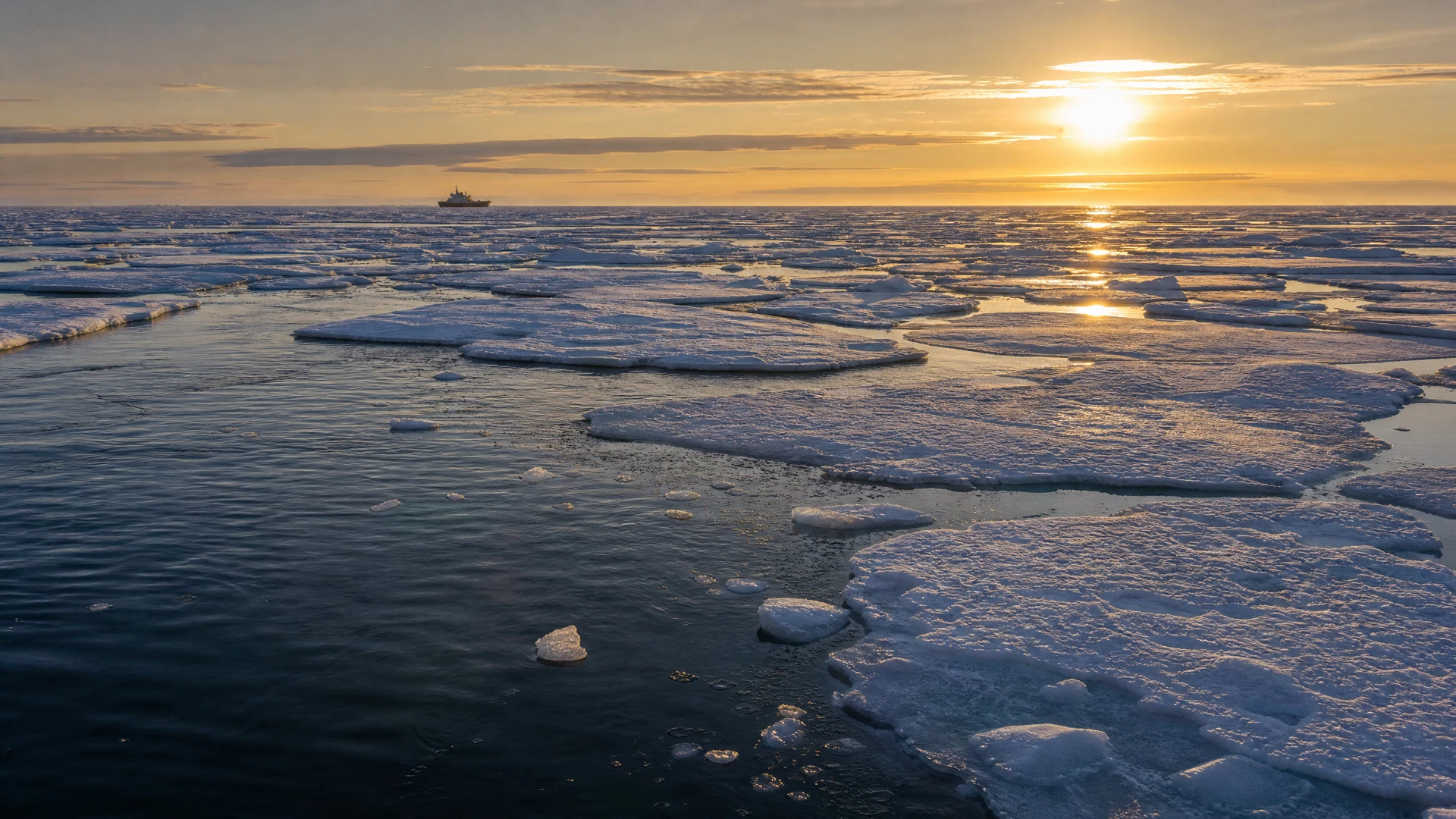
The Arctic summer arrives not with greening, but with a relentless, horizontal light that refuses to yield to night. Above the 66th parallel, the sun ceases its daily descent, tracing a low path that bathes the pack ice in a perpetual, honey-colored glow. The light is soft, filtered through an atmosphere that bends shorter wavelengths, leaving the world in a state of permanent twilight. It is a wistful light, revealing the Arctic as a space of subtle texture rather than a frozen void. In this brighter summer, long blue shadows stretch across pressure ridges and melt ponds. To stand on a research vessel at three in the morning is to witness a world neither day nor night. The silence is profound, broken only by shifting floes. This light triggers a hidden world beneath the ice, yet also illuminates a landscape defined by what is no longer there.
As summer progresses, sea ice transforms from a solid expanse into a mosaic of fragile pieces. Multi-year ice, the thick floes that survived multiple melt seasons, is becoming rarer, replaced by thinner, saltier first-year ice prone to the whims of wind and current. Observation shows a clear trend toward earlier break-ups and later freeze-overs, creating an increasingly fluid landscape. Small rivulets of freshwater gather in floe hollows, forming turquoise melt ponds that eventually bore holes through the ice. This thinning is a sensory change; the ice feels less like stone. While it is difficult to say with certainty what the ultimate fate of the summer ice will be, evidence suggests a transition toward a seasonally ice-free ocean. The wistfulness lies in the realization that the light bringing life to the ocean is also dismantling its most iconic feature.
Beneath the surface, the Arctic Ocean is structured by a delicate architecture of density, a hidden layering that governs heat and nutrients. Unlike other oceans ruled by temperature, the Arctic is governed by salinity. A thick layer of fresh water, the halocline, sits atop warmer, saltier Atlantic water flowing from the south. This freshwater lens, fed by rivers and melting sea ice, acts as a barrier, preventing deep heat from reaching the surface. However, as summer melt intensifies, this balance is tested. The influx of freshwater is increasing, shoaling the polar mixed layer and strengthening stratification, while in others, ice loss allows wind to stir the water more deeply, potentially bringing hidden heat to the surface. The density of the ocean is its silent regulator, a ghost in the machine determining whether the Arctic remains an isolated sanctuary.
The biological response to this brightening summer is a compressed explosion of life known as the spring bloom. As light penetrates thinning ice, it reaches the underside of floes where ice algae have been waiting in dormancy. These algae form the foundation of the Arctic food web, producing a rich energy source consumed by swarms of *Calanus* copepods—tiny, oil-rich crustaceans often described as the "fat" of the northern seas. These copepods are the critical link, transferring energy from microscopic plants to larger predators like seals and whales. The timing of this bloom is everything; if ice melts too early, algae may fall to the seafloor before copepods are ready to graze, creating a mismatch. We see the effects in shifting fish distributions, yet the complexity makes definitive predictions difficult. The food web is a shifting web, rewoven as environmental cues become less reliable.
High above the Arctic Circle, human presence is represented by remote outposts like Ny-Ålesund or Alert, where scientists work in the shadow of the pole. These are places of intense activity, where the routine of data collection is carried out against a backdrop of raw beauty. In summer, stations are a hive of movement—drones map the ice, moorings are recovered from the deep, and sensors are calibrated in the crisp air. Life is a blend of high-tech precision and frontier survival; a researcher might analyze isotopic signatures of meltwater while keeping a wary eye out for an Arctic fox. A particular camaraderie develops in these isolated communities, a shared sense of purpose in documenting a world changing faster than our ability to comprehend it. The wistfulness here is found in the contrast between the scientific mission and the transience of the environment.
Contrary to the myth of the "empty Arctic," the region is a lived-in space, home to indigenous communities that have navigated these waters for millennia. For the Inuit, the Gwich'in, and the Nenets, sea ice is not a barrier but a vital infrastructure, a highway connecting villages and providing access to traditional hunting grounds. The sea is the source of life, a provider of food and a repository of cultural memory. In northern communities like Utqiagvik or Nuuk, changes in the ocean are not abstract data points but daily realities affecting the safety of travel and the availability of resources. The "brighter summer" brings new challenges: thinning ice roads, eroding coastal permafrost, and shifting migration patterns. Yet, these communities are also sites of profound resilience and adaptation, where traditional knowledge is integrated with modern technology. To treat the Arctic as a pristine wilderness is to ignore the deep relationship between people and sea. The Arctic is a peopled ocean, and its story is linked to those who call it home.
This human element is complicated by growing economic interest in the Arctic's potential as a shipping hub. The Northern Sea Route and the Northwest Passage are touted as the "Golden Waterways" of the future, promising to shave weeks off transit times between Europe and Asia. In the brighter summer, as ice recedes, the prospect of a trans-polar shortcut becomes more alluring to international shipping companies. However, the reality on the water remains far more hazardous than optimistic forecasts suggest. The Arctic is still a place of extreme weather, shifting ice floes, and limited infrastructure. A vessel must contend with the threat of "growlers"—dense chunks of ice nearly invisible to radar—and the logistical challenges of operating in one of the most remote regions on Earth. The tension between the economic gaze and the environmental reality is a defining feature of the modern Arctic. The ocean is being reframed as a resource and a corridor, a shift that brings risks of oil spills and noise pollution. The wistfulness lies in the realization that the opening of the Arctic may come at the cost of its unique isolation.
The speed of transformation in the Arctic is often described through the lens of "Arctic amplification," a feedback loop where the loss of reflective ice reveals the dark, heat-absorbing ocean below, further accelerating warming. This is a world being rewritten in real-time, where environmental cues that remained stable for generations are now in flux. We observe the retreat of glaciers and the thinning of pack ice, yet the full implications remain obscured by the system's complexity. There is a risk of falling into melodrama when describing these shifts, of treating the Arctic as a doomed icon rather than a functioning ocean. The evidence suggests a system reaching new tipping points, but it also reveals a remarkable capacity for persistence. The challenge is to describe this rapid change without losing sight of the Arctic's inherent vitality. It is not just a place that is disappearing; it is becoming something new. The "brighter summer" is a period of transition, where the old and new Arctic coexist in a fragile balance.
There is a profound need to describe the Arctic as it is—vibrant, complex, and deeply interconnected—rather than as a simplified symbol of environmental loss. Witnessing and describing is a way of honoring the reality of the place, recognizing that the Arctic is not just a barometer for the planet, but a world in its own right. The wistfulness that permeates the Arctic summer is not a form of despair, but a deep appreciation for a beauty defined by its impermanence. By framing the Arctic as a peopled space, a scientific laboratory, and a biological engine, we can move beyond the "empty Arctic" trope and engage with the region in all its magnificent reality. The stories we tell about the Arctic matter; they shape how we value the region and how we choose to protect it. To describe the Arctic without melodrama is to acknowledge the gravity of change while celebrating the enduring spirit of the north. It is a call to recognize that even in a time of rapid transformation, the Arctic remains a place of wonder and significance.
As the sun begins its slow descent toward the horizon in late August, the Arctic prepares for the return of the dark. The "brighter summer" draws to a close, leaving behind an ocean that has been subtly, irrevocably altered. Melt ponds freeze over, copepods descend into the deep to overwinter, and research stations begin the process of winterization. The light changes once again, shifting from the honeyed glow of the midnight sun to the long, purple shadows of the approaching autumn. The Arctic Ocean remains a place of mystery, a vast, cold expanse that continues to defy our attempts to fully map it. The changes we have witnessed are real, and their consequences will be felt far beyond the Arctic Circle, yet the ocean itself persists, a living, breathing system that is part of our future. The wistfulness of the Arctic summer is a reminder of our connection to the natural world. In the end, the Arctic is not just an ocean at the top of the world; it is a mirror that reflects our own relationship with the planet.