Learn
The Indian Ocean’s Seasonal Breath
The Indian Ocean’s seasonal winds redraw its surface every year, linking rain, currents, coasts, reefs, ports, and work across a vast basin.
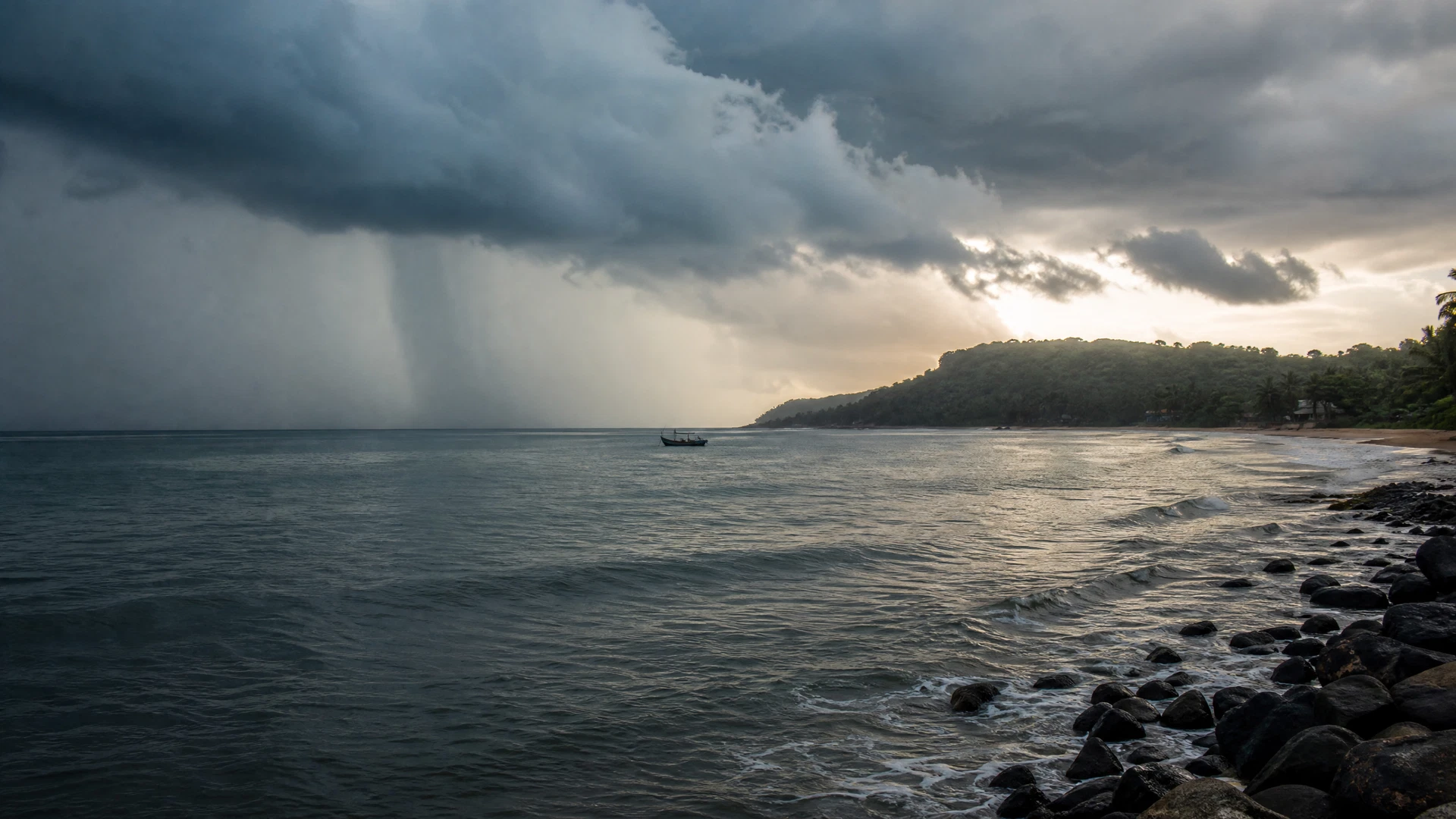
The Indian Ocean is a geographic torso severed by the Asian landmass, a "half-ocean" that dictates its unique and rhythmic character. Unlike the symmetrical Atlantic or Pacific, its northern reaches are land-locked, creating a stage for the profound monsoon pulse. For months, the basin basks in the dry, steady breath of the northeast trades, carrying dust from the Arabian Peninsula and the cooling influence of the Himalayan winter. During this time, the sea is a mirror of cobalt tranquility, its currents moving in a predictable, clockwise rotation. Yet, there is a tension in this stillness, a sense of a held breath. As the sun migrates northward, baking the Asian interior, the thermal balance tilts. The air above the Tibetan Plateau grows thin and buoyant, creating a low-pressure vacuum that calls to the moisture-heavy air of the southern ocean. This is the beginning of the reversal, a shift in the very orientation of the world as the ocean prepares to exhale.
The mechanics of this transition are driven by the thermal contrast between the heat-absorbing land and the heat-retaining sea. As the land warms, the Intertropical Convergence Zone is pulled northward, dragging a colossal volume of water vapor. The winds, once blowing from the dry interior of Asia, pivot to strike from the southwest, crossing thousands of miles of open water. This southwest monsoon is the ocean’s primary pulse, a surge of energy that redefines the relationship between sea and sky. The transition periods are marked by the Wyrtki Jets—narrow, eastward-flowing equatorial currents that race across the basin at high speeds. These jets are the hidden messengers of change, moving heat and salt to ensure the basin remains a connected whole. Observation suggests these jets are becoming more erratic as the climate warms, though the long-term implications remain a subject of intense scientific scrutiny rather than settled certainty.
Nowhere is the monsoon’s power more evident than in the seasonal reversal of the Somali Current. In winter, it flows southward as a modest stream. But as the southwest monsoon takes hold, the current pivots, surging northward to become one of the fastest in the world. As it brushes against the Horn of Africa, the physics of Ekman transport pulls deep, cold, nutrient-rich waters from the abyss. This upwelling is a biological awakening, a rising of the ocean’s memory into the sunlit zone. The sea transforms from a clear blue into a vibrant green, thick with the building blocks of life. This cold-water intrusion can drop sea surface temperatures by five degrees Celsius in weeks, a chilling reminder of the deep ocean’s influence. While we can measure the current’s velocity, the complexity of these turbulent eddies means predicting their exact path remains an exercise in probability, a reminder of the ocean’s resistance to total human understanding.
This influx of nutrients triggers a cascading explosion of life. Microscopic phytoplankton bloom in such density that they can be seen from space, swirling in patterns that trace the upwelling eddies. Following this green tide are zooplankton and vast shoals of sardines, which draw the ocean’s great predators. Tuna, billfish, and whale sharks converge on these seasonal hotspots, moving with a purpose encoded in their biology. For coastal communities, this is a season of plenty, though the churning seas make traditional fishing a perilous endeavor. The link between deep-sea upwelling and the prosperity of a village thousands of miles away is a testament to the ocean’s role as a global connector. We observe the correlation between upwelling and fishery yields, yet the precise timing of these blooms is subject to the whims of the wind, making each year an uncertain chapter. The sea does not promise a harvest; it only offers the conditions for one.
The coral kingdoms, from the Maldives to the Seychelles, experience the monsoon pulse as both a challenge and a sanctuary. These delicate ecosystems are sensitive to temperature, and the monsoon brings a complex mix of stressors and relief. In some regions, the cooling effect of upwelling provides a crucial buffer against rising ocean temperatures, potentially shielding corals from bleaching events. However, the monsoon also brings increased turbidity and nutrient surges, which can favor algae over coral, shifting the reef’s balance in subtle ways. The monsoon’s influence extends to the structure of the islands, as changing winds redistribute sand, causing beaches to migrate and sandbars to reappear seasonally. This fluid geography is a hallmark of the Indian Ocean’s coral seas, where nothing is truly static. While scientists monitor these reefs with precision, their long-term resilience remains an open question, framed by the wistful realization that these vibrant cities are as ephemeral as the winds that sustain them.
As the southwest monsoon journeys across the open sea, it eventually encounters the high barriers of the Indian subcontinent. The moisture gathered over thousands of miles is released in a torrential outpouring that transforms parched landscapes into lush, emerald expanses. This is where the ocean’s pulse becomes the land’s lifeblood, marked by the scent of petrichor—the aroma of the first rain hitting dry soil. The rain is a messenger from the sea, carrying the chemical signatures of distant upwellings into the heart of the continent. The Bay of Bengal funnels moisture into the Ganges-Brahmaputra delta, sustaining one of the most densely populated regions on Earth. The relationship between ocean temperature and rain intensity is delicate; a slight shift can mean the difference between a life-giving season and a devastating flood. We frame these changes not as disasters, but as an ancient, evolving dialogue between the sea and the land, a conversation now being rewritten by a warming world.
The human history of the Indian Ocean is inextricably linked to these seasonal winds, creating a shared maritime culture. For generations, the dhow has been the vehicle of this connectivity, navigating the monsoon’s reversal with skill passed through oral tradition. Sailors of the Swahili coast, Arabia, and India understood that the winds were engines of commerce. They waited for the northeast monsoon to carry them south and west, and for the southwest monsoon to bring them home, creating a loop of trade linking Aden, Mumbai, and Zanzibar. This was a world where distance was measured in seasons, and the arrival of a ship was as predictable as the changing leaves. The dhow trade was a movement of ideas, languages, and faiths, weaving a tapestry of cultural hybridity that still defines the region. While the modern world relies on steam and satellites, the legacy of the dhow remains a wistful reminder of a time when humanity lived in closer harmony with the ocean’s natural rhythms.
Today, the ports of the Indian Ocean serve as vital nodes of this connectivity, though the scale of trade has transformed. The docks of Colombo, Singapore, and Salalah are modern successors to ancient trading posts, handling a significant portion of the world’s energy. Yet, even these industrial giants are not immune to the monsoon’s influence. Seasonal shifts in currents and wave heights still dictate the timing of ship arrivals, a reminder that the ocean’s pulse cannot be entirely silenced. The connectivity once provided by sailing ships is now reflected in the web of underwater fiber-optic cables that follow the same routes the dhows once sailed. There is a profound irony in our most advanced systems being laid along the oldest trade routes, linking the digital world through the physical geography of the sea. We observe the growth of these ports as symbols of progress, yet there is a lingering uncertainty about their vulnerability to rising sea levels and intensifying storms.
In the final analysis, the Indian Ocean monsoon is a reminder that the planet’s systems are defined by constant, rhythmic flux. The Indian Ocean Dipole—a seesaw of temperatures between the eastern and western basin—is a primary driver of this variability, influencing rainfall from Australia to East Africa. A positive dipole can bring drought to Indonesia while fueling floods in Kenya, illustrating the ocean’s ability to link distant places through a single atmospheric thread. As the climate warms, the stability of this dipole and the predictability of the monsoon pulse are being questioned. We see evidence of shifting wind patterns and warming waters, yet we avoid false precision, acknowledging the inherent mystery of a system so vast. The Indian Ocean remains a wistful presence, a sea of seasons that continues to breathe, even if that breath is growing more labored. The monsoon is not just a weather event; it is the heartbeat of a third of the world’s population, a seasonal ocean connecting us all.