Learn
Where the Atlantic Learns to Turn
The Atlantic’s famous current is not a conveyor belt with one switch; it is a restless arrangement of heat, salt, wind, depth, and observation.
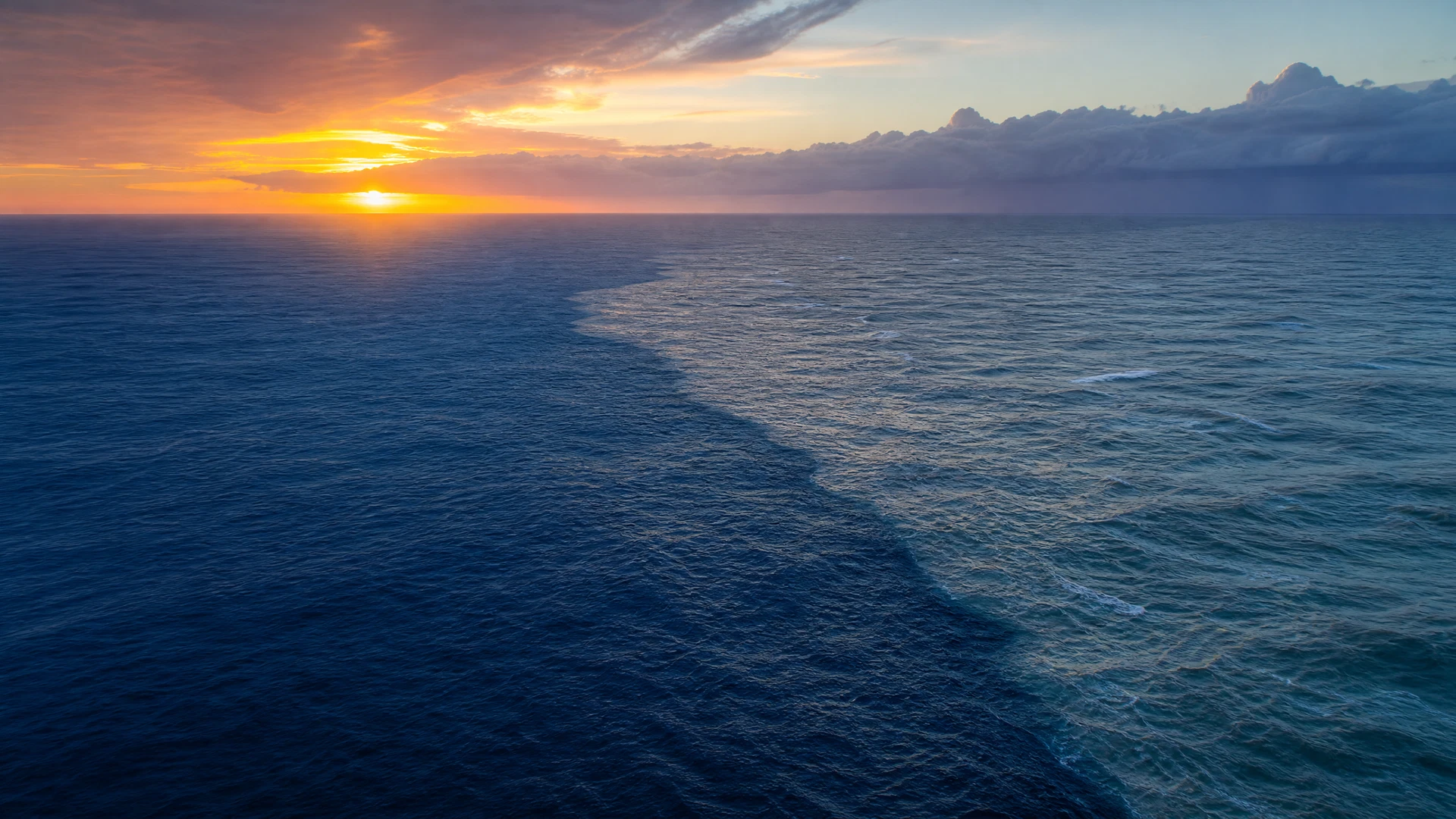
The Atlantic Ocean does not sit still; it breathes in a slow, rhythmic cycle of heat and salt that dictates the climate of continents and the survival of species. To look at a map of the ocean is to see a blue expanse, but to understand its movement is to envision a three-dimensional engine of staggering proportions. At the heart of this system is the Atlantic Meridional Overturning Circulation, or AMOC, a vast network of currents that acts as a global radiator. It carries the warmth of the tropics toward the high latitudes of the North, where the water eventually cools, sinks, and begins a long, cold journey back toward the south. This movement is not merely a matter of wind pushing water; it is a delicate balance of density, driven by the invisible interplay of temperature and salinity. When we speak of the Atlantic as a moving heat system, we are describing a process that moves more water than all the world’s rivers combined, a silent, subterranean migration that has persisted for millennia, yet remains one of the most complex and difficult systems to predict in the natural world.
The most famous limb of this circulation is the Gulf Stream, a powerful, warm current that emerges from the Florida Straits and follows the eastern coastline of North America. It is often described as a "river in the sea," but that metaphor fails to capture its true scale. The Gulf Stream is a ribbon of deep, cobalt-blue water, distinct from the surrounding greenish-gray of the North Atlantic. It moves at speeds of up to five miles per hour, carrying a volume of water that is nearly a hundred times greater than the Amazon River. More importantly, it carries heat—massive quantities of it, absorbed from the intense tropical sun. This heat is what allows the British Isles and Scandinavia to remain temperate despite their high latitudes; without this northward delivery of warmth, London would share the climate of Labrador, and the ports of Northern Europe would be locked in ice for much of the year. The current is not a steady, straight line but a meandering, pulsing force, shedding massive eddies—circular swirls of water hundreds of miles wide—that spin off into the open ocean like planetary gears, carrying their own distinct ecosystems and weather patterns within them.
As the Gulf Stream travels north, it undergoes a profound transformation. In the subpolar regions of the North Atlantic, the warm water releases its heat into the atmosphere, warming the winds that blow toward Europe. As the water cools, it becomes denser. This process is accelerated by the Atlantic’s unique salinity. Because the Atlantic is saltier than the Pacific, its water is naturally heavier. When this salty water reaches the frigid regions near Greenland and the Labrador Sea, it becomes so dense that it can no longer remain at the surface. It begins to sink, plunging miles downward into the abyss in a process known as deep-water formation. This is the "engine" of the Atlantic circulation—a vertical pump that pulls warm water from the south to replace the cold water that has descended into the dark. These sinking zones are small, localized, and difficult to observe, yet they are the critical points where the ocean’s surface and deep interior communicate, locking away carbon and heat for centuries at a time.
The meeting of these currents creates some of the most productive and dangerous environments on Earth. Off the coast of Newfoundland, the warm, salt-rich Gulf Stream encounters the cold, fresh Labrador Current flowing south from the Arctic. The result is a collision of worlds. The temperature difference between the two water masses creates the legendary fogs of the Grand Banks, where visibility can drop to zero in a matter of minutes. This mixing of waters also stirs up nutrients from the deep, fueling massive blooms of phytoplankton that form the base of a rich marine food web. For centuries, these fishing coasts have sustained human civilizations, providing the cod and haddock that built the economies of New England and the Canadian Maritimes. Yet the very system that provides this abundance is also a source of volatility. The position of the Gulf Stream’s "North Wall"—the sharp boundary between warm and cold water—fluctuates from year to year, shifting the location of fish stocks and influencing the intensity of coastal storms.
The atmosphere and the ocean are locked in a continuous, turbulent embrace, and the Atlantic’s heat system is the primary driver of this interaction. The massive amount of energy carried by the Gulf Stream acts as a fuel source for storms. When cold air from the North American continent moves over the warm waters of the current, it creates steep temperature gradients that can rapidly intensify low-pressure systems. These "nor'easters" and winter storms draw their power directly from the ocean’s stored heat, lashing the coastlines with wind and rain. The Atlantic circulation also influences the path of hurricanes, which rely on warm surface waters to maintain their strength. Because the ocean has a much higher heat capacity than the atmosphere, it acts as a stabilizer, absorbing the shocks of seasonal changes, but this also means that any shift in the ocean’s circulation has long-lasting consequences for the weather patterns of the entire Northern Hemisphere.
For much of human history, our understanding of these currents was limited to the surface—to the drift of logs, the speed of sailing ships, and the occasional recovery of messages in bottles. Early mariners noticed the warmth of the water and the way it could carry a vessel hundreds of miles off course, but the depths remained a silent mystery. Scientists once relied on "bottle casts," lowering heavy metal canisters into the dark to capture a single snapshot of temperature and salt at a specific depth. These were lonely, labor-intensive efforts, providing only a fragmented glimpse of a system that is constantly in motion. There is a certain wistfulness in those early records, the handwritten logs of sailors who felt the pulse of the Gulf Stream under their hulls but could only guess at the vast, cold return flow miles beneath them. Today, that mystery is being dismantled by technology, yet the sense of awe remains as we realize how much of the ocean’s internal life we have only just begun to see.
To understand a system so vast and inaccessible, scientists have deployed a fleet of robotic sentinels. These drifting instruments, known as Argo floats, are perhaps the most important tools in modern oceanography. Each float is a sleek, cylinder-shaped device that spends most of its life in the dark, drifting at a depth of about 1,000 meters. Every ten days, the float sinks further to 2,000 meters and then slowly rises to the surface, measuring temperature and salinity as it ascends. Once it reaches the air, it beams its data to a satellite before sinking back down to begin the cycle again. There are thousands of these floats scattered across the Atlantic, providing a real-time pulse of the ocean’s health. They have revealed that the ocean is warming at all depths, and that the salinity patterns are shifting as melting ice from the Arctic adds fresh water to the North Atlantic. These instruments allow us to see what the human eye cannot: the slow, inexorable changes in the ocean’s internal structure that will dictate the climate of the future.
Despite the wealth of data provided by satellites and drifters, the Atlantic circulation remains frustratingly difficult to reduce to a single, elegant diagram. For decades, the "Great Ocean Conveyor Belt" was the standard way to teach oceanography—a simple loop of red and blue lines showing warm water flowing one way and cold water the other. But modern research has shown that this is a vast oversimplification. The real Atlantic is a chaotic, turbulent mess of branches, recirculations, and eddies. Water does not move in a single, continuous stream; it breaks apart, mixes, and stalls. Some water stays in the tropics for decades, while other parcels are whisked north in a matter of months. The circulation is not a single belt but a complex web of interconnected pathways that vary on timescales ranging from days to centuries. This complexity is why it is so difficult to say with certainty whether the circulation is "slowing down" or merely entering a different phase of its natural variability.
We live on a planet defined by these invisible migrations of heat and salt. The Atlantic Ocean is not just a barrier between continents, but a bridge that connects the equator to the poles, the surface to the deep, and the past to the future. The familiarity of the Gulf Stream’s warmth and the reliability of the fishing seasons are products of a system that is far more fragile than it appears. As the climate changes, the delicate balance of density that drives the AMOC is being tested. More fresh water from melting glaciers and increased rainfall could potentially "freshen" the North Atlantic, making the water less dense and slowing the sinking process that drives the entire engine. While we avoid the melodrama of sudden collapses, we must acknowledge the quiet, steady shifts that are already underway. The Atlantic is a moving system, and as it moves, it carries with it the blueprint for the world we will inhabit in the coming centuries—a world where the familiar pulse of the ocean may beat to a different, more uncertain rhythm.