Learn
The Southern Ocean Sets the Planet’s Pace
The Southern Ocean works beyond the edges of most maps: wind, ice, deep water, and unbroken current set a rhythm that reaches every other sea.
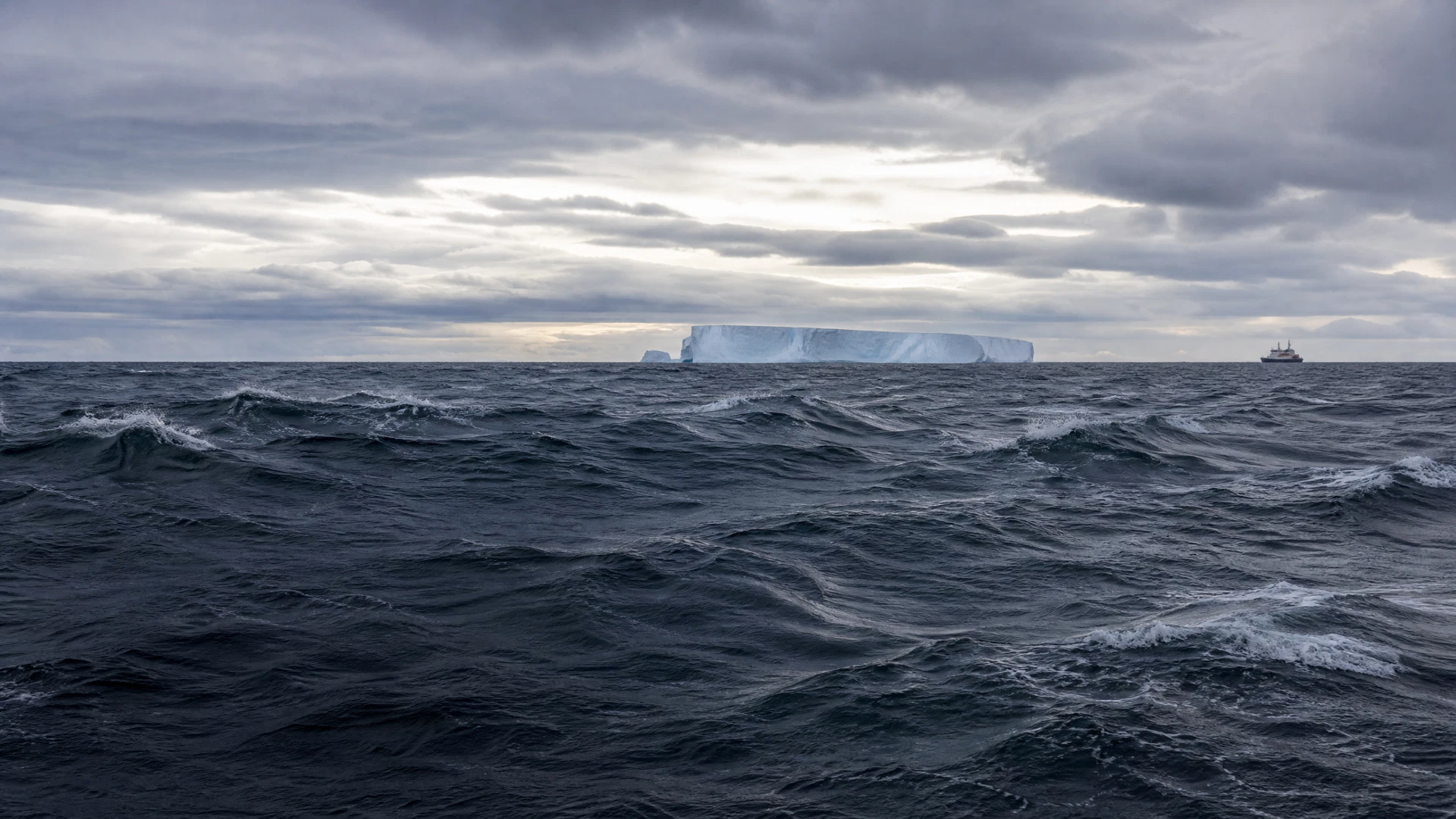
To stand at the southern tip of any continent is to look toward a boundary that does not exist in the traditional sense of geography. Unlike the Atlantic or the Pacific, which are defined by the landmasses that cradle them, the Southern Ocean is a realm defined solely by its own motion. It is the only body of water on Earth that flows entirely around the globe, unimpeded by the rise of mountains or the sprawl of plains. Its northern border is not a shoreline of sand or rock but a shifting, invisible wall of temperature and salt known as the Antarctic Circumpolar Current. This lack of a northern coast creates a unique hydraulic isolation, a liquid ring that separates the frozen interior of Antarctica from the rest of the world while simultaneously acting as the planet’s primary circulatory engine. It is a place where the concept of "ocean" shifts from a container to a process, a continuous loop of water that has been orbiting the pole for millions of years, gathering the histories of three other oceans and blending them into a single, cold, and restless identity.
The Antarctic Circumpolar Current is the massive heart of this system, a conveyor of water so vast that its volume exceeds the combined flow of all the world's rivers by a factor of hundreds. It moves roughly one hundred and thirty-five million cubic meters of water per second through the Drake Passage, a narrow squeeze between South America and the Antarctic Peninsula. This current is not a surface phenomenon; it extends from the wind-whipped waves down to the very floor of the sea, dragging the entire water column along in its eastward journey. Because there is no land to break the wind’s fetch, the westerlies—the Furious Fifties and Screaming Sixties—blow with a relentless consistency that transfers immense kinetic energy into the sea. This energy creates a "mixer" effect, drawing up ancient, nutrient-rich deep water from the Atlantic, Indian, and Pacific basins and exposing it to the atmosphere for the first time in centuries. The Southern Ocean is thus the great mediator, a site where the deep past of the global ocean meets the immediate present of the air.
Above this churning surface, the atmosphere is a chaotic gradient of pressure and wind speed. The Wandering Albatross, a creature with a wingspan that can reach eleven feet, has evolved to inhabit this chaos through a technique known as dynamic soaring. By exploiting the wind shear—the difference in wind speed between the air just above the waves and the faster air twenty meters higher—the albatross can travel thousands of miles without a single flap of its wings. It climbs into the wind, gaining height and potential energy, then turns and dives downwind, converting that height into speed, skimming just inches above the crests of the swells. This flight is a biological mirror of the ocean’s own physics, a constant extraction of energy from the friction between air and water. To observe an albatross in the Southern Ocean is to see the wind made visible, a wistful reminder that in this part of the world, survival is not about resisting the elements but about aligning oneself with their inexorable flow.
As winter descends, the ocean undergoes a transformation that is perhaps the most significant seasonal event on the planet. The surface begins to freeze, not in a single sheet, but in a chaotic mosaic of pancake ice and floes that eventually consolidate into a white mantle doubling the size of the Antarctic continent. This process is not merely a change of state; it is a chemical engine. As sea ice forms, it rejects salt, creating a layer of brine that is colder and denser than the surrounding water. This heavy brine sinks, cascading down the continental slope in massive, underwater waterfalls that can reach speeds of several meters per second. This is the birth of Antarctic Bottom Water, the densest water mass in the world. It is a silent, gravity-driven descent that carries oxygen and coldness into the dark abyss, where it will eventually spread across the floors of every major ocean basin, cooling the planet’s interior for the next millennium.
The mechanics of this deep-water formation are being monitored by a silent fleet of robotic sentinels known as Argo floats. These cylinders, roughly the height of a human, drift through the Southern Ocean in ten-day cycles of observation and transmission. A float begins its journey at the surface, then deflates a small external oil bladder—no larger than a grapefruit—to reduce its buoyancy and sink to a depth of two thousand meters. For nine days, it drifts with the deep currents, a passive witness to the ocean’s internal rhythms. On the tenth day, it re-inflates its bladder, rising slowly through the water column while its sensors record temperature, salinity, and carbon levels. When it breaks the surface, it beams its data to a satellite before sinking once more. These floats have transformed our understanding of the Southern Ocean, revealing that it absorbs a disproportionate amount of the heat and carbon dioxide generated by human activity, acting as a massive thermal sponge that buffers the rest of the biosphere.
Yet, even this powerful system shows signs of subtle, persistent shifts. Data from the SOCCOM project and long-term shipboard measurements suggest that the volume of the densest Antarctic Bottom Water has been contracting in recent decades. In the Weddell Sea, the deep layers are becoming slightly fresher and less voluminous, a change that points toward a softening of the brine-rejection engine. This is not a sudden collapse but a gradual thinning of the ocean’s coldest pulse. Observations also indicate that the Antarctic Circumpolar Current may be shifting its path or intensifying in response to changing wind patterns, though the complexity of the eddies and the sheer scale of the water mass make it difficult to distinguish long-term trends from natural variability. The Southern Ocean does not offer easy answers; it is a landscape of high noise and deep signals, where certainty is a rare commodity and the evidence must be gathered over generations of careful measurement.
The biological life of the Southern Ocean is as interconnected as its currents. The massive upwelling of nutrients fueled by the circumpolar current supports a bloom of phytoplankton so vast it can be seen from space. These microscopic plants are the foundation for the Antarctic krill, a tiny crustacean that serves as the primary energy source for almost everything else in the region, from the blue whale to the Adélie penguin. The krill are inextricably linked to the sea ice, using its underside as a nursery and a source of algae during the dark winter months. If the ice patterns shift, the krill populations may follow, creating ripples that extend through the entire food web. The seabirds that roam these waters are not just residents but commuters, traveling thousands of miles to find the specific frontal zones where the mixing of water masses brings prey to the surface. Their lives are mapped to the geography of the currents, a testament to the ocean’s role as a provider.
In the end, the Southern Ocean remains a place of profound solitude and connective power. It is the only region where a drop of water can travel around the world without ever touching land, a liquid ring that binds the disparate basins of the Earth into a single global system. To look at this ocean is to realize that the boundaries we draw on maps are often arbitrary, and that the true divisions of the planet are made of temperature, salt, and momentum. There is a certain wistfulness in the realization that this powerful engine, which has operated with such reliability for epochs, is now being subtly altered by forces originating far to the north. Yet, the Southern Ocean continues its circumpolar journey, a restless, cold, and beautiful reminder of the planet’s fundamental unity. It is an ocean that asks us to look not for a shore, but for the movement that sustains us all.
The instrument floats continue their rhythmic diving, the albatrosses continue their dynamic soaring, and the deep water continues its slow crawl across the abyssal plains. Each of these processes is a thread in a larger tapestry of planetary health. The Southern Ocean is not a remote wilderness; it is the center of the world’s water, the place where the atmosphere and the abyss hold their most important conversations. Our understanding of this realm is still growing, profile by profile and season by season. As we watch the data stream in from the remote reaches of the Ross Sea and the Drake Passage, we are learning that the Southern Ocean is not just a barrier protecting the ice, but a bridge connecting the past of the deep sea to the future of the air. It is a powerful, connective ring that defines the very nature of a blue planet.