Cultural landmark
Ancient stone networks and sacred stories along the banks of the Barwon River
In Brewarrina, the Barwon River holds Baiame's Ngunnhu, a 40,000-year-old stone fish trap network. This Aboriginal engineering marvel remains a sacred site, offering a profound connection to the Ngemba people’s enduring legacy and outback history.
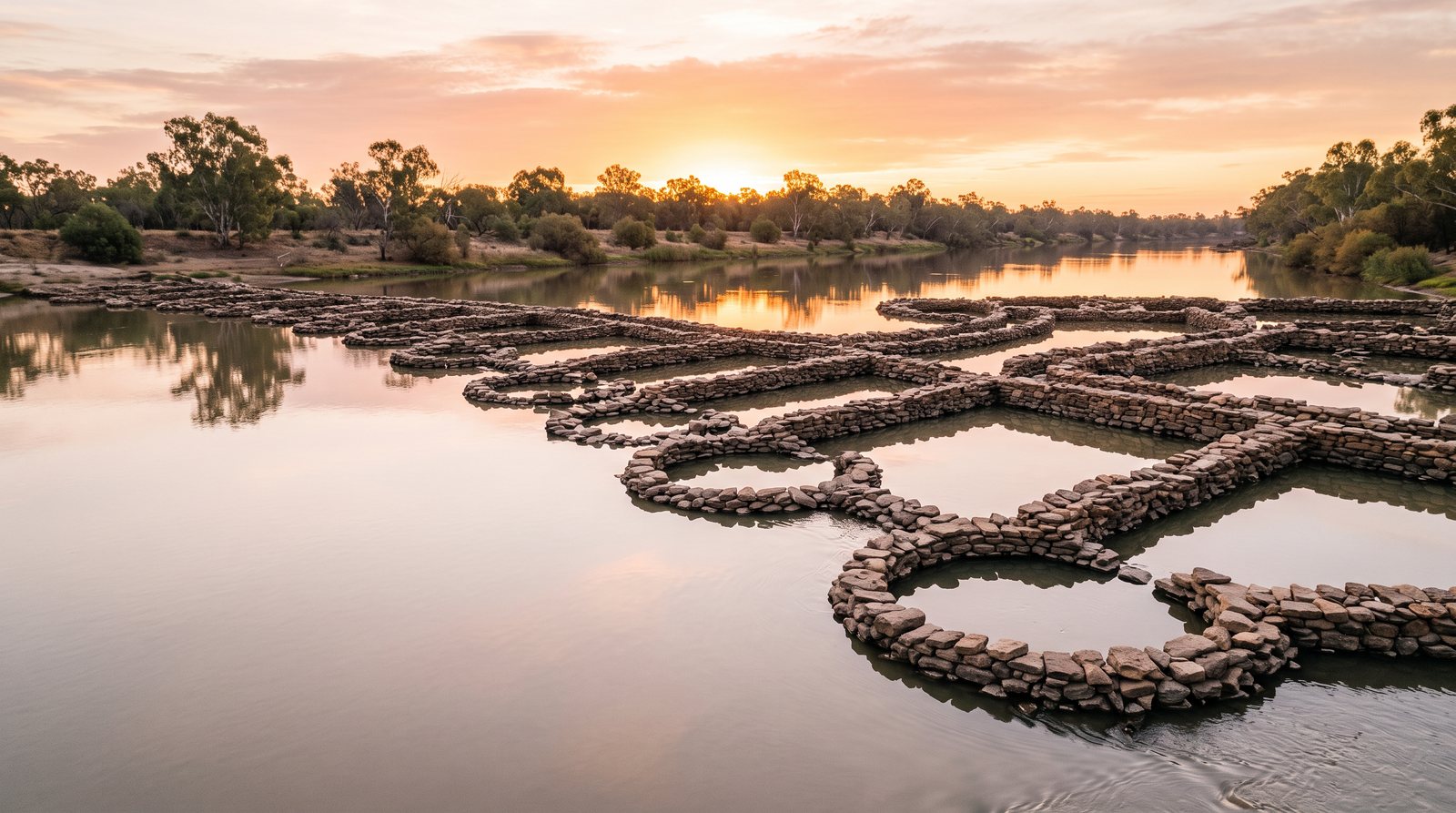
In Outback New South Wales, where the red earth holds the heat of a thousand summers, the town of Brewarrina sits as a quiet sentinel on the banks of the Barwon River. Beneath the surface of the water and along its rugged edges lies a legacy that defies the modern understanding of time. Here, the water flows over a complex network of stone, a series of U-shaped and circular pens known as Baiame’s Ngunnhu. The Brewarrina Aboriginal Fish Traps are a living testament to forty millennia of human ingenuity, spiritual devotion, and social organization. To stand on the riverbank is to confront the reality of deep time, where the whispers of the past are as audible as the rustle of the river red gums in the evening breeze.
The engineering of the Ngunnhu is a marvel of ancient technology, predating the pyramids of Giza by tens of thousands of years. Extending for half a kilometer along the riverbed, the traps consist of dry-stone walls meticulously arranged to harness the natural flow of the Barwon River. The Ngemba people, the traditional custodians of this land, designed the system with a sophisticated understanding of river hydrology and fish ecology. As the river levels rise and fall, the stone walls create interconnected pools that allow fish to enter but prevent their easy escape. This was a system designed for sustainable harvest; the design ensured that while enough fish were caught to sustain the community, many others could continue their journey, preserving the health of the river’s ecosystem for thousands of generations.
According to Ngemba tradition, the traps were not the work of mortals alone but were gifted to the people by Baiame, a powerful ancestral being. The story tells of a time of drought when the river had ceased to flow and the people were facing starvation. Baiame, seeing their plight, descended to the river and moved the massive stones into place, creating the intricate patterns that still exist today. He then showed the people how to use the traps and established the laws for their management. These laws dictated that the traps were to be shared among the various nations of the region, including the Muruwari, Weilwan, and Kamilaroi. In this way, Baiame’s Ngunnhu became a sacred site of diplomacy and cooperation, where different groups would gather during the harvest to trade, conduct ceremonies, and reinforce social bonds.
The site’s significance as a diplomatic hub cannot be overstated. For thousands of years, Brewarrina served as one of the great meeting places of Aboriginal Australia. The abundance provided by the fish traps allowed for large gatherings that would otherwise have been impossible in the harsh outback environment. During these times, the banks of the Barwon River would be lined with the camps of thousands of people, each respecting the strict protocols and sharing arrangements set down in the Dreaming. This ancient form of governance ensured that the resources of the river were managed fairly and that conflicts were resolved through traditional law. The stones themselves, worn smooth by the passage of water and the touch of countless hands, are silent witnesses to a history of peaceful coexistence and complex social structures that flourished long before the arrival of Europeans.
In the modern era, the resilience of the fish traps is a source of profound pride for the Brewarrina community. Despite the challenges of the colonial period and the changes to the river’s flow caused by modern agriculture, the Ngunnhu have remained largely intact. In 2005, the site was officially recognized for its outstanding significance to the nation and was added to the National Heritage List. This listing acknowledges the traps as one of the oldest man-made structures in the world and a unique example of Aboriginal innovation. Today, the Ngemba people continue to act as stewards of the site, working to ensure that the stones are protected and that the stories associated with them are passed down. Their connection to the river remains unbroken, a testament to the enduring strength of their culture and their commitment to their ancestral responsibilities.
For visitors to Brewarrina, the experience of the fish traps is best mediated through the Brewarrina Aboriginal Cultural Museum. Located on the banks of the river overlooking the traps, the museum serves as a center for education and truth-telling. Guided tours led by local Aboriginal rangers offer visitors an opportunity to see the traps up close and to hear the stories of Baiame and the Ngemba people from those who know them best. The museum’s displays include traditional tools, artifacts, and historical photographs that provide context for the site’s long history. It is a place where the complexity of Aboriginal culture is laid bare, challenging the simplistic narratives that have often dominated the portrayal of Australia’s First Nations people. Through these encounters, visitors gain a deeper appreciation for the sophistication of the Ngunnhu and the depth of the spiritual connection that ties the community to the Barwon.
The health of the fish traps is inextricably linked to the health of the Barwon-Darling river system, a fact that brings modern environmental challenges into focus. The Murray-Darling Basin has faced significant pressure from water extraction, drought, and climate change. When river levels are low, the traps can become exposed and vulnerable, and the fish populations they depend on can dwindle. The community in Brewarrina has been vocal in its advocacy for the river, emphasizing that the Ngunnhu cannot be preserved in isolation from the water that gives them life. The struggle for sustainable water management is, for the Ngemba, a struggle for the survival of their heritage. The stones require the river’s flow to remain a living part of the landscape rather than a static monument to a lost past.
Ultimately, Brewarrina and its ancient stone networks offer a bridge between the past and the present, a place where the continuity of human experience is visible. As the sun dips below the horizon and the first stars appear in the vast outback sky, the fish traps remain, held in the embrace of the Barwon River. The atmosphere at sunset undergoes a transformation; the shadows of the river red gums lengthen across the water, and the ancient stones begin to glow with a golden light. It is a moment of profound beauty that invites reflection on the relationship between humanity and the natural world. The Baiame’s Ngunnhu are not just relics; they are active participants in the ongoing story of the Ngemba people, a sacred reminder of the enduring power of story, the resilience of culture, and the timeless beauty of the Australian landscape.