Historic outback town
The legendary outback gateway where historic river trade meets timeless desert horizons
Once a bustling nineteenth-century river port, Bourke remains a legendary gateway where the Darling River meets the vast outback. Explore historic paddleboat routes, ancient Aboriginal rock art at Gundabooka, and the resilient spirit of the red-earthed interior.
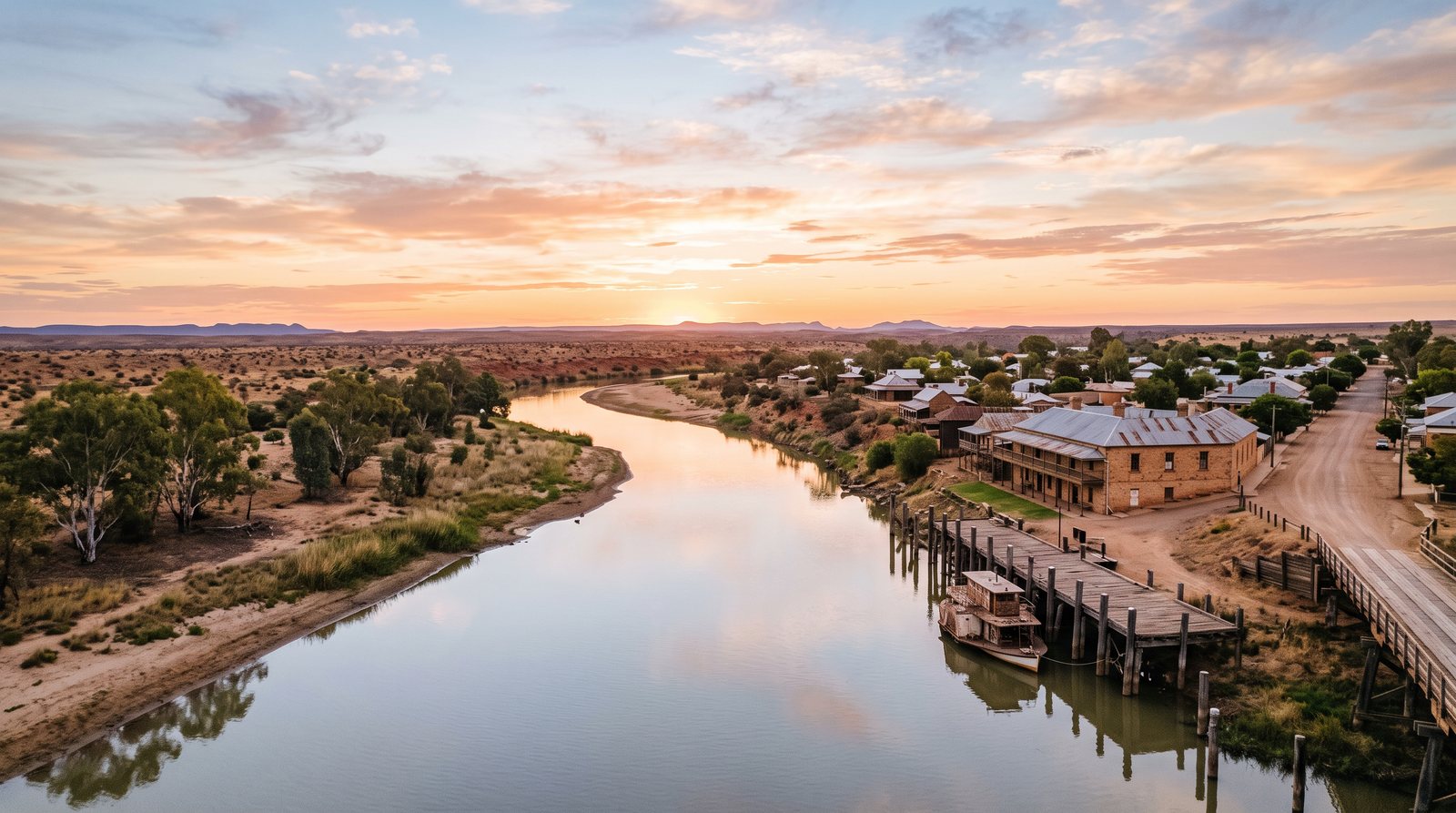
Bourke occupies a singular position in the Australian psyche, serving as the symbolic threshold between the settled coast and the vast interior. Located on the banks of the Darling River, the town is more than a geographic coordinate; it is a cultural landmark defining the concept of the "Back O' Bourke." This phrase, which has entered the national lexicon to describe the remote and the legendary, captures a place where horizons stretch infinitely and the red earth meets a sky of immense proportions. The town’s history is inextricably linked to the river, a vital artery that sustained Indigenous communities for millennia before becoming a conduit for colonial trade. Today, Bourke remains a resilient community that balances its deep heritage with the practicalities of modern outback life, offering visitors a profound encounter with the landscapes and stories that have shaped the Australian identity.
The Darling River, or the Baaka, is the lifeblood of Bourke, and its presence dominates the town’s layout and history. During the late nineteenth century, Bourke flourished as a busy inland river port, with paddlewheelers transporting wool and supplies across vast distances. The Jandra, a modern heritage-style paddleboat, allows visitors to experience the rhythm of the river as it was during the height of the wool boom. Navigating the murky, slow-moving waters, one passes beneath the ancient, gnarled limbs of river red gums that have stood witness to centuries of change. The historic North Bourke Bridge, completed in 1883, remains a testament to this era; it was designed to lift and allow the passage of tall-masted steamers, facilitating the flow of commerce that once made Bourke a critical hub for the colonial economy.
Long before European settlers arrived, the region around Bourke was the domain of the Ngemba, Barkindji, Budjiti, and Murrawari people. Their connection to the land is most vividly preserved in Gundabooka National Park, located fifty kilometers south of the town. The park is home to Mount Gunderbooka, a massive sandstone monolith that rises abruptly from the surrounding plains. Within the rocky recesses of the mountain, ancient rock art galleries provide a silent record of Aboriginal life, depicting ceremonies, animals, and the spiritual traditions of the Traditional Owners. These sites are not merely historical artifacts but living connections to a culture that has managed the land for over forty thousand years. The red-earthed expanses of the park, characterized by mulga woodlands and stony ridges, offer a starkly beautiful environment where the silence is broken only by native birds.
Bourke’s influence on Australian literature is famously embodied in the work of Henry Lawson, who was sent to the town in 1892. Lawson’s experiences in the harsh landscape profoundly influenced his writing, leading to his observation that knowing Bourke was essential to understanding Australia. His stories and poems captured the grit, humor, and stoicism of the people he encountered, from shearers and drovers to publicans and travelers. The landscape Lawson described—a place of dust, heat, and immense distance—remains recognizable today, and his legacy is celebrated throughout the town. Walking through the streets, one can still feel the echoes of the "Lawson country," where the resilience of the human spirit is tested against the elements, a theme that continues to resonate in the town’s contemporary cultural life and its enduring literary significance.
To understand the complex layers of Bourke’s history, the Back O' Bourke Exhibition Centre provides a comprehensive experience. The center uses interactive displays, historical artifacts, and oral histories to tell the stories of the region’s diverse inhabitants. From the early explorers who struggled to map the inland rivers to the pioneers who established the wool industry, the exhibitions provide a nuanced view of the challenges and triumphs of outback life. The center also highlights the significant contributions of the Indigenous people, ensuring their perspectives are central to the narrative of the region. By weaving together these disparate threads, the exhibition center offers a sophisticated interpretation of Bourke’s past, moving beyond nostalgia to address the realities of environmental change, social shifts, and the ongoing process of reconciliation within the broader Australian context.
Bourke was once a vital link in the Cobb & Co stagecoach network, providing the primary means of transport across the interior before the expansion of the railways. The town served as a major terminus where coaches arrived from all directions, carrying passengers, mail, and news to the remote corners of the colony. The remnants of this era can still be seen in the historic buildings that line the town’s main streets and the dusty tracks that radiate out into the surrounding country. The resilience required to operate such a network in the face of floods, droughts, and extreme temperatures is a recurring theme in the town’s history. Today, visitors can trace these historic routes, gaining an appreciation for the sheer scale of the landscape and the ingenuity of the people who built the infrastructure that connected the outback.
Modern Bourke remains an important service center for the surrounding agricultural and pastoral industries. The cultivation of cotton and citrus has added new dimensions to the local economy, though these industries remain subject to the unpredictable cycles of the Darling River’s flow. The town is also a place of significant social history, most notably as the final resting place of Fred Hollows, the pioneering ophthalmologist who worked to improve the health of Indigenous Australians. His grave serves as a reminder of the values of practical compassion and dedication that are deeply respected in the outback. Bourke’s ability to honor its past while looking toward the future is a testament to the enduring spirit of its people.
The natural environment around Bourke is characterized by a dramatic seasonal rhythm. During the summer, the heat can be intense, turning the landscape into a shimmering expanse of red dust and golden grass. However, rain can transform the country almost overnight, with dormant seeds bursting into life and the river systems swelling. Bourke remains a destination that rewards the traveler who looks beneath the surface. It is a place where history is written into the landscape itself, from the scarred trees along the riverbank to the sandstone heights of Gundabooka. The town’s allure lies in its authenticity: a rugged, resilient, and deeply storied gateway to the heart of Australia, where the sun sets over the Darling River in a timeless display of outback beauty.