Opal mining town
The subterranean desert town where life thrives beneath the ancient opal fields
In the arid expanse of Outback New South Wales, White Cliffs offers a profound study in human adaptation. As Australia’s oldest commercial opal field, the town thrives underground, where cool dugouts provide sanctuary from the desert’s relentless heat.
The journey to White Cliffs is a transition into a landscape defined by its absences. As bitumen gives way to the red dust of the Corner Country, the horizon flattens until the sky occupies more space than the earth. The first sign of human presence is not a skyline of rooftops, but a series of white, conical mounds—mullock heaps—rising from the desert floor like frozen waves. These are remnants of a century of searching, the discarded earth of miners who looked downward for fortune. In the shimmering heat, the silence is absolute, broken only by the rustle of saltbush. It appears uninhabitable, yet it is home to a resilient community living in a town that has retreated beneath the surface to survive.
The history of White Cliffs began in 1884 with a chance discovery by kangaroo hunters who found precious opal lying on the surface. This sparked a rush that transformed the remote region into Australia’s first commercial opal field. By the turn of the century, thousands of miners had descended upon the area, enduring primitive conditions in their quest for the "fire" of the desert. The town grew rapidly, with a hospital and several hotels serving a population that peaked at over 2,500 people. However, the harsh environment dictated the town's form. With timber in short supply and summer temperatures exceeding forty degrees Celsius, miners looked to the very ground they were excavating for a housing solution.
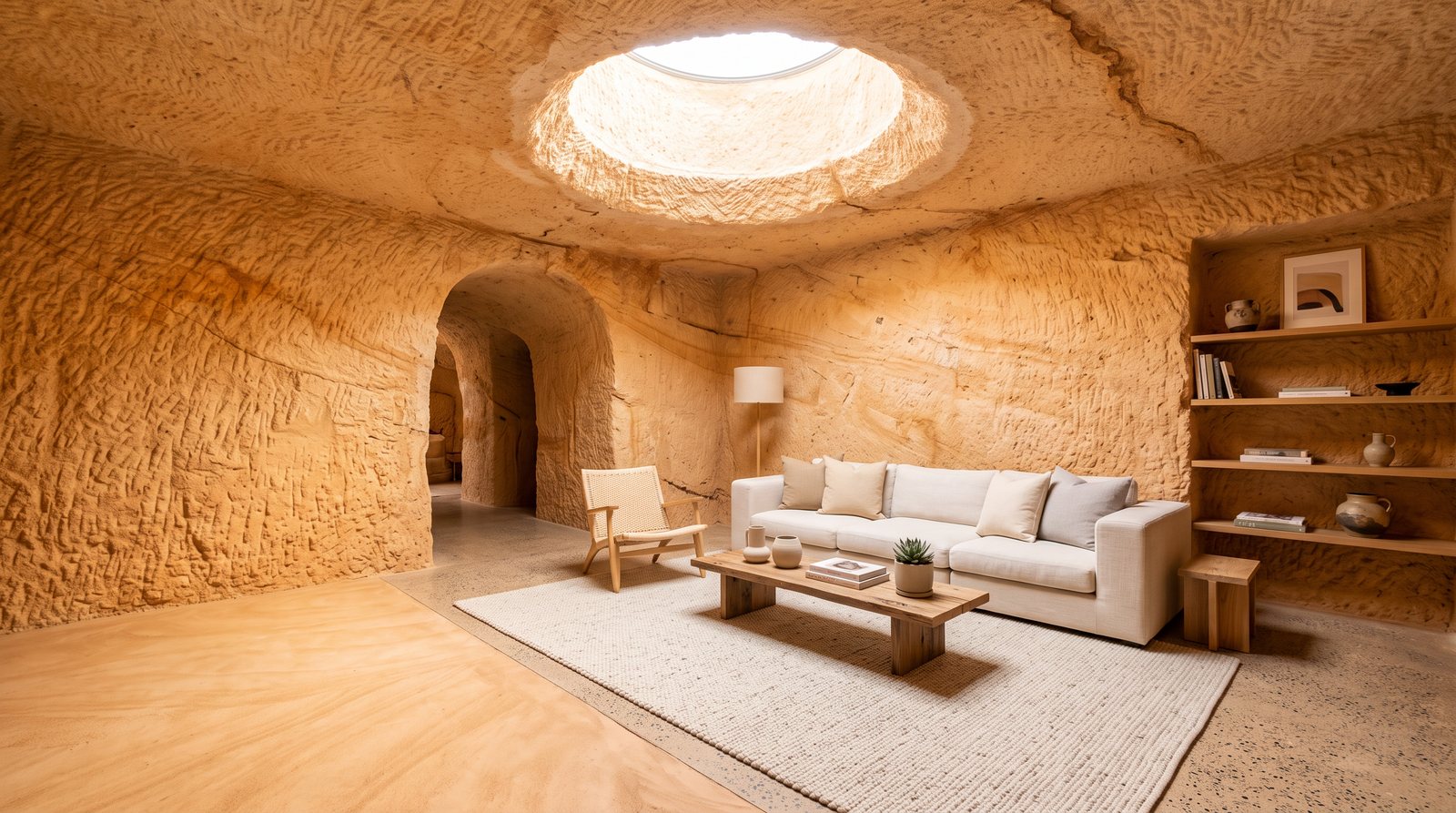
The defining feature of White Cliffs is the "dugout," a form of subterranean architecture representing a masterclass in passive environmental design. Rather than building upwards, residents carved homes directly into the soft, white sandstone hillsides. These underground dwellings offer a constant temperature of around twenty-two degrees Celsius year-round, regardless of the searing heat or freezing desert nights outside. Over decades, these dugouts evolved from simple one-room shelters into sophisticated multi-room residences with modern amenities and ventilated shafts. Living underground is not a compromise but a preference; it provides a quiet, dust-free sanctuary where the outside world feels distant and the atmosphere is one of profound stillness.
While famous for its history, the unique nature of its gems continues to draw global interest. The field is renowned for "opalised pineapples," a rare form of opal found nowhere else. These specimens are pseudomorphs, where opal replaced the crystal structure of glauberite from an ancient inland sea. The result is a cluster of opal crystals retaining the spiky, pineapple-like shape of the original mineral, often glowing with brilliant color. These gems are highly prized by collectors as a geological record of the region’s prehistoric past. Finding them remains a labor-intensive endeavor, requiring miners to navigate labyrinthine tunnels of old workings, relying on experience and intuition to locate the narrow seams where the opal hides.
Life in a remote outback town requires a character that values independence while recognizing the necessity of community. White Cliffs is a town where the social fabric is as durable as the stone. The local pub serves as the community’s living room, where news is shared over cold drinks. Perhaps the most famous symbol of the town’s spirit is its golf course. In a region where water is precious, residents created a course consisting of "browns"—scraped patches of earth where players carry synthetic turf to tee off. This adaptation is a testament to the local philosophy: if the environment does not provide what you need, you simply reinvent the game to suit the landscape you have.
For the modern traveler, White Cliffs offers an experience both alien and welcoming. The town has embraced tourism, offering visitors the chance to experience subterranean life firsthand. Underground motels allow guests to sleep in the cool silence of a dugout, providing a sensory experience impossible to replicate in a conventional hotel. The hospitality is grounded in the reality of the outback; it is practical, honest, and often accompanied by local knowledge about the best sunset spots or mine history. Tourism here is not about polished attractions but about the opportunity to step into a different rhythm of life, dictated by the sun and the seasons rather than the clock.
The sustainability of White Cliffs is linked to its environment. The town was one of the first in Australia to embrace solar power, recognizing that the sun making surface life difficult could also provide clean energy. Water management is critical, with residents relying on tanks to capture infrequent desert rains. The landscape is a fragile ecosystem of saltbush and hardy wildflowers that bloom spectacularly after a wet season. Protecting this environment is a priority, as the community understands their survival depends on a respectful relationship with the land. The stark beauty of the region, with its vast horizons and clear night skies, remains the town’s greatest asset.
Today, White Cliffs faces challenges common to remote Australian communities, from opal market fluctuations to infrastructure maintenance in an isolated location. The population has settled into a small, dedicated group committed to preserving the town’s unique heritage. While the days of massive opal rushes are over, the spirit of exploration remains. New technologies are used to map old workings and identify new areas for mining, while the town’s status as a historic site ensures its story continues. The endurance of White Cliffs is a reminder that human ingenuity can find a way to thrive in even the most inhospitable environments, creating a culture as multifaceted and enduring as the opals themselves.
As the sun sets over the mullock heaps, the true character of White Cliffs becomes clear. It is a place of contradictions: a town invisible from a distance, a community thriving in a desert, and a landscape yielding precious gems from its dry heart. To visit is to be reminded of the scale of the Australian outback and the determined efforts of those who call it home. The "fire" of the opal is not just in the stones, but in the resilience of people living beneath the surface, adapting to the rhythm of the ancient earth. It remains a destination for the curious and a lasting tribute to the enduring allure of the desert’s hidden treasures.