National park
Ghostly river red gums and desert sunsets at the historic Menindee Lakes
Rising from the arid plains of the Far West, the Menindee Lakes form a haunting desert oasis. This historic landscape preserves the skeletal beauty of drowned river red gums and the deep colonial echoes of the Kinchega Woolshed and Burke and Wills.
The journey into the Far West of New South Wales is defined by a gradual thinning of the world, where coastal textures give way to the horizontal geometry of the arid interior. As red earth stretches toward an impossible horizon, the sudden appearance of the Menindee Lakes feels less like a geographical feature and more like a profound atmospheric shift. This expansive inland water system, fed by the Darling River, emerges as a shimmering contradiction to the surrounding saltbush. For the visitor, the first glimpse of the lakes is a reminder of the continent’s capacity for surprise, where a desert landscape can suddenly host a maritime scale of blue, rippling under the relentless outback sun.
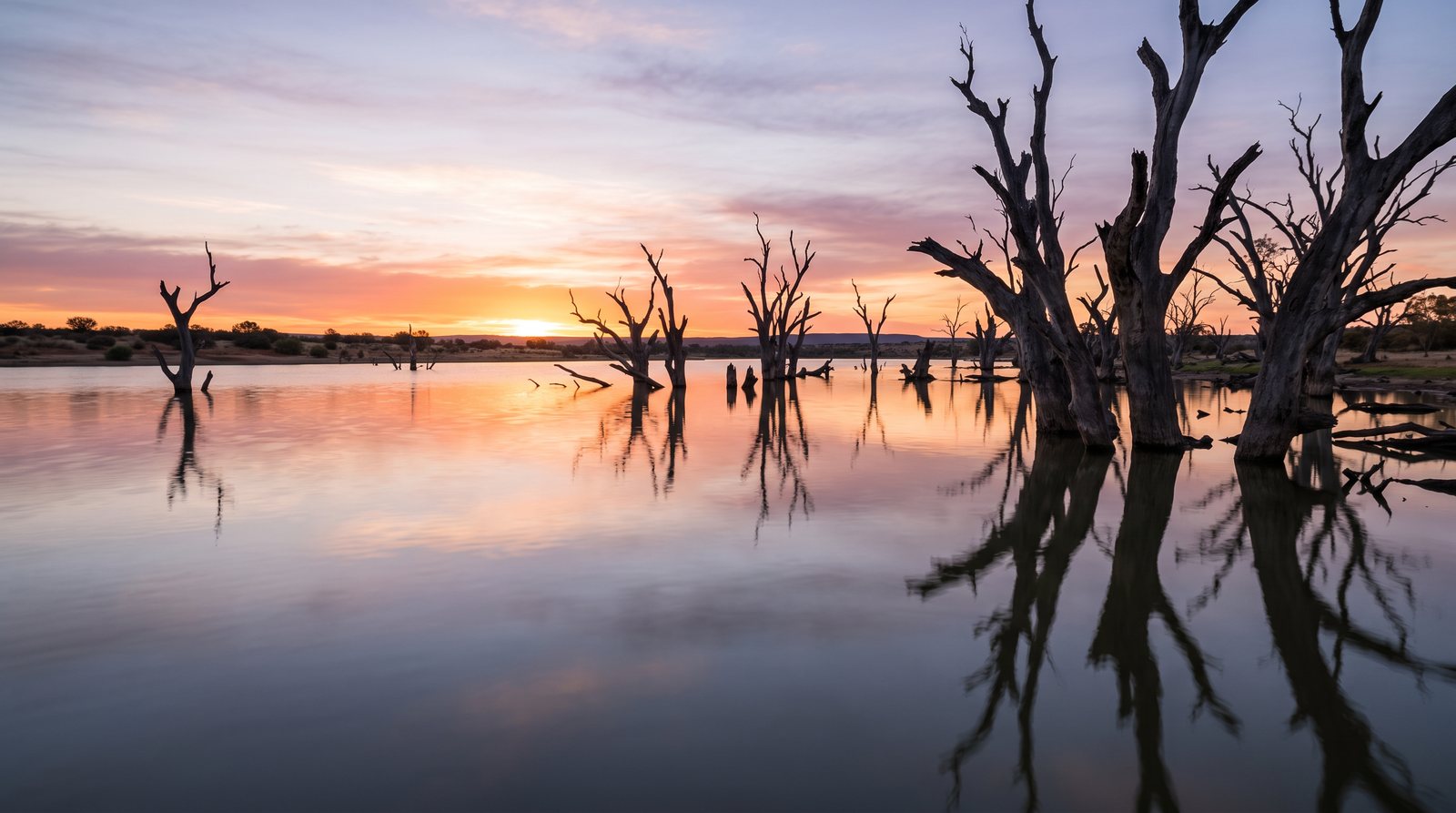
Standing as the most iconic symbols of this landscape are the drowned river red gums, their silver-grey skeletons rising from the still waters like ancient sentinels. These trees, once the giants of the riverbanks, were submerged during the engineering of the lake system in the mid-twentieth century. Stripped of their leaves and bark, their bleached limbs reach upward in complex, calligraphic gestures, casting intricate shadows across the surface. There is a haunting, sculptural quality to these groves, particularly when the wind drops and the lakes become a perfect mirror. They are a testament to the hardwood's endurance and a visual record of the human intervention that reshaped the natural flow of the Darling.
Beyond the water’s edge, the history of Kinchega National Park is etched into the structures remaining from its pastoral past. The Kinchega Woolshed stands as a monumental relic of the nineteenth-century wool boom, a massive timber and iron cathedral that once echoed with the rhythmic clicking of shears. At its peak, the station spanned over a million acres, and the woolshed was the heart of a sophisticated industrial operation connecting the remote outback to global markets. It is a place where environmental harshness met colonial ambition, resulting in a structure that is as much a part of the landscape as the dunes.
The human story of Menindee is also linked to the history of Australian exploration, serving as a pivotal staging point for the Burke and Wills expedition of 1860. It was here, at the edge of the known colonial world, that the party established their Depot Camp before venturing into the unexplored interior. The lakes provided a final reliable source of water and a moment of relative comfort before the brutal realities of the desert took hold. Today, the sites associated with the expedition offer a somber reflection on the challenges of navigating this terrain. In the quiet of the park, one can almost sense the weight of their departure, the transition from the safety of the river to the uncertainty of the northern plains.
Ecologically, the Menindee Lakes serve as a vital sanctuary, particularly during dry seasons when water is the most precious commodity in the outback. When the lakes are full, they become a bustling metropolis for birdlife, attracting thousands of waterbirds from across the continent. Pelicans, swans, and various ducks congregate in the shallows, their calls creating a constant hum that fills the air. The sight of a thousand white cockatoos rising from the red gums at dawn is a spectacle of motion that defies the stereotypical stillness of the desert. The lakes are a nursery and a refuge, playing a critical role in the survival of species across the Australian interior.
As the day wanes, the Menindee landscape undergoes its most dramatic transformation, as harsh afternoon light softens into the deep orange and purple hues of an outback sunset. The sky becomes a canvas of shifting color, reflecting off the vast expanse and illuminating the silver trunks of the drowned trees with a warm, golden glow. During these hours, the "ghostly" quality of the gums is most apparent, as they stand silhouetted against a sky that seems to burn with a slow fire. This is the time when the remote nature of the sanctuary is most keenly felt, a moment of stillness allowing for a deep connection to the ancient rhythms of the land.
For those visiting this remote corner, the experience is defined as much by preparation as by the destination. The roads leading to Kinchega are often unsealed, cutting through red dust and over corrugated tracks that demand respect. There is a practical reality to outback travel that reinforces the sense of isolation; one must carry water, check lake levels, and be mindful of rapidly changing weather. This necessity for self-reliance adds a layer of intentionality to the journey, making the arrival at the lakes feel like a hard-won reward. The isolation is not a barrier but a defining characteristic of the Menindee experience.
Reflecting on the Menindee Lakes, one sees a place where multiple layers of time are visible simultaneously. There is the deep time of the geological formations and the ancient river systems that have carved the path of the Darling over eons. There is the cultural time of the Barkandji people, the traditional owners whose connection to the land remains central to its identity. And there is the more recent, tumultuous time of colonial expansion, pastoral industry, and large-scale water management. To stand on the shores is to witness the ongoing dialogue between the land and those who inhabit it, a conversation recorded in the silt and the rings of the ancient gums.
Ultimately, the allure of the Menindee Lakes lies in their ability to exist as a place of both immense beauty and stark reality. They represent the enduring spirit of the Australian outback—a landscape that is resilient, unpredictable, and endlessly fascinating. As stars begin to emerge over the darkened water, the skeletal trees remain as silent witnesses to the passing of another day in this extraordinary sanctuary, a place where the ink of history is written in the water and the dust of the Far West.