Historic village
A cinematic outback relic where silver mining history meets the silver screen
Once a bustling silver mining hub, Silverton has evolved into a cinematic landmark and a sanctuary for outback art. From the rusted relics of its industrial boom to the infinite horizons of the Mundi Mundi Plains, the village offers a profound study in endurance and the desert light.
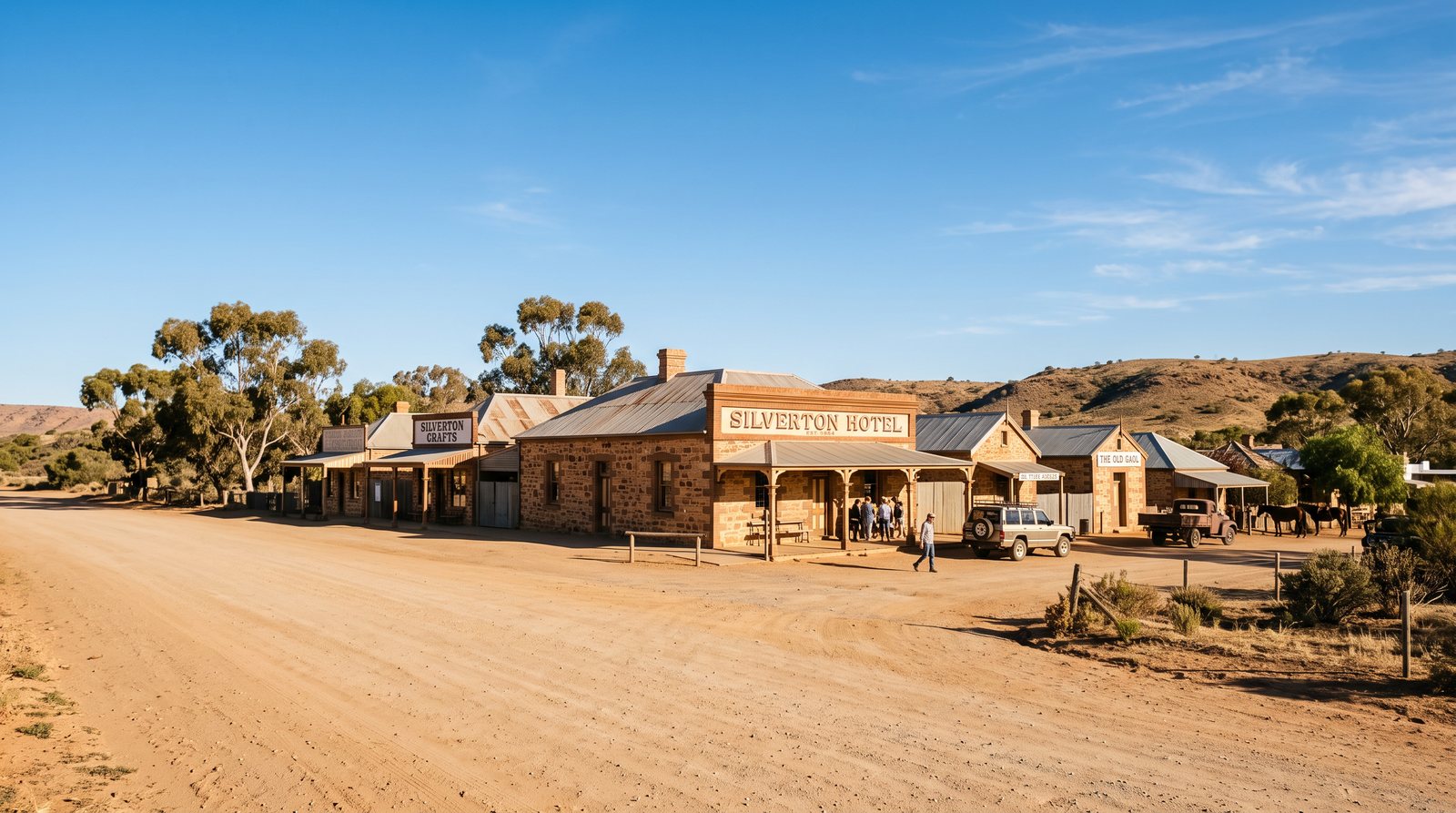
The drive from Broken Hill to Silverton represents a profound shift in the outback experience. As bitumen gives way to red dust, the landscape asserts itself as both ancient and cinematic. Silverton emerges as a collection of resilient stone buildings and rusted iron roofs huddled against the Barrier Ranges. The iconic Silverton Hotel, a low-slung structure that has served as the social heart since the nineteenth century, remains the town’s anchor. Here, the air carries a mixture of dry earth, eucalyptus, and the silence of a place that has seen its population swell and then contract. It is a town where the physical remains of a mining boom are slowly being reclaimed by the desert.
Silverton’s story began with a pickaxe. In the 1880s, the discovery of silver at Umberumberka triggered a rush that transformed this arid patch of outback into a bustling municipality. By 1885, Silverton had three thousand people, a newspaper, and a municipal council. It was a place of optimism and hardship, where wealth lay just beneath the sun-baked surface. However, the town’s supremacy was short-lived. The discovery of a massive ore body at Broken Hill proved to be its undoing. As the mines faltered, the population and buildings were moved to the new industrial giant. Entire houses were dismantled and transported by bullock team, leaving behind the stone skeletons that now define the village’s aesthetic.
Walking through Silverton is an exercise in reading the endurance of stone. The Silverton Gaol stands as the most formidable witness to the town's past. Built in 1889, its thick sandstone walls and iron-barred cells were designed to hold the rowdy elements of a mining frontier. Today, the cells are filled with a dense collection of artifacts: rusted tools, Victorian photographs, and domestic relics that tell a story of everyday survival. Beyond the gaol, the town’s architecture is a study in functional beauty. The old St Carthage's Church and various small cottages are built from local stone, their textures mirroring the rugged hills. These buildings have survived decades of extreme heat, a testament to the masons of the boom.
While its industrial life was brief, Silverton found a second existence on the silver screen. The town’s combination of nineteenth-century ruins and an expansive horizon made it a magnet for filmmakers seeking a post-apocalyptic landscape. Most famously, George Miller chose Silverton and the Mundi Mundi Plains as the setting for Mad Max 2, cementing its association with the wasteland aesthetic. The rusted cars and desolate roads featured in the film became iconic, drawing fans from across the globe. Silverton’s cinematic history also includes films like Priscilla, Queen of the Desert and Wake in Fright. The light here has a sharp, uncompromising clarity that cinematographers prize, blurring the line between reality and fiction in the red dust.
The transition to a cinematic icon was accompanied by the rise of Silverton as a sanctuary for outback art. In the 1970s, the 'Brushmen of the Bush' began to capture the unique colours of the Far West, and their legacy continues to influence the town’s cultural life. Today, quirky galleries are tucked into historic buildings, showcasing work ranging from traditional landscapes to surrealist interpretations of the desert. The most famous local resident is Peter Browne, whose gallery features the town’s famous donkeys. These animals, descendants of those used by early miners, now wander the streets at will, becoming a symbol of the town’s character. The art of Silverton is found in the galleries and the decorated homes of the residents.
To understand the scale of Silverton, one must visit the Mundi Mundi Plains lookout. Here, the Barrier Ranges end, and the earth falls away into a vast, flat expanse stretching toward the South Australian border. The horizon is so distant that the curvature of the earth becomes a visible fact. Standing on the edge, the silence is profound, broken only by the rush of the wind. It is a landscape that defies human scale, where the sky occupies most of the field of vision. At sunset, the plains undergo a spectacular transformation as the light shifts through shades of ochre and deep orange. This landscape inspired Mad Max 2, a reminder that Silverton is a small human foothold on the edge of wilderness.
In this arid environment, water is both a miracle and a managed necessity. The Umberumberka Reservoir, completed in 1915, was built to provide a reliable supply for the mines of Broken Hill. The dam wall and surrounding parkland offer a contrast to the dusty plains, providing a pocket of green and a sanctuary for birdlife. The engineering required to capture water in this landscape is a story of human ingenuity. For early residents, water was often more valuable than silver, and the town’s history is punctuated by severe droughts that threatened its existence. Today, the reservoir serves as a reminder of the precarious balance between the town and its environment. It is a place of beauty, where the reflection of the hills provides coolness.
Today, Silverton exists as a balance between a historic site and a living community. Visitors are welcomed into a town that refuses to be a theme park. Residents maintain a way of life deeply connected to the outback, and the Silverton Hotel remains the social hub where locals and travellers share stories. There is a lack of pretension here that is rare in popular travel destinations. The town does not hide its rusted edges or dusty streets; instead, it invites visitors to appreciate the beauty in the weathered and the worn. It is a place that rewards slow travel, encouraging people to walk the wide streets, listen to the wind, and watch the long shadows stretch across the red earth.
Ultimately, Silverton is a study in the layers of time. It is a place where ancient geological history meets the brief burst of the silver boom, and where the fictional worlds of cinema have left their own tangible marks. The silver that once drew thousands is gone, but the town has found a different value in its desolation and light. It stands as a bridge between the industrial past and a creative future, a place where the endurance of the human spirit is mirrored in the stone buildings. As the sun sets over the Mundi Mundi Plains, casting a golden light across the village, Silverton feels like a testament to what remains.