National park
Scale the ancient granite tors of Cathedral Rock for panoramic tableland views
Perched atop the New England Tablelands, Cathedral Rock National Park offers a profound encounter with ancient granite geology. Its weathered tors and sub-alpine woodlands provide a rugged stage for reflection on deep time and the vastness of the high country.
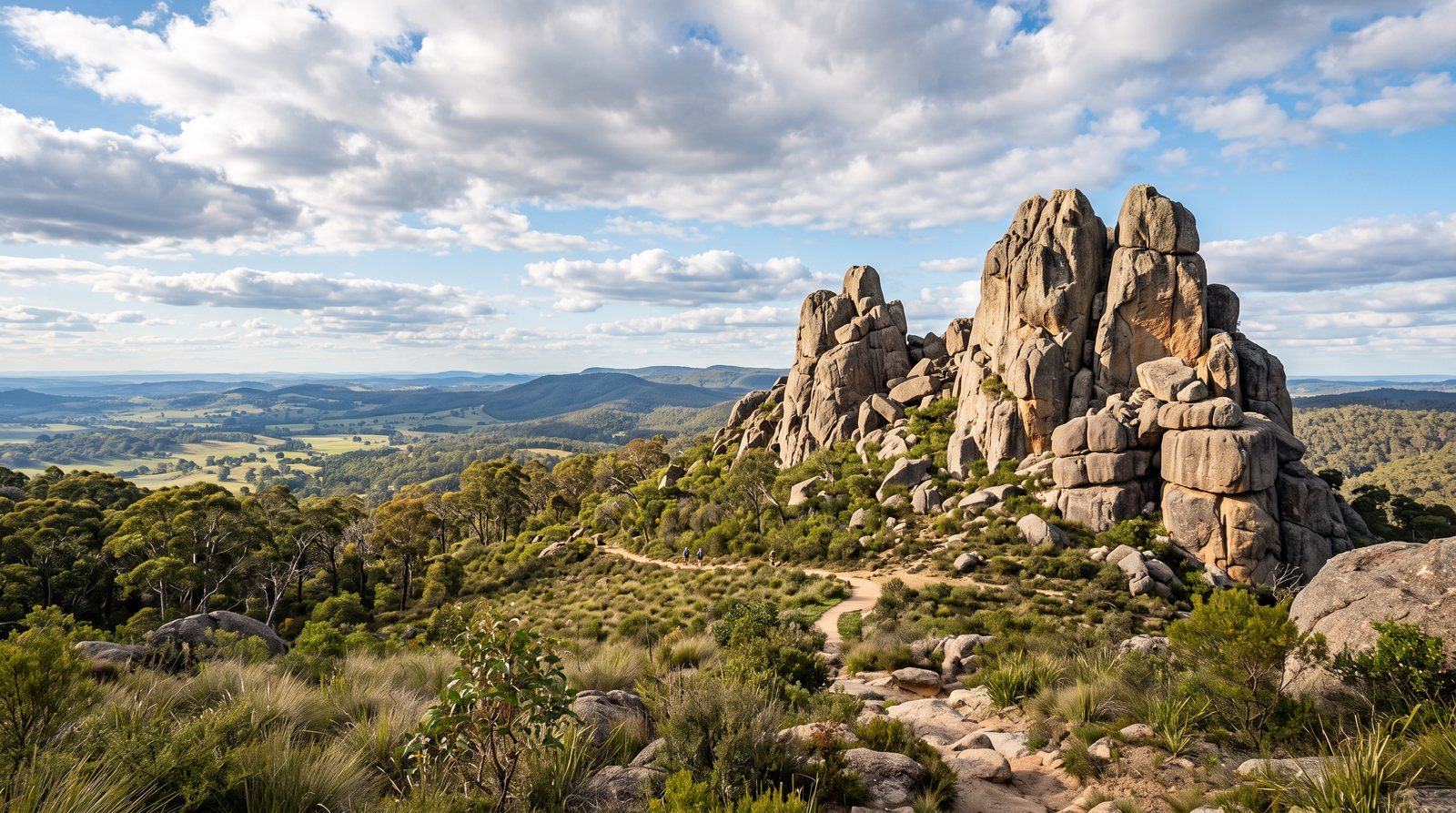
The New England Tablelands of New South Wales represent a high-altitude plateau defined by its elevation and ancient geological time. At the heart of this region lies Cathedral Rock National Park, a sanctuary of rugged beauty that stands as a testament to the enduring nature of granite. Unlike the soft, rolling hills of the interior, this park is characterized by sharp contrasts and formidable stone structures. The air here is thinner and cooler, carrying a crispness that speaks to its sub-alpine positioning. For the traveler, the ascent into this territory is a temporal journey, moving into a space where the rhythm of the earth is measured in millennia. The landscape demands a specific attention, acknowledging the slow work of erosion and the resilience of the life that takes root in this challenging environment.
The granite tors of Cathedral Rock are the result of a complex geological history beginning deep beneath the earth's surface in the distant past. These massive formations were born from the slow cooling of molten magma, which crystallized into the dense granite that now dominates the skyline. Over eons, surrounding softer rocks were stripped away by wind, water, and ice, leaving behind these resilient "islands" of stone. The process of spheroidal weathering has further refined these structures, rounding the edges of the granite blocks and creating the stacked, precarious-looking piles known as tors. This geological narrative is visible in every crevice, offering a physical record of the earth's internal heat and subsequent cooling. To stand among these boulders is to confront the sheer scale of planetary time, where human presence is but a fleeting moment.
The journey to the summit begins in the relative shelter of sub-alpine woodlands, where vegetation is adapted to the harsh winters and nutrient-poor soils. The trail winds through stands of snow gums, their bark peeling in strips of orange and grey, creating a mosaic that mirrors the granite itself. As the path climbs, the forest thins, and massive stone formations appear through the canopy. The transition from shaded woodland to exposed rock is a sensory shift; the sounds of the forest fade, replaced by the whistle of the wind across open stone. This part of the hike requires a change in pace, as steady walking gives way to the deliberate engagement of a rock scramble. The stone is coarse and grippy underfoot, a reliable surface that nonetheless demands respect and careful navigation.
Cathedral Rock and Woolpack Rocks stand as the park’s most significant landmarks, each possessing a distinct character. Cathedral Rock rises with a verticality that evokes grand architecture, its massive blocks stacked in a way that suggests deliberate design. The "cathedral" metaphor is apt not only for its shape but for the quiet reverence it inspires. Nearby, the Woolpack Rocks offer a different silhouette, their name derived from their resemblance to the wool bales of the region's pastoral history. These formations are geological anchors that define the identity of the park. The weathered surfaces of these rocks are home to hardy lichens and mosses, which add subtle splashes of neon green and orange to the grey granite, proving that even in this seemingly barren stone, life finds a way to persist.
The ecosystem surrounding these granite giants is a delicate balance of endurance and opportunistic growth. In crevices between the boulders, small pockets of soil collect, supporting specialized flora such as the rock-felt fern and various species of heath. These plants are remarkably resilient, surviving extreme temperature fluctuations and periods of intense dryness. The sub-alpine environment also provides a habitat for fauna, from agile swamp wallabies that navigate the boulder piles with ease to bird species utilizing the high-altitude thermals. The relationship between the geology and biology of the park is symbiotic; the rocks provide shelter and collect moisture, while the vegetation helps stabilize the thin soils. This interplay creates a landscape that is both ruggedly independent and intricately connected, representing a unique microcosm of survival in the high country.
Reaching the summit of Cathedral Rock is a moment of profound clarity, where physical exertion is rewarded with a 360-degree vista encompassing the vast New England Tablelands. From this vantage point, the scale of the wilderness becomes apparent, with forested ridges and deep valleys stretching toward the distant horizon. The sense of isolation is palpable, yet it is an expansive one, a reminder of the world’s immense scale. The panoramic view allows one to trace the contours of the land, seeing how the granite outcrops punctuate the landscape like the vertebrae of the earth itself. In the clear, high-altitude light, the colors of the tablelands—the deep greens of the eucalypts and the blue-grey of distant ranges—are rendered with startling intensity. It is a place that invites contemplation, where the silence is broken only by the elements.
The human encounter with such ancient landscapes often evokes a sense of wistfulness, a longing for connection to a time before the complexities of modern life. Cathedral Rock, with its prehistoric appearance and silent grandeur, serves as a bridge to that deep past. For generations, these formations have been a source of wonder, first for the Aboriginal people who have a long-standing connection to this land, and later for the travelers who sought to understand its mysteries. There is a specific humility that comes from standing atop a rock that has remained unchanged for millions of years while civilizations have risen and fallen elsewhere. This perspective does not diminish the human experience but contextualizes it, offering a reminder of our role as temporary stewards of a much older world. The park becomes a space for mental exploration.
In an era of rapid change, the preservation of wilderness areas like Cathedral Rock National Park is of paramount importance. These spaces are not merely recreational assets but essential reservoirs of biodiversity and geological history. They provide a necessary counterpoint to the controlled environments of the city, offering a place where the wild and the ancient are still accessible. The challenge of the rock scramble and the reward of the summit view are metaphors for the broader human need to engage with the natural world on its own terms. As we look to the future, the value of these granite tors will only increase, standing as enduring symbols of the earth's resilience. To visit Cathedral Rock is to participate in a tradition of seeking meaning in the landscape, returning with a renewed appreciation for the high country.