National park
Witness the dawn of time from the mist-shrouded peaks of the Great Escarpment
Perched on the Northern Tablelands, this World Heritage wilderness protects ancient Gondwana rainforests. At Point Lookout, sunrise illuminates a vast expanse of forested valleys stretching toward the Pacific, revealing a landscape unchanged for millennia.
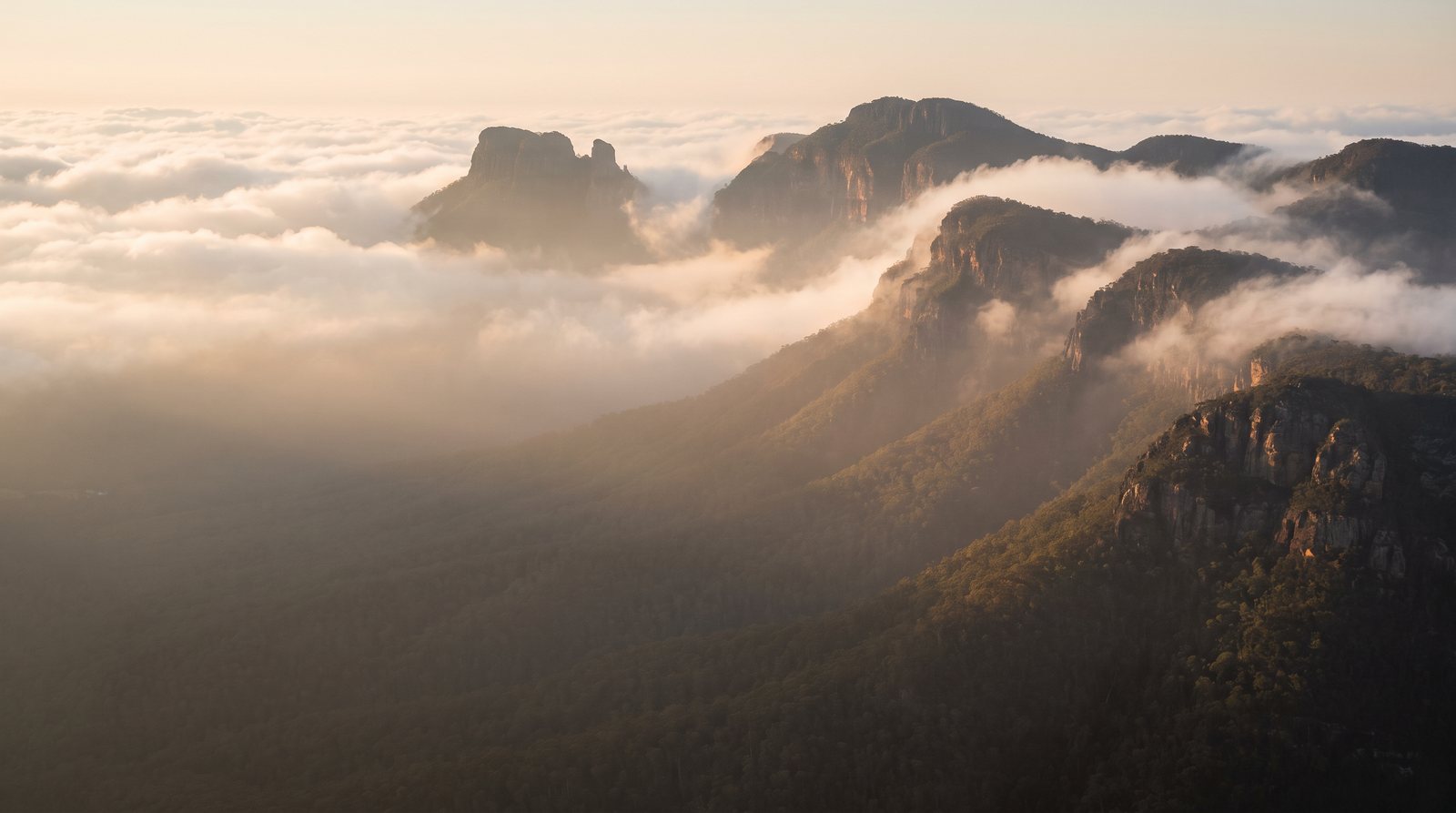
The air at Point Lookout carries a high-altitude clarity that feels detached from the humid coastal plains below. At over 1,500 metres above sea level, the temperature remains crisp even in summer, a reminder that New England National Park is defined by its elevation. Before the sun breaks the horizon, the landscape is a study in deep blues and charcoal greys, with the silhouette of the Great Escarpment forming a jagged boundary between the Northern Tablelands and the vast void of the valleys. The silence is profound, broken only by the rustle of wind through sub-alpine heath or the distant call of a lyrebird. It is a moment of suspended animation, where the modern world feels distant and the ancient character of the Australian continent becomes the primary reality for anyone standing on the precipice.
This dramatic geography is the result of millions of years of geological transformation, where the retreat of the coastline left behind the massive wall of the Great Escarpment. This is not merely a scenic viewpoint but an ecological threshold where the fertile soils of the tablelands drop into the steep ravines of the Bellinger and Macleay River catchments. The scale of the drop at Point Lookout provides a vertical cross-section of natural history, offering a rare opportunity to look down upon the canopy of forests that have remained largely undisturbed since the time of Gondwana. The park’s inclusion in the Gondwana Rainforests of Australia World Heritage area recognizes this continuity, marking it as a sanctuary for species that have survived through epochs of climatic change.
Walking from the cliff’s edge, the landscape transitions into the cool temperate rainforests that are the park’s most celebrated feature. Here, the Antarctic beech trees stand as living monuments to a cooler, wetter era. These trees are often hundreds of years old, their trunks thick with moss and lichen, and their gnarled roots creating a complex architecture on the forest floor. In the misty conditions that frequently shroud the peaks, the beech groves take on a prehistoric quality, with light filtering through a canopy of small leaves that have remained unchanged for tens of millions of years. The presence of these trees is a direct link to the flora that once covered much of the southern hemisphere, providing a tangible connection to a lost world.
The ecosystem is a sophisticated mosaic, where different forest types overlap according to altitude and soil. Below the beech forests, the slopes are covered in warm temperate and subtropical rainforests, where giant stinging trees and red cedars reach toward the light. This vertical diversity supports an extraordinary range of fauna, from the rare Hastings River mouse to the powerful owl and spotted-tailed quoll. The park acts as a vital corridor for wildlife, allowing species to move between the coastal lowlands and the high country in response to seasonal changes. This connectivity is essential for the long-term survival of the region’s biodiversity, making the park a cornerstone of conservation efforts in the New England North West region.
As the sun appears over the Pacific Ocean, the mist in the valleys below begins to glow with a golden light. This moment draws photographers to Point Lookout, as shadows retreat to reveal the complexity of forested ridges and deep gorges. On a clear day, the view extends to the coast, over 70 kilometres away, where the sea meets the morning sky. The transition from darkness to light happens with a quiet intensity, illuminating the textures of basalt cliffs and the soft clouds of vapor clinging to the treetops. It is a visual spectacle that emphasizes the park’s role as a place of witness, where the daily cycle of the sun serves as a reminder of the much longer cycles of geological time.
The cultural significance of this landscape is as deep as its biological roots, with the high country serving as a traditional meeting place for the Dhanggati, Gumbaynggirr, and Anaiwan people. For these traditional owners, the peaks and valleys are woven into a tapestry of stories and seasonal migrations. The rugged terrain provided challenges and resources, and the knowledge of how to navigate and sustain life in this high-altitude wilderness has been passed down for thousands of generations. Acknowledging this connection is central to understanding the park as a lived landscape, where the heritage of the first Australians remains an active presence in the management of the land.
Protecting such a fragile wilderness requires a balance between public access and ecological integrity. The journey to Point Lookout is a testament to this, involving a drive along a steep and narrow gravel road through dense forest. This controlled access helps preserve the sense of isolation that defines the park, discouraging large-scale development that might compromise its World Heritage values. Visitors are encouraged to move through the landscape with restraint, sticking to established tracks and respecting seasonal closures necessary to protect the environment during periods of rain or high fire risk. The NSW National Parks and Wildlife Service plays a crucial role in this stewardship, monitoring the health of the forests and maintaining the infrastructure that allows people to experience the wilderness safely.
The weather is famously unpredictable, with sudden mists and heavy rainfall adding to the park’s dramatic character. These conditions are the lifeblood of the rainforest, providing the moisture and cool temperatures that the Antarctic beech and other ancient species require to thrive. The mist is a defining element of the park’s identity, softening the edges of the landscape and creating a sense of mystery. For those who visit, the experience of being enveloped in a cloud at the edge of the escarpment is a reminder of the power of the natural world to dictate the terms of the encounter, demanding a slower pace and a more attentive way of looking.
In the end, a visit to New England National Park is an exercise in perspective, a chance to step outside the rapid pulse of contemporary life and into a realm where time is measured in centuries. Whether standing at Point Lookout at dawn or walking through the silent, moss-draped beech groves, there is a sense of participating in something larger than oneself. The park serves as a reminder of what has been lost elsewhere and what must be protected here: a fragment of the original wildness of the Australian continent. As the sun rises higher, the ancient forests remain, holding their secrets in the shadows and continuing their slow growth on the edge of the great escarpment.