Cultural Hub
Lismore: a creative regional heart where vibrant street art meets ancient rainforest
Lismore serves as the creative heart of the Northern Rivers, where mural-lined laneways meet ancient Gondwana rainforests. Explore prestigious galleries and volcanic-soil markets before venturing into World Heritage-listed wilderness just beyond the town.
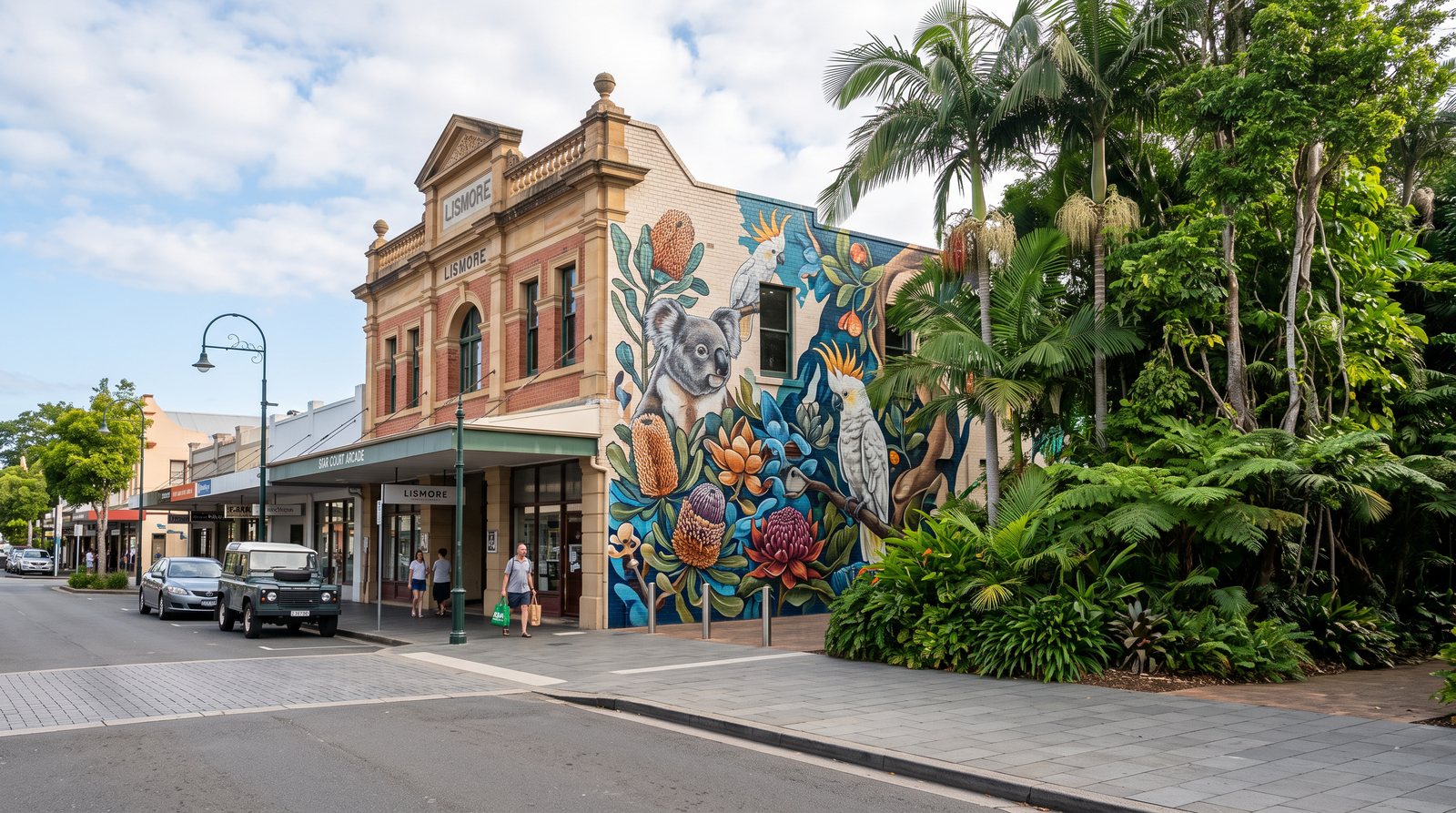
Lismore occupies a distinct position in the Northern Rivers of New South Wales, serving as a creative regional heart where the boundaries between human expression and the ancient natural world are porous. Located on the traditional lands of the Bundjalung people, the town is built upon the fertile remnants of a massive volcanic past, a legacy that informs both its lush surroundings and its vibrant, resilient community. It is a place where the humidity of the subtropics seems to thicken the air of its galleries and laneways, creating an atmosphere that encourages a slower, more deliberate form of observation. Unlike the coastal hubs that define much of the region’s tourism, Lismore offers a more interior, reflective experience—one that prioritizes the depth of its cultural archives and the complexity of its surrounding ecosystems over the immediate spectacle of the surf.
The city’s architectural identity is perhaps most vividly expressed in its laneways, where the Back Alley Gallery has transformed functional service corridors into a sprawling, open-air museum. Here, the concrete and brickwork of the CBD become a vibrant stage for street art that ranges from intricate, large-scale murals to smaller, more intimate interventions. These works do not merely decorate the town; they function as a living record of its creative energy and social preoccupations. The interplay between the colorful pigments and the soft, filtered morning light of the Northern Rivers gives these murals a shifting quality, as if the art itself is responding to the changing humidity and temperature of the day. For the visitor, walking through these spaces offers a candid encounter with the town’s pulse, revealing a community that values public expression as a fundamental part of its civic life.
Beyond the streetscapes, Lismore’s prestigious galleries and eclectic studios provide a more formal structure for the region’s artistic output. The town has long acted as a magnet for creators, drawn by a combination of affordable space, a supportive community, and the undeniable influence of the surrounding landscape. The local arts scene is characterized by a lack of pretension, favoring instead a rigorous exploration of material, place, and identity. Whether through contemporary painting, sculpture, or experimental media, the work produced here often reflects the tension between the region’s alternative history and its traditional country roots. This cultural density makes Lismore a vital node in the Northern Rivers’ creative network, a place where ideas are tested and shared in a setting that feels both secluded and connected to the wider world.
The vibrancy of Lismore’s human culture is inextricably linked to the extraordinary fertility of its soil, a direct result of the Tweed Shield Volcano that dominated the landscape millions of years ago. This volcanic legacy is visible in the deep, red earth that supports the region’s agriculture and its dense pockets of rainforest. The soil is not just a medium for growth but a historical archive, containing the minerals and nutrients that have sustained life here for eons. In the local markets, this geological history becomes edible, manifesting in a bounty of fresh produce that is celebrated for its flavor and nutritional density. For the resident and the visitor alike, the act of purchasing a crate of macadamias or a bunch of tropical greens is a way of participating in a much older cycle of renewal.
Just beyond the leafy, riverside borders of the town, the landscape transitions into the profound quiet of the Gondwana rainforests. These World Heritage-listed national parks, including Nightcap and Border Ranges, represent some of the oldest and most diverse ecosystems on the planet. To walk beneath their canopy is to experience a different sense of time, one measured in centuries rather than seasons. The air here is cooler, scented with damp earth and decaying leaves, and the soundscape is dominated by the calls of birds that have inhabited these forests for generations. These parks are not merely scenic backdrops but vital refuges for biodiversity, protecting species that have survived since the time of the supercontinent Gondwana. The proximity of such a significant wilderness to the creative heart of Lismore creates a unique dynamic of deep history.
Water is the defining element of the Lismore landscape, from the winding course of the Wilsons River to the dramatic waterfalls that spill from the surrounding plateaus. Minyon Falls and Protestors Falls are iconic landmarks, their sheer drops providing a powerful visual representation of the region’s topography. These cascades are the result of millions of years of erosion, as water has carved its way through the volcanic rock to reach the valleys below. The rivers and creeks provide a sense of continuity, connecting the high rainforests to the agricultural plains and the town itself. However, water is also a reminder of the environment’s power and unpredictability, a force that has shaped Lismore’s history and continues to influence its resilience. The riverside parks offer a space for reflection, where the steady flow of the water provides a calming counterpoint to the busy CBD.
The Lismore markets are perhaps the most authentic expression of the town’s country warmth and its commitment to sustainable living. Held regularly in the leafy outskirts or the town center, these gatherings are more than just commercial events; they are essential social circuits. Here, the eclectic mix of people that defines the Northern Rivers comes together—farmers, artists, students, and retirees—all united by a shared appreciation for local craft and produce. The markets offer a sensory experience that is uniquely Lismore: the smell of wood-fired bread, the sight of vibrant textiles, and the sound of local musicians providing a low-frequency soundtrack to the morning. It is a space where expertise is shared freely, whether it’s a tip on growing citrus in volcanic soil or a discussion on a new exhibition, reinforcing the idea that a community is built one encounter at a time.