Coastal town
An aquatic playground where clear lake waters meet the Pacific Ocean surf
Nestled on a narrow spit between the turquoise expanse of Wallis Lake and the Pacific Ocean, Forster offers a quintessential coastal escape defined by its clear waterways, historic oyster farms, and the dramatic vistas of Cape Hawke.
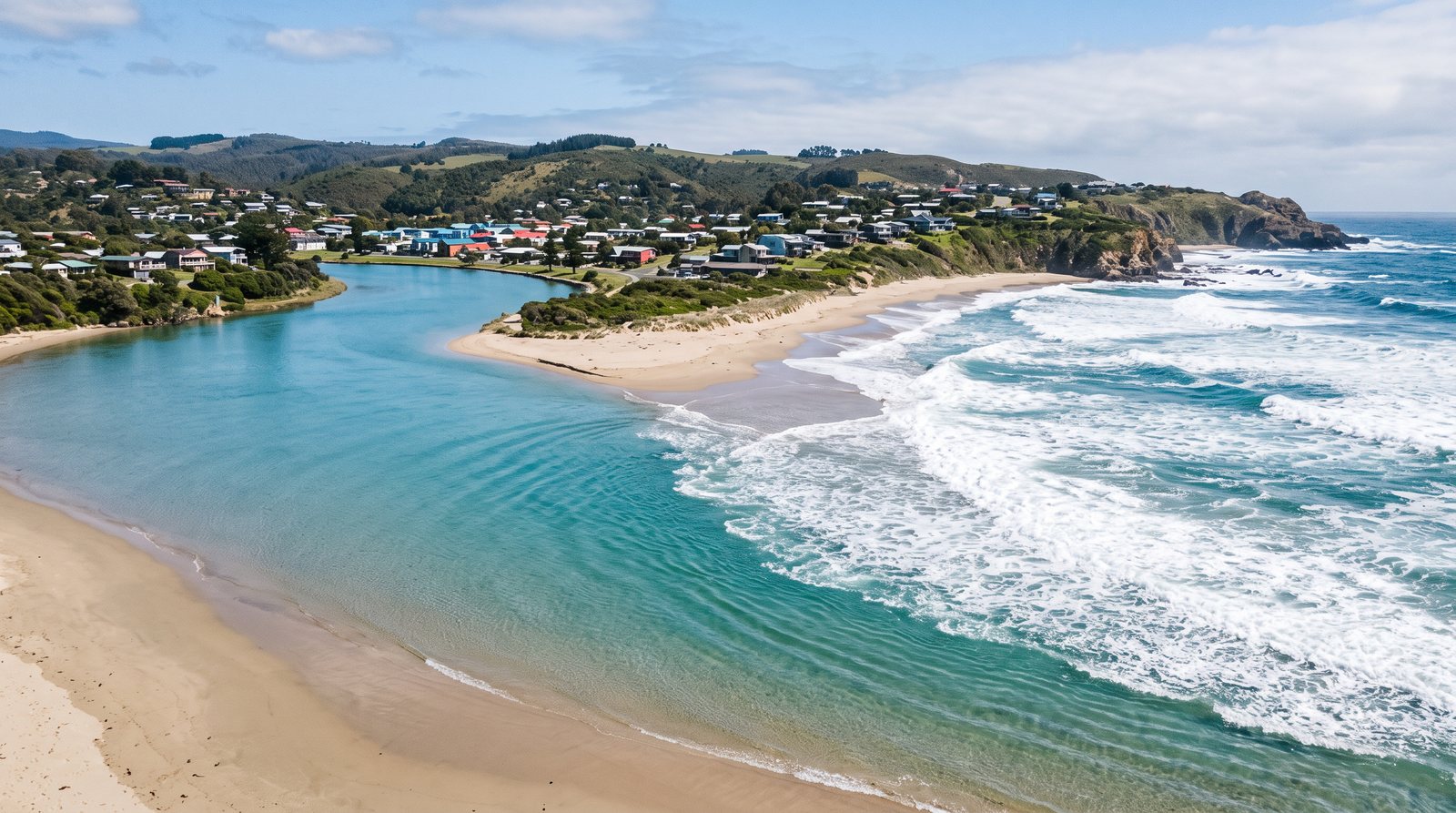
Forster sits at a beautiful intersection of water and land, defined by a narrow spit of earth that separates the turbulent Pacific Ocean from the expansive tranquility of Wallis Lake. To arrive in Forster is to enter a world where the horizon is constantly shifting between the deep indigo of the open sea and the pale, crystalline blues of the lake’s shallow sandbars. The town serves as the southern anchor of the Barrington Coast, a region where the Great Dividing Range begins its slow descent toward the sea, leaving behind a legacy of dramatic headlands and intricate waterways that have shaped the lives of those who live here for generations.
At the center of this identity is Wallis Lake, a massive 99-square-kilometer waterway that functions as the town’s beating heart. The lake is renowned for its exceptional water quality, a result of the complex tidal exchange that flushes the system twice daily through the narrow entrance at the bridge. This clarity allows sunlight to reach the sandy floor, creating the characteristic aqua-blue hues that give the region its "aquatic playground" reputation. Beneath the surface, the lake is a nursery for marine life, producing a staggering eighty percent of New South Wales’ commercial crab catch. For the visitor, the lake offers a sense of safety and stillness that contrasts sharply with the nearby ocean, providing hidden coves and white-sand islands that are best explored by small boat or kayak, where the only sound is the rhythmic lap of water against the hull.
The purity of Wallis Lake is best represented by its most famous export: the Sydney rock oyster. Oyster farming in these waters is a tradition that dates back to the turn of the twentieth century, evolving from simple harvesting to a sophisticated and sustainable industry. Families like the Barclays have been tending these submerged leases for over a hundred years, passing down the specialized knowledge required to nurture an oyster from a tiny spat to a mature, briny delicacy. The industry is a testament to the patient observation of nature; farmers must account for salinity levels, water temperature, and the subtle shifts in the lake’s currents. The resulting harvest carries a sharp, clean minerality that has made Wallis Lake oysters a benchmark for quality across the state.
Turning away from the lake, the Pacific Ocean asserts its presence through a string of world-class beaches that line the town’s eastern edge. Forster Main Beach is the quintessential Australian surf destination, where the rolling swell of the Pacific meets a long, golden arc of sand patrolled by surf lifesavers. At the southern end, a tidal ocean pool offers a sheltered place to swim, carved into the rocks where the waves crash against the sandstone. Further south, One Mile Beach is defined by its massive sand dunes, which provide a dramatic backdrop for surfers and a natural playground for families. The proximity of the wild energy of the surf to the controlled, glassy surface of the lake offers a dual experience of the coast that few other towns can match.
To truly understand the scale of this landscape, one must ascend to the Cape Hawke Lookout within Booti Booti National Park. The journey to the summit involves a 500-meter hike that climbs 224 meters above sea level, passing through a rare and regenerating littoral rainforest. This forest is a dense canopy of salt-tolerant species that provides a cool, shadowed contrast to the bright exposure of the coast. The trail includes nearly four hundred steps, a physical demand that heightens the sense of arrival at the viewing tower. From the top, the view is a 360-degree revelation: to the north, the twin towns of Forster and Tuncurry are laid out like a map; to the west, the intricate maze of Wallis Lake stretches toward the mountains; and to the east, the infinite blue of the Pacific Ocean meets the sky.
Forster is inextricably linked to its twin town, Tuncurry, by a long concrete bridge that spans the lake’s entrance. While Forster is the bustling commercial hub, Tuncurry retains a more relaxed, fishing-village atmosphere. The bridge itself is a vital piece of infrastructure and a popular walking route, offering pedestrians a bird’s-eye view of the sandbars and the clear water below. Today, the connection is seamless, yet the two sides maintain distinct personalities. Tuncurry’s Nine Mile Beach offers a more rugged and less crowded alternative to Forster’s main stretches, while its rock pool and breakwall provide some of the best land-based fishing spots in the region. Together, the two towns form a unified community that revolves around the shared stewardship of the waterway that both joins and divides them.
The life of the town is dictated by the seasons and the migrations of the animals that share its waters. During the winter and spring months, the headlands of Forster become prime vantage points for whale watching, as humpback whales pass close to the shore on their annual journey along the coast. In the lake, the seasons are marked by the arrival of different fish species and the changing activity of the waterbirds that congregate on the sand islands. Pelicans, cormorants, and sea eagles are constant residents, their presence a sign of the ecosystem’s health. For the human residents and visitors, the rhythm is one of slow travel and outdoor life—a culture that values the early morning surf, the midday boat trip, and the evening walk along the breakwall as the sun sets over the lake.
In the end, Forster is defined by its refusal to choose between the lake and the sea, instead finding a unique identity in the narrow space between them. It is a town that honors its industrial roots in oyster farming while embracing its role as a sanctuary for those seeking a connection to the water. The "wistful" landscape reflects life at the edge, where land is constantly being reshaped by the elements and where the horizon is always present. Whether viewed from the heights of Cape Hawke or the deck of a boat in the middle of Wallis Lake, Forster offers a profound reminder of the beauty that emerges when human settlement respects the scale and power of the natural world. It remains an aquatic playground in the truest sense: a place of play, of work, and of deep, restorative quietude that rewards a considered visit.