National park
A sanctuary of coastal lakes, ancient dunes, and the state's tallest trees
Myall Lakes National Park preserves one of the state's largest coastal lake systems alongside forty kilometers of pristine beaches. From the towering seventy-six-meter Grandis gum tree to the historic Sugarloaf Point Lighthouse, the park offers a profound connection to the wild North Coast.
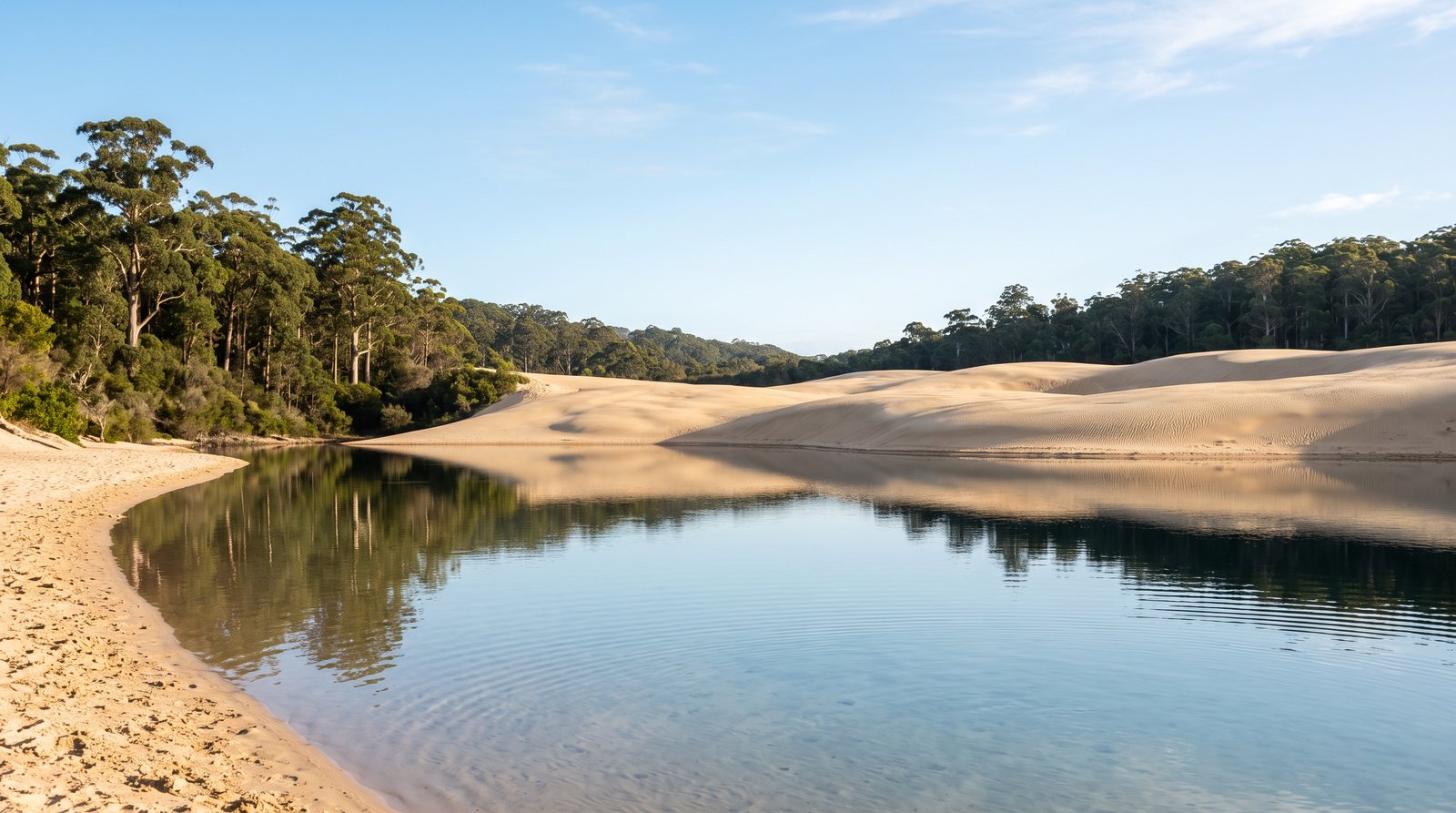
The Myall Lakes National Park stands as a significant coastal wilderness in New South Wales, representing a complex intersection of aquatic and terrestrial ecosystems. Stretching across the North Coast, this sanctuary is defined by one of the largest brackish water systems in the state, where three distinct lakes—Myall, Boolambayte, and the Bombah Broadwater—are linked by narrow channels. This interconnected network creates a unique hydrological environment that shifts between the influence of the Pacific Ocean and freshwater runoff from the hinterland. Navigating these mirror-like waters, particularly in the early morning, reveals a world governed by the rhythm of the tides. The shoreline is often fringed by thick stands of paperbark and swamp mahogany, their silver trunks reflecting in the still water of Boolambayte Lake.
Contrasting with the sheltered tranquility of the lakes is the park’s formidable coastal fringe, a forty-kilometer stretch of pristine sand that faces the full force of the Pacific. This eastern boundary is dominated by the Mungo Brush area, where some of the tallest and most extensive sand dunes in New South Wales rise like pale mountains against the blue horizon. These dunes are dynamic, wind-sculpted landforms that have migrated across the landscape over millennia, occasionally swallowing stands of forest in their slow progress. Walking along the crest of these dunes offers a panoramic view of the park’s diversity, with the crashing surf on one side and the dark, forested basins of the lakes on the other. The vegetation here is hardy, ranging from low-lying spinifex to resilient banksia and wattle scrubs.
Deep within the hinterland, the environment shifts again into the damp, cathedral-like atmosphere of the Grandis picnic area. Here stands the Grandis, a flooded gum of such immense proportions that it has become a living monument to the region’s botanical heritage. Reaching a height of seventy-six meters, it is recognized as the tallest tree in New South Wales, its smooth, pale trunk rising straight toward a canopy that seems to touch the sky. To stand at its base is to experience a shift in perspective, as the surrounding forest seems to shrink in the presence of this ancient giant. The Grandis is surrounded by a lush pocket of rainforest, where cabbage tree palms and climbing vines thrive in the filtered light, providing a glimpse into a prehistoric landscape where the scale of life was far greater.
The park’s northern reaches are anchored by the historic Sugarloaf Point Lighthouse, a sentinel that has watched over the treacherous waters of Seal Rocks since 1875. Perched on a dramatic headland, the lighthouse remains an active aid to navigation, its white tower standing in sharp contrast to the dark, jagged rocks and the churning turquoise water below. The precinct around the lighthouse offers one of the best vantage points on the North Coast for observing the annual migration of humpback whales, as they pass close to the shore. The architecture of the lighthouse and the nearby keepers’ cottages reflects a period of colonial maritime history when such outposts were the only link between isolated coastal communities and the wider world. Today, the heritage-listed site provides a cultural anchor for the park, blending human history with the raw power of the ocean.
Biodiversity is the silent engine that drives the Myall Lakes ecosystem, manifesting in a vast array of species that occupy every niche from the lake floors to the forest canopies. The park is a stronghold for the black swan, whose graceful silhouettes are a common sight on the open waters of Myall Lake, particularly during the molting season. The diversity of habitats—ranging from heathlands and dry sclerophyll forests to wet rainforests and saltmarshes—ensures that the park supports a wide range of fauna, including eastern grey kangaroos, swamp wallabies, and an extraordinary variety of honeyeaters. This biological richness is a direct result of the park’s size and its relative isolation, which have allowed natural processes to continue with minimal interference. For researchers, the Myall Lakes represent a living laboratory where the interactions between different environmental zones can be studied.
The human history of the Myall Lakes is as layered as its geology, beginning with the Worimi people, the traditional custodians who have maintained a deep connection to this land for thousands of years. Evidence of their presence is found throughout the park in the form of shell middens and scarred trees, marking a long history of sustainable resource use. In more recent centuries, the area saw the rise of timber harvesting and sand mining, industries that shaped the local economy but also posed significant threats to the environment. The transition from an industrial landscape to a national park was a hard-won victory for conservationists, who recognized that the unique qualities of the lake system were too valuable to be lost. This legacy of protection is now managed by the National Parks and Wildlife Service, ensuring that the cultural and natural values of the region are preserved.
For the modern visitor, the Myall Lakes National Park offers a range of experiences that prioritize a direct connection with the environment. Camping at sites like Mungo Brush or White Tree Bay allows for an immersion in the park’s nocturnal rhythms, where the sound of the ocean provides a constant backdrop to the calls of night-birds. The park’s infrastructure is designed to be unobtrusive, with walking trails and picnic areas that encourage exploration without dominating the landscape. Whether it is the challenge of a multi-day kayak expedition or a simple afternoon spent fishing in the Broadwater, the activities here are defined by a sense of space and autonomy. There are no large-scale resorts within the park boundaries; instead, there is the luxury of distance and the opportunity to experience a coastline that still feels wild and expansive.
As the sun sets over the Myall Lakes, the water turns to liquid gold and the silhouettes of the paperbarks sharpen against the fading light. This daily transformation serves as a final reminder of why such places are essential in a rapidly developing world. The park is more than just a collection of lakes and trees; it is a sanctuary for the quiet processes of nature and a refuge for the human spirit. In the height of the Grandis, the sweep of the Mungo Brush dunes, and the steady beam of the Sugarloaf Point Lighthouse, one finds a sense of permanence that is increasingly rare. Myall Lakes National Park remains a testament to the beauty of the New South Wales coast, a place where the elements of water, earth, and air converge to create a landscape of enduring wonder and profound peace.