Historic town
Explore art deco architecture and wetland sanctuaries in the Riverina agricultural heartland
From the geometric precision of Walter Burley Griffin’s urban plan to the neon glow of the Roxy Theatre, Leeton offers a sophisticated intersection of Art Deco heritage and Ramsar-listed wetlands within the fertile heart of the Riverina agricultural bowl.
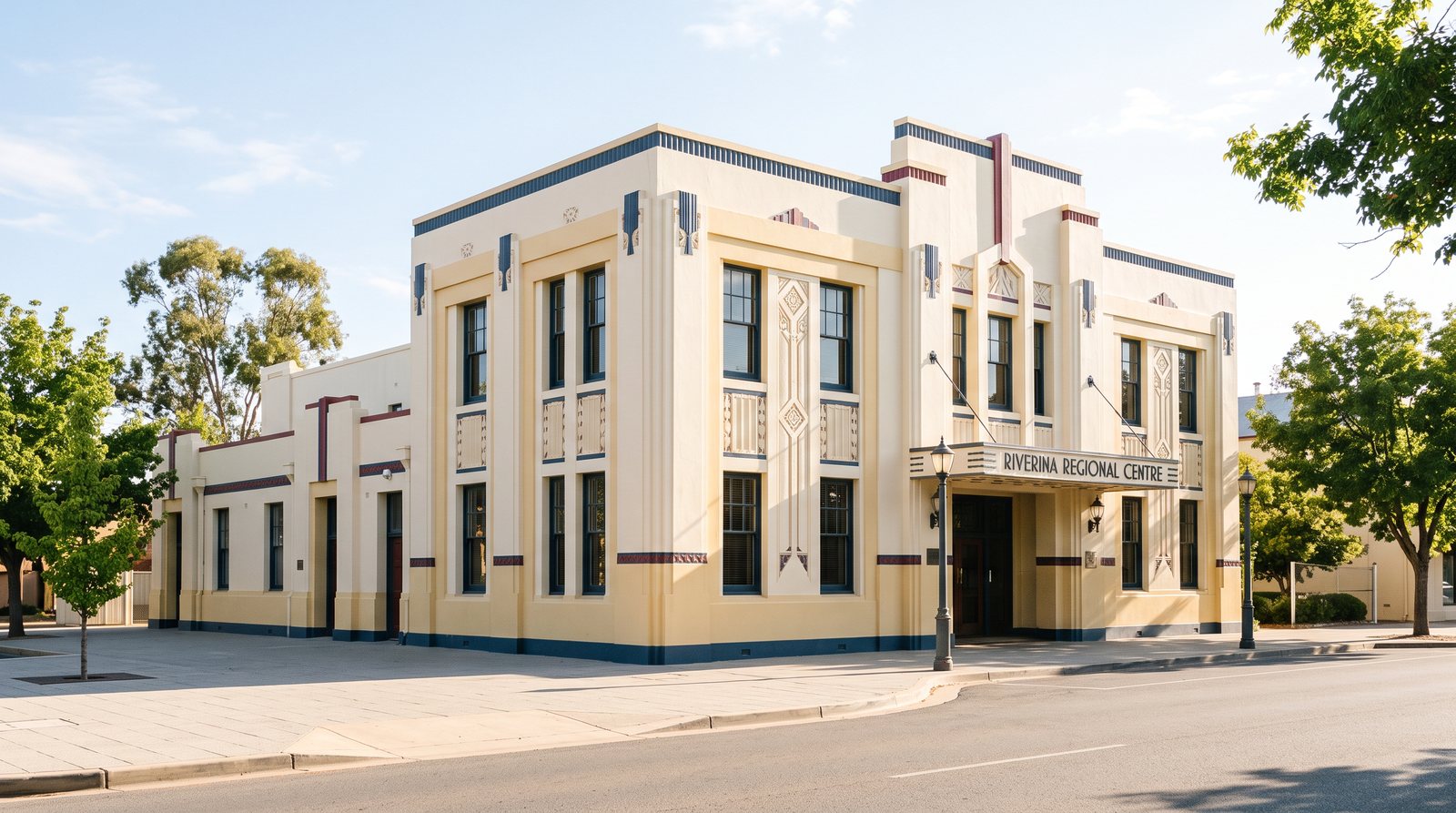
Leeton, in the Riverina of New South Wales, is a deliberate intersection of visionary urban planning and raw productivity. Unlike organic railway towns, Leeton was a "masterpiece" design by Walter Burley Griffin and Marion Mahony Griffin. They brought Prairie School sensibilities to the region, envisioning a community where circular street patterns and wide avenues harmonized with agricultural abundance. This design created a sophisticated rural escape, where street geometry mirrored the precision of the irrigation channels that enabled the town’s existence. Today, that legacy remains visible in the unique layout, offering a sense of order and elegance that distinguishes it from the vast expanses of the New South Wales interior.
Leeton’s architectural identity is defined by its collection of Art Deco buildings, which flourished during the interwar years. The town centre is a living museum of Jazz Age design, with over 45 buildings showcasing geometric patterns and bold lines. This concentration of heritage reflects the town’s prosperity during the 1930s, as the Murrumbidgee Irrigation Scheme reached its full potential. The transition from the Griffins’ Prairie School influence to the streamlined Art Deco style occurred seamlessly, creating a townscape that feels both historic and forward-looking. The preservation of these facades is a point of immense local pride, serving as a vital link to a period when rural communities led architectural innovation.
At the heart of this landscape stands the Roxy Theatre, a cultural anchor since 1930. The Roxy is a masterpiece of Art Deco design, its striking facade becoming a beacon of light as the sun sets over the Riverina. The interior has been carefully restored to maintain the atmosphere of cinema’s golden age, complete with its original stage and decorative flourishes. The theatre’s endurance is a testament to the community’s commitment to its heritage, serving as a venue for film, live performances, and gatherings. For visitors, the Roxy offers a tangible connection to the social history of the region. The theatre ensures the town’s artistic spirit remains as vibrant as its agricultural industry, providing a sophisticated venue that rivals those found in larger metropolitan centers.
Beyond the Roxy, Leeton’s identity is linked to the Murrumbidgee Irrigation Scheme, a significant engineering feat. This network of channels transformed a semi-arid landscape into one of the nation’s most productive agricultural regions, known as the "food bowl" of Australia. The scheme brought water from the Snowy Mountains to the Riverina, enabling cultivation that was otherwise impossible. In Leeton, this legacy is visible in the citrus orchards and rice fields surrounding the town. The air is often thick with the scent of orange blossoms, a reminder of the town’s status as a major producer of oranges and lemons. The citrus industry is a way of life, with generations of farming families tending to the trees that have become a defining feature of the local landscape.
The importance of rice to Leeton is equally significant, as the town serves as the headquarters for SunRice. The introduction of rice cultivation in the 1920s was a turning point, providing a high-yield crop that thrived in irrigated conditions. The flat expanses of the Leeton countryside are ideally suited to rice paddies, which create a shimmering, reflective landscape during the growing season. This industry has shaped the town’s social fabric, leading to the establishment of the biennial SunRice Festival, a celebration of the harvest that brings the community together. The scale of the industry is a reminder of Leeton’s global reach, with local produce exported worldwide. Despite this international connection, the industry remains deeply rooted in the local community, with the rhythms of the harvest dictating the pace of life.
In recent decades, Leeton has also become a significant site for environmental conservation through the protection of the Fivebough and Tuckerbil Wetlands. These Ramsar-listed sites are of international importance, providing a vital habitat for migratory and resident bird species. The transition from agricultural land to a protected sanctuary represents a sophisticated understanding of the need to balance human productivity with ecological preservation. Fivebough Wetlands, near the town centre, is home to over 170 bird species, including the rare Australasian Bittern. The wetlands offer a different kind of rural escape, defined by the quiet observation of nature and the changing seasons. For birdwatchers, the site is a sanctuary of global significance, where the sounds of avian inhabitants replace the hum of machinery, reminding us that even in productive regions, there is space for the wild.
The experience of visiting Leeton is one of constant discovery, where the sophisticated lines of a Griffin design give way to the natural beauty of a wetland sanctuary, and the industrial scale of a rice mill is balanced by the delicate scent of a citrus grove. It is a town that rewards the attentive traveler, offering a depth of history and culture that is both surprising and satisfying. The town holds these disparate elements together—the planned and the wild, the historic and the modern, the industrial and the ecological. It is a place that understands its past but is not confined by it, using its heritage as a foundation for a sustainable future. Whether exploring the Roxy Theatre or watching the sun set over the Fivebough Wetlands, there is a sense of being in a place that has been carefully considered and deeply loved.
In conclusion, Leeton remains a destination that defies simple categorization, where the elegance of the past meets the productivity of the present. The legacy of Walter Burley Griffin and the appeal of Art Deco architecture provide a framework for a community that is as culturally rich as it is agriculturally fertile. The Ramsar-listed wetlands offer a sanctuary for the spirit, while the citrus and rice industries provide the foundation for a resilient economy. In this corner of the Riverina, the character of the Australian experience is written in the lines of the street, the scent of the blossom, and the flight of the bird, creating a narrative that is as complex as it is beautiful. For those seeking a deeper connection to the land, Leeton offers a journey that is both sophisticated and grounded, a reminder that the most memorable places are those where design and community are in perfect harmony.