Historic town
Heritage architecture and pioneer legends meet in the heart of the Riverina
Gundagai remains a site where pioneer folklore and colonial architecture intersect with the deep history of the Wiradjuri people. From the Prince Alfred Bridge to the Old Gaol, the town offers a precise study in how a landscape holds its stories.
Gundagai sits at a strategic bend in the Murrumbidgee River, a location that served as a crossing point for centuries before colonial surveyors arrived. In the heart of the Riverina, the town is often introduced through its folklore, yet its physical presence is defined by a grounded reality of stone, timber, and floodplains. The approach is dominated by the rolling slopes of the surrounding hills, which transition into the fertile expanses that have long supported the region’s agricultural identity. To arrive here is to enter a landscape where the scale of the sky matches the depth of the history embedded in the soil. It is a place where the architecture does not merely sit upon the land but seems to have grown from the specific requirements of surviving in a territory defined by the unpredictable rhythms of the river.
The Murrumbidgee River is the central protagonist in Gundagai’s history, providing both lifeblood and a recurring challenge. The historic Prince Alfred Bridge stands as a monumental testament to this relationship, its timber viaduct stretching across the floodplains like the skeletal remains of Victorian ambition. Completed in the late nineteenth century, it was one of the longest structures of its kind, designed to keep vital trade routes open even when the river broke its banks. Walking along these remnants today, one can feel the vibration of the past in the weathered wood and iron bolts. The engineering was a direct response to devastating floods that had previously swept through the original town site, a reminder that in this part of the Riverina, the natural world dictates the terms of human settlement.
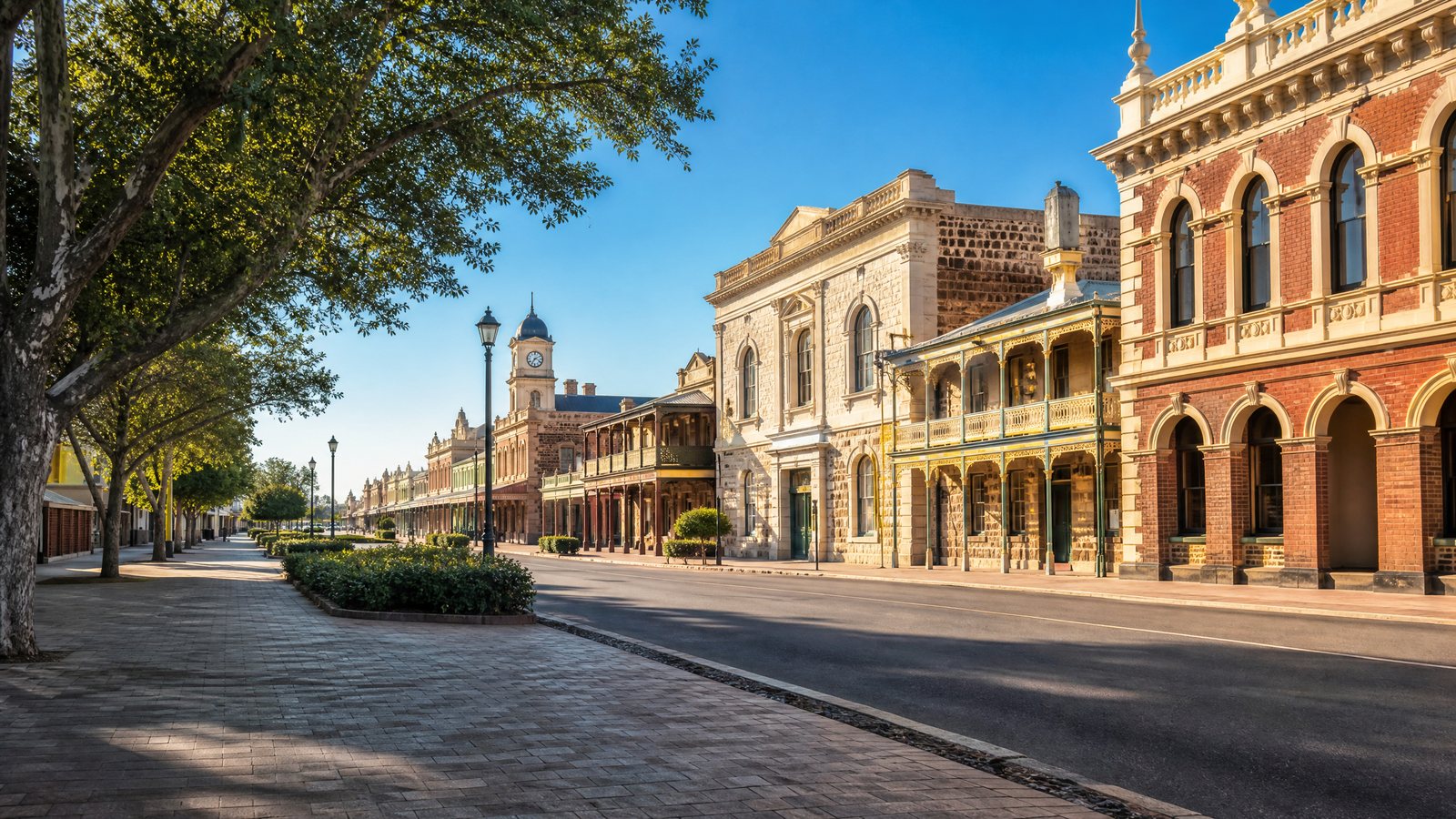
Moving into the town center, the heritage-listed main street offers a remarkably preserved vista of colonial development. Sheridan Street is lined with buildings reflecting the confidence of a town that was once a major hub for the Cobb & Co stagecoach circuit. The architecture here is not the grand style of capital cities, but a functional, sturdy variety of brick and corrugated iron that has weathered the decades with dignity. Each storefront and balcony tells a story of commerce and community, from the old post office to the traditional pubs that have served as social anchors for generations. There is a sense of continuity here, maintaining a living connection to the pioneers who first laid these foundations without the town becoming a mere museum piece.
The Old Gundagai Gaol provides a starker perspective, standing as a site of confinement and colonial justice. Built from local stone, the structure’s thick walls and narrow cells offer a chilling insight into mid-nineteenth-century conditions. It is a place where the silence is heavy with the weight of the stories it contains, from the bushrangers held within its gates to the wardens who kept watch over the frontier. The gaol is not just a building; it is a physical record of the tensions that defined the early years of the Riverina, where expansion often clashed with the realities of law and order. Today, the site allows visitors to contemplate the complexities of the past, acknowledging the harshness of the era while appreciating the preservation of such a significant historical landmark.
However, the history of Gundagai extends far deeper than the colonial era, rooted in the enduring presence of the Wiradjuri people. For the traditional custodians, this land has always been a place of significance, a part of a vast network of songlines and seasonal movements that predates European arrival by millennia. The river, hills, and plains are all imbued with Wiradjuri stories and knowledge, which continue to be shared and celebrated by the local community today. Recognizing this connection is essential to understanding the full character of the town. It is not just a pioneer settlement; it is a Wiradjuri place, where the modern town sits atop layers of indigenous history that are increasingly being brought to the forefront through art, storytelling, and cultural preservation.
Folklore has a powerful hold on the Australian imagination, and Gundagai is perhaps best known through the legend of the Dog on the Tuckerbox. Located just outside the town, the monument commemorates the loyalty of a pioneer’s dog and has become shorthand for the resilience that defined the early days of European settlement. While the poem and statue have attained mythic status, the reality behind the legend is one of hard work and the practical bonds formed between people and animals in the bush. The monument serves as a gateway to the town, a familiar landmark that invites travelers to consider the broader narrative of the Riverina. It is a reminder that stories, whether based in fact or embellished over time, are the threads that bind a community to its heritage.
Beyond the historic structures and legends, the landscape surrounding Gundagai continues to be a productive part of the Riverina. The rolling hills are home to boutique wineries that have begun to draw international attention, particularly for their cool-climate shiraz. These vineyards represent a new chapter, one that blends traditional agricultural practices with a modern appreciation for the local terroir. To sit on a hillside overlooking the valley with a glass of local wine is to experience the contemporary spirit of the region—a place that values its roots but is not afraid to innovate. The panoramic views from these vantage points reveal a patchwork of grazing land and vineyards, illustrating the ongoing vitality of a landscape that has supported human endeavor for so long.
In conclusion, Gundagai is a place where different strands of Australian history are woven into a complex tapestry. It is a town defined by its architecture, its legends, and its landscape, but most importantly by the way these elements interact. From the timber spans of the Prince Alfred Bridge to the stone walls of the Old Gaol, and from ancient Wiradjuri paths to modern vineyards, every corner of the town offers a new perspective on the Riverina. To visit Gundagai is to engage with a story that is still being written, a narrative that respects the past while looking forward to the future. It remains a vital heart of the region, a place where the pioneer spirit and indigenous heritage meet under the vast, open skies of the New South Wales interior.