Caves
Subterranean limestone wonders and thermal springs in the northern Snowy Mountains
Deep within the northern Snowy Mountains, Yarrangobilly Caves reveals a 440-million-year-old limestone archive. From subterranean limestone wonders to the constant warmth of a natural thermal spring, the landscape offers a profound encounter with deep time.
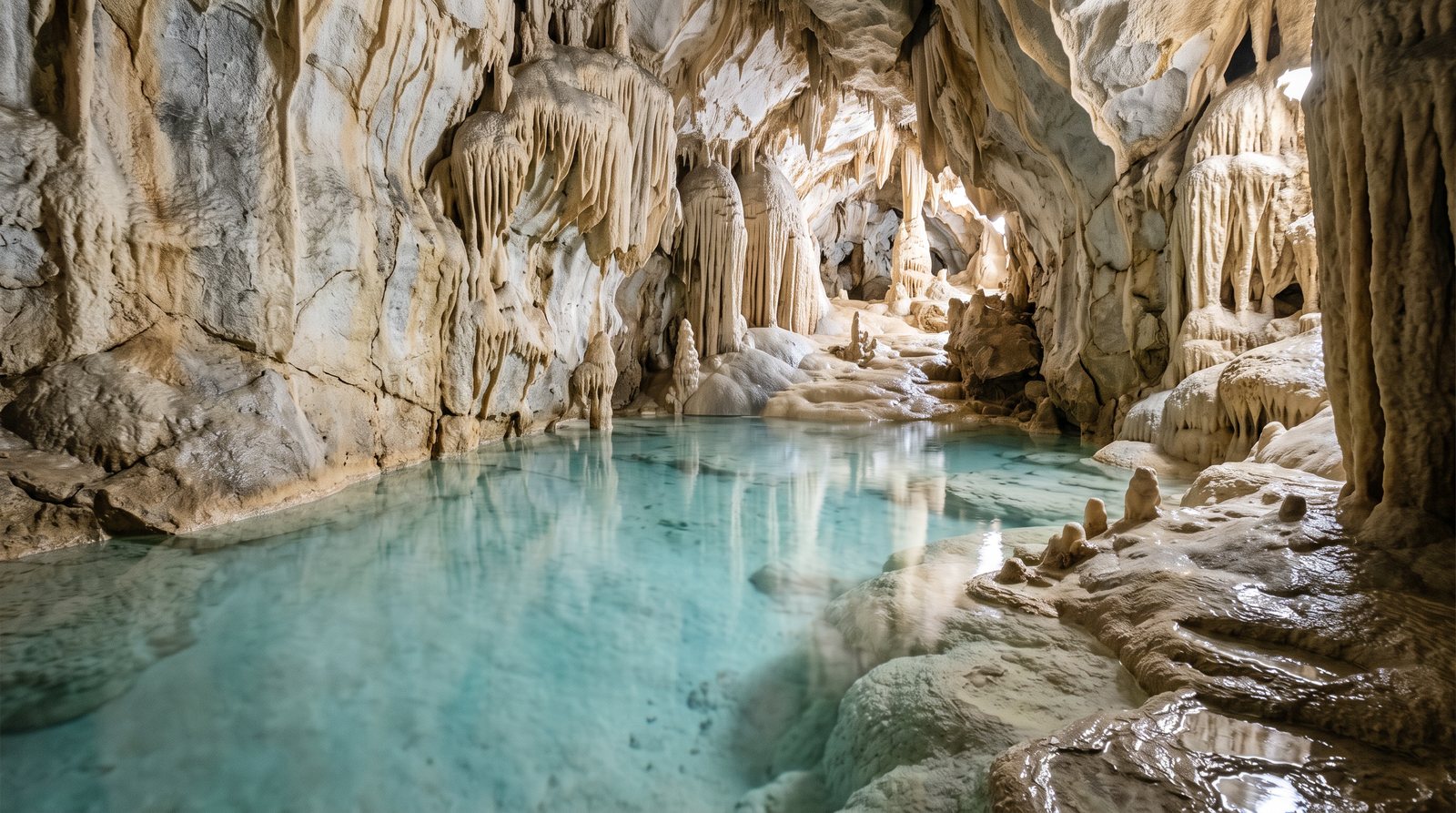
The northern Snowy Mountains are often defined by their alpine peaks, yet at Yarrangobilly, the most profound encounter with the landscape is found by looking downward into a subterranean archive millions of years in the making. This karst system, carved into a belt of limestone dating back 440 million years to the Silurian period, serves as a physical record of the slow work of water. Here, geography is a living instrument of geological time, where every stalactite and flowstone represents a precise mark of environmental history. To enter the Yarrangobilly Caves is to step away from the immediate concerns of the surface and into a space where time is measured in the steady drip of mineral-rich water rather than the ticking of a clock.
The geological foundation of this region is a testament to the enduring power of chemical processes acting over vast durations. The limestone was formed from the remains of ancient marine organisms when this part of the continent was submerged beneath a shallow sea. Over hundreds of millions of years, tectonic forces lifted these deposits, and the subsequent action of acidic rainwater began the long process of dissolution. This is the essence of karst formation: a choreography of erosion and deposition that creates cavernous voids beneath the earth. The Yarrangobilly system is notable for its complexity, featuring a series of chambers that reveal the scale of this transformation. Witnessing the ongoing dialogue between rock and water, visitors can see how the landscape continues to evolve through the patient accumulation of mineral deposits.
Within this subterranean network, six show caves are open to the public, each offering a distinct perspective on the art of geological formation. The Jillabenan Cave, though the smallest, is often regarded as the most beautiful due to the density and delicacy of its formations. It is also recognized as the oldest discovered show cave in the system, adding historical weight to its intimate chambers. In contrast, the Glory Hole Cave provides a sense of grand scale, with its massive entrance and soaring ceilings that allow natural light to filter into the limestone. Moving between these spaces, one notices the variety of the "ink" that water has left behind—the long stalagmites rising from the floor and the shimmering flowstones that drape over the rock like frozen curtains.
These formations—the shawls, helictites, and soda straws—are more than just visual curiosities; they are the result of a delicate chemical balance. As water trickles through the limestone above, it picks up calcium carbonate, which is then deposited as the water enters the cave air and releases carbon dioxide. This process is so slow that a single centimeter of growth can take hundreds of years, making the caves a repository of past climates. The "wistful" nature of these sites lies in this permanence; they are structures built from the most ephemeral of materials—dripping water—yet they outlast entire civilizations. For the observer, the challenge is to slow one’s own pace of looking, to appreciate the marks of revisions and repetitions that have occurred over eons. The caves are not merely a route through information but a place to notice how an object holds time.
Emerging from the cool air of the caves, the landscape offers a different kind of sensory anomaly: the Yarrangobilly thermal pool. Nestled in the valley floor, this natural spring-fed pool remains a constant twenty-seven degrees Celsius year-round, regardless of the snow that may blanket the surrounding hills. The history of the pool as a place of rest dates back to 1898, and it remains a central fixture of the Yarrangobilly experience. The warmth is generated by water descending deep into the earth’s crust, where it is heated by geothermal energy before rising back to the surface. In the early morning, steam rises from the surface, creating a soft veil that blurs the edges of the limestone cliffs and the eucalyptus forest. This thermal spring provides a moment of quiet reflection that bridges the gap between the subterranean depths and the alpine surface.
The Yarrangobilly River, which winds through the valley, provides a vital ecological link for the region’s diverse wildlife. The river walk is a study in the transition between stone and water, where the rugged karst landscape meets the lush riparian vegetation of the valley floor. For the patient observer, this area is one of the premier locations in the Snowy Mountains to spot the platypus. These elusive monotremes are best seen at dawn and dusk, when they emerge to forage in the clear, mountain-fed streams. The presence of the platypus, a creature that has remained largely unchanged for millions of years, mirrors the ancient nature of the caves themselves. Seeing one glide through the water is a reminder that the landscape is not a static museum but a working ecosystem, where the ancient and the contemporary exist in a state of constant, interleaved motion.
Human interaction with Yarrangobilly has its own history, beginning long before the first European discovery by stockman John Bowman in 1834. The area has deep significance for the local Aboriginal people, for whom the caves and the thermal waters have been part of a cultural landscape for generations. Today, the site is managed with a focus on conservation, with the Yarrangobilly Caves Visitor Centre serving as a hub for those seeking to understand the science behind the scenery. The modern visitor experience is designed to be a "choreography of curiosity," where guided tours provide expert insight into the fragile nature of the limestone environment. Visitors are encouraged to check for seasonal closures and weather alerts, ensuring that their journey through the Snowy Mountains is both safe and respectful of the fragile alpine environment.
Ultimately, a visit to Yarrangobilly is an exercise in "slow looking," a practical way to let the landscape reveal the marks and decisions of time. Whether one is standing in the silent depths of the Jersey Cave or soaking in the mineral-rich warmth of the thermal pool, the experience is one of profound connection to the earth’s fundamental processes. The caves do not demand specialist knowledge to be appreciated, but they do reward the attentive visitor with a clearer sense of the patient decisions that allow a landscape to outlast any single human encounter. As the light fades over the northern Snowy Mountains and the steam continues to rise from the river valley, Yarrangobilly remains a durable third place—a sanctuary where the science of the past and the beauty of the present are permanently interleaved. It is a reminder that the most generous decision is often to make room for what is already there.