Alpine resort
Experience the high-altitude allure of Australia’s premier year-round alpine village and mountain resort
Nestled in Kosciuszko National Park, Thredbo blends European village charm with Australia’s highest alpine peaks, offering a year-round sanctuary where sustainable design meets the rugged beauty of the Snowy Mountains.
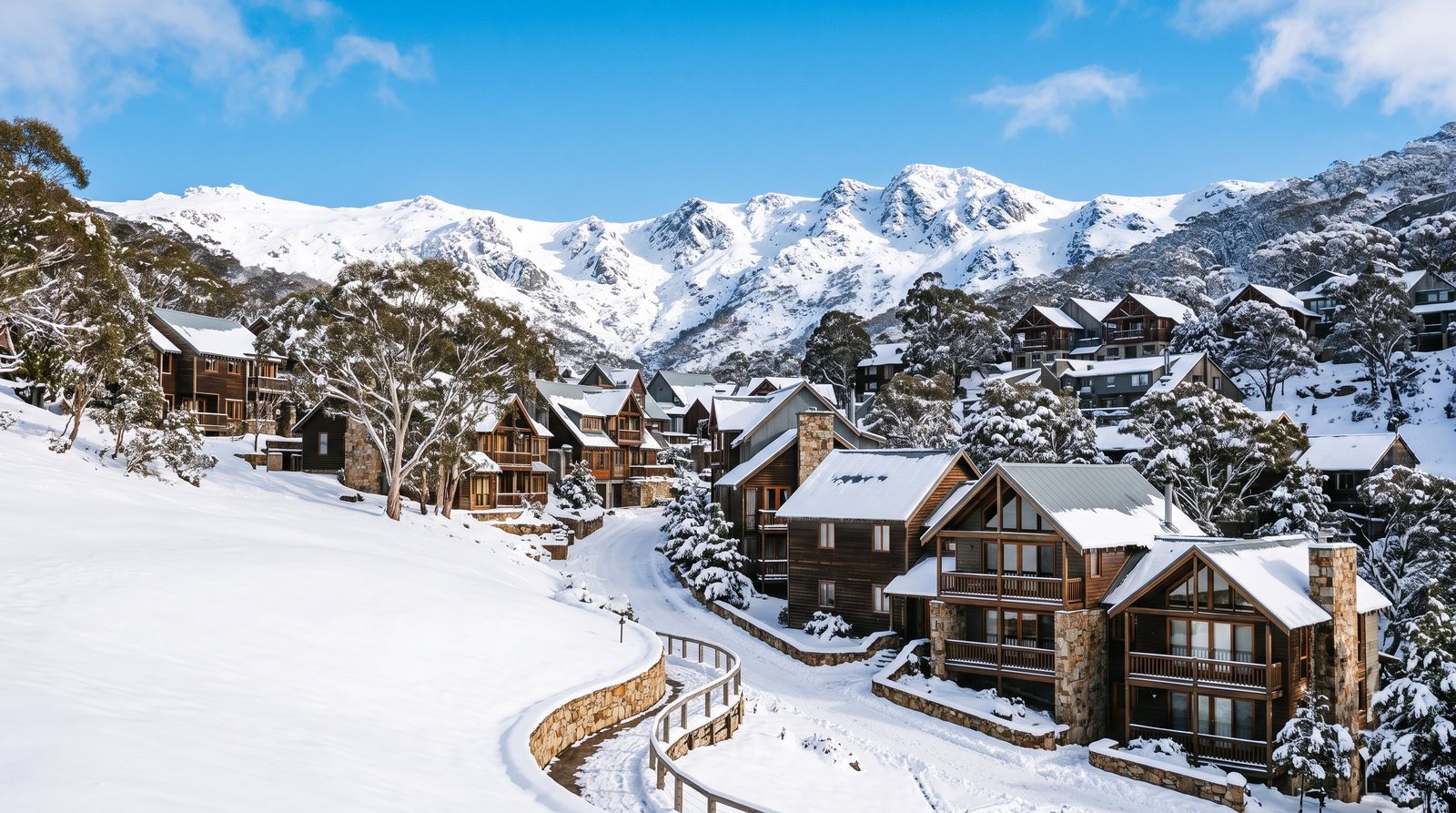
Australia is often defined by its horizontal vastness—the red dust of the interior and the sapphire fringe of its coastline. Yet, in the southeast, the land rises into the Snowy Mountains, creating a high-altitude sanctuary that feels distinct from the rest of the continent. Thredbo, nestled within the folds of Kosciuszko National Park, represents a deliberate intersection of human design and rugged alpine geography. It is a place where the air is noticeably thinner and the light carries a sharp, crystalline quality that clarifies the landscape. The resort is not merely a collection of structures but a functional response to the extreme conditions of the Australian high country. Here, the scale of the mountains dictates the pace of life, demanding a different kind of attention from those who visit, whether they arrive for the winter snow or the verdant clarity of the summer months.
The origins of Thredbo are rooted in a specific moment of mid-century optimism and European influence. In 1957, Tony Sponar, a Czech ski instructor who had seen the potential of the Crackenback Range, conceptualized a resort that would mirror the alpine villages of his homeland. This vision was not about imposing a foreign aesthetic onto the Australian bush, but rather about finding a way to live within it. The syndicate incorporated in that same year began the patient work of building a village that followed the contours of the valley floor. The resulting European-style architecture, with its pitched roofs and colorful facades, creates a sense of containment and warmth against the vast, often unforgiving backdrop of the peaks. It is a testament to the idea that a resort can be a permanent community, a place where the infrastructure of recreation is secondary to the experience of the environment itself.
When winter arrives, the landscape of Thredbo undergoes a profound simplification. The diverse textures of the alpine heath are smoothed over by snow, and the resort’s geometry becomes defined by the white ribbons of its ski runs and the mechanical pulse of its chairlifts. The Kosciuszko Express Chairlift, which serves as the primary artery for the mountain, carries visitors to Australia’s highest lifted point, offering a perspective that is both exhilarating and humbling. The experience of skiing or snowboarding here is as much about the silence of the high peaks as it is about the motion. In the early morning, before the village fully awakens, the sound of the wind through the frozen eucalypts provides a reminder of the mountain’s wilder state. The infrastructure—the lifts, the grooming, the lodges—is a thin layer of human effort laid over a geological reality that remains largely indifferent to it.
As the snow recedes, Thredbo does not go dormant; instead, it transforms into a vibrant hub for a different kind of exploration. The white slopes give way to a complex mosaic of green, gold, and grey, as the alpine wildflowers and ancient snow gums reappear. The Thredbo River, which runs through the heart of the village, becomes a focal point for visitors who trade their skis for mountain bikes or hiking boots. The resort has become a premier destination for mountain biking, with trails that navigate the steep terrain with the same precision as the winter runs. This seasonal shift is a practical demonstration of the resort’s year-round utility. The transition is not just a change in activity, but a change in the way the mountain is read. The summer light reveals the intricate details of the granite boulders and the delicate ecosystems that are hidden beneath the winter drifts.
The proximity to Mount Kosciuszko, Australia’s highest peak, gives Thredbo a unique status among alpine destinations. The journey from the top of the Kosciuszko Express to the summit is a ritual for many visitors, a walk that traverses a fragile and ancient landscape. This high-altitude plateau is home to species that exist nowhere else on Earth, adapted to the extreme cold and the short growing season. The trail is designed to minimize human impact, reflecting a growing awareness of the ecological sensitivity of the "alpine backyard." Standing at the summit, one is granted a panoramic view of the Snowy Mountains, a sea of peaks that stretches toward the horizon. It is a place where the scale of the continent is finally matched by the height of the land, providing a rare sense of verticality in a country known for its flatness.
In recent years, the management of Thredbo has shifted its focus toward a more deliberate form of environmental stewardship. The resort became the first in Australia to operate on 100% renewable energy, a significant milestone in its history. This commitment to sustainability is not just a corporate target but a necessary response to the vulnerability of the alpine environment. Through partnerships like the one with Greenfleet, the resort and its visitors have offset thousands of tonnes of carbon emissions by planting tens of thousands of trees. These initiatives cover all aspects of resort operations, from waste reduction to water conservation. The goal is to preserve the unique alpine ecosystem for future generations, ensuring that the mountain remains a place of wonder. It is a reminder that the privilege of accessing these heights carries a corresponding responsibility to protect them.
The social fabric of Thredbo is woven into the architecture of the village itself. Unlike many purpose-built resorts that feel transient, Thredbo possesses the character of a durable "third place"—a community that exists between the home and the workplace. The European-style village atmosphere encourages lingering, with its pedestrian-friendly lanes and communal squares. In the evening, the village becomes a lantern in the valley, its lights reflecting off the snow or the dark water of the river. The restaurants, bars, and shops are not merely service providers but gathering points where the day’s experiences are shared and recorded. This sense of place is what draws visitors back year after year. It is a social ecosystem that mirrors the natural one, built on a foundation of shared appreciation for the high country and the specific rituals of alpine life.
Ultimately, the allure of Thredbo lies in its ability to offer a different perspective on the Australian landscape. It is a place where the seasons are felt with a clarity that is often lost in the coastal cities. The mountain serves as a lens, focusing the visitor’s attention on the quiet details of a snow gum’s bark or the vastness of a starlit alpine sky. As the resort continues to evolve, it remains anchored by the same potential that Tony Sponar saw in 1957. It is a testament to the enduring human desire to reach the high places, to find sanctuary in the cold, and to build communities that respect the scale of the natural world. Thredbo is not just a destination for recreation; it is a vital part of the Australian story, a high-altitude archive of effort, beauty, and the patient work of living well within a wild landscape.