Coastal town
A rugged coastal sanctuary where ancient whaling legends meet the deep sapphire sea
Perched on the rugged shores of Twofold Bay, Eden is a sanctuary where maritime history and natural wonder converge. From the haunting legacy of the killer whales to the striking red cliffs of Beowa National Park, the town offers a profound connection to the deep sapphire sea.
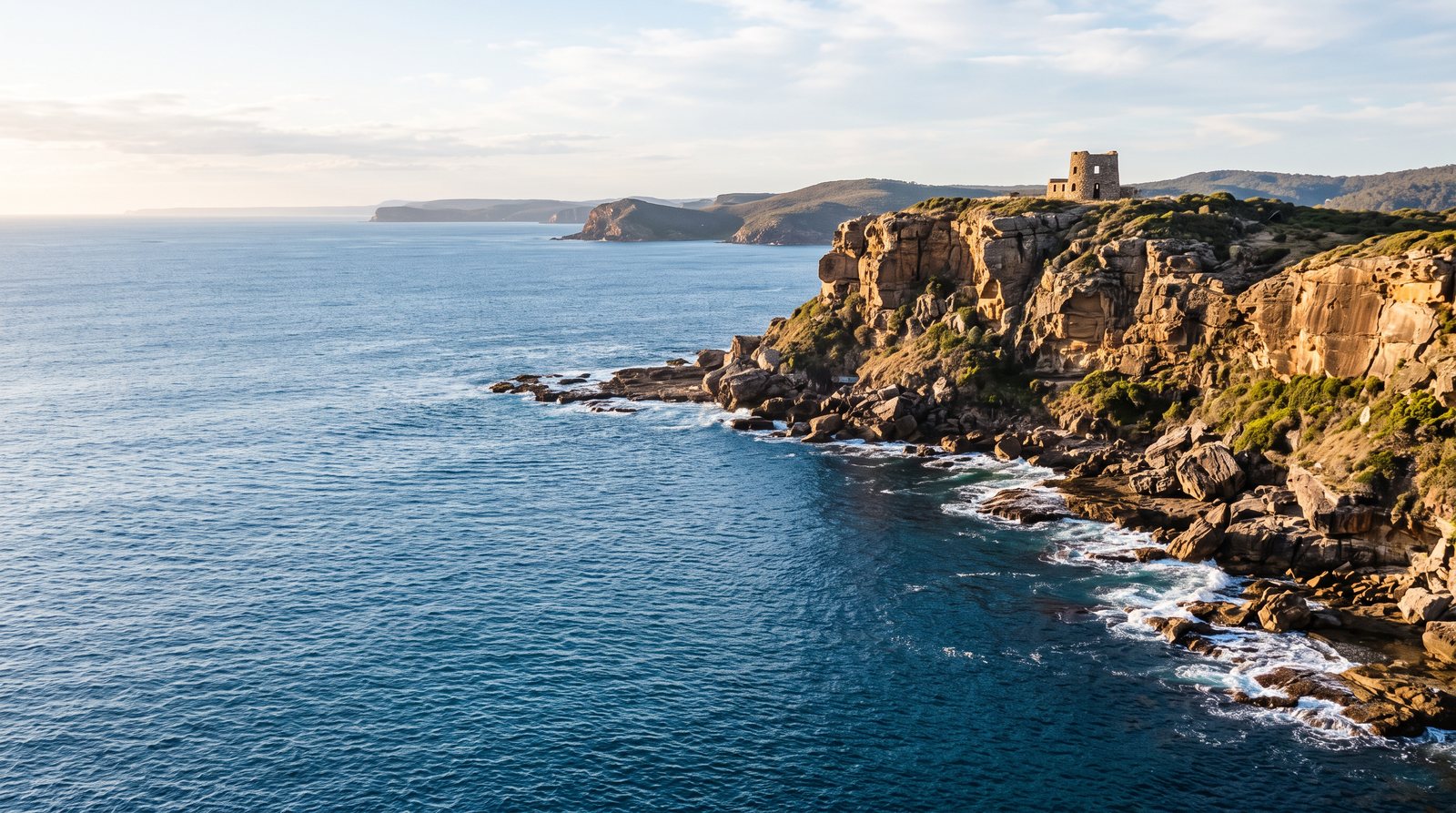
Eden sits at the southern edge of New South Wales, where the landscape feels both ancient and immediate. It is defined by Twofold Bay, a vast expanse of water that serves as the town’s heart. The geography is dramatic; the land does not merely meet the sea but seems to plunge into it, creating the world’s third deepest natural harbour. The water is a saturated sapphire, often still in the bay’s protected reaches, yet capable of showing the raw power of the Southern Ocean beyond the headlands. To arrive in Eden is to enter a territory where the scale of the natural world is impossible to ignore.
The history of the region is inextricably linked to these deep waters. Twofold Bay has long provided shelter for those navigating the rugged coastline, from the Thaua people of the Yuin nation to the early European settlers. In the 19th century, the town became a focal point for the whaling industry, a period that left a permanent mark on its identity. Unlike other whaling stations, Eden’s history is distinguished by a remarkable ecological partnership. The deep harbour allowed for a proximity to the sea that shaped the town’s layout, with the working wharf at Snug Cove remaining a central hub. Today, the structural legacy continues to define the town’s character.
Central to Eden’s lore is the story of the "Killers of Eden," a pod of orcas led by the legendary Old Tom. For nearly a century, these apex predators and the human whalers of Twofold Bay operated in a symbiotic relationship that remains unique in natural history. The orcas would alert the whalers to the presence of baleen whales in the bay, herding them toward the harpoons in exchange for the "law of the tongue"—the right to consume the tongue and lips of the catch. This was a documented reality, a rare instance where the boundaries between wild animals and human industry blurred into a cooperative effort.
The preservation of this history is housed within the Eden Killer Whale Museum, an institution that stands as a sentinel overlooking the bay. Inside, the skeleton of Old Tom is displayed, a physical testament to the legend that defines the town. The museum does not merely catalogue the tools of the whaling trade; it serves as a repository for the collective memory of a community that lived in constant dialogue with the ocean. The exhibits detail the lives of the Davidson family and the Thaua men who worked alongside them, highlighting a complex social history. Visitors are invited to contemplate the transition from hunting to conservation, as the museum tracks modern efforts to protect marine life.
Beyond the town’s maritime centre, the landscape opens into the rugged expanse of Beowa National Park. This wilderness area preserves the striking beauty of the Sapphire Coast, where the "Light to Light" walk stretches forty-seven kilometres between Boyds Tower and the Green Cape Lighthouse. To walk this path is to experience the raw texture of the Australian coast. The trail winds through coastal heaths, banksia woodlands, and over dramatic headlands that offer uninterrupted views of the Pacific. There is a sense of solitude here that is increasingly rare; the path follows the natural contours of the land, requiring a steady pace. Each turn reveals a new perspective on the bay.
The geology of Beowa National Park is perhaps its most arresting feature, notably exemplified by the Pinnacles. These ancient rock formations consist of white sands topped by a layer of vibrant red clay, a stark vertical contrast that appears almost painted against the backdrop of the eucalyptus forest and the blue sky. The red rock is a signature of the region, appearing in various formations along the coast and glowing with intensity during the golden hours of sunrise and sunset. These cliffs are not just visual landmarks but geological records, showing the slow accumulation of minerals over millions of years. The interaction between the red stone and the sapphire sea creates a palette synonymous with Eden.
While the whaling industry has long since ceased, the whales themselves remain a vital part of Eden’s seasonal rhythm. Every year, between May and November, the humpback migration brings thousands of these majestic creatures past the shores of Twofold Bay. Eden is widely regarded as one of the best places in Australia for whale watching, as the deep, nutrient-rich waters of the bay provide a perfect resting ground for mothers and their calves on their journey back to the Antarctic. The sight of a humpback breaching in the bay is a common occurrence, drawing visitors who come to witness the spectacle from the shore or from the decks of local charter boats.
The life of the town continues to revolve around the water. The wharf at Snug Cove is a place of constant motion, where the local fishing fleet brings in the day’s catch and the air is thick with the scent of the sea. Eden’s reputation for fresh seafood is well-earned, with local mussels, oysters, and flathead being staples of the town’s culinary identity. To sit at the wharf and watch the boats come in is to see the practical side of Eden—the hard work and the specialized knowledge that keep the community thriving. There is a lack of pretension here; the beauty of the surroundings is matched by a grounded, industrious spirit.
In the end, Eden is a place that invites a slower kind of engagement. It is a sanctuary where the noise of the modern world is dampened by the vastness of the sea and the silence of the national park. Whether one is standing on the cliffs at Green Cape, looking out toward the horizon where the Tasman Sea meets the Southern Ocean, or walking the quiet streets as the evening mist rolls in from the bay, there is a profound sense of place. It is a destination that rewards the patient observer—the person who stays long enough to see the whales pass, to watch the light change the colour of the cliffs, and to understand the connection between this rugged coast and the people.