Coastal town
A coastal escape where tranquil lakes and rugged ocean beaches meet
Merimbula serves as a precise intersection of calm estuarine life and the rugged Pacific. Between the patient rhythm of oyster leases and the seasonal passage of migrating whales, the town offers a sanctuary where the Sapphire Coast’s natural character remains clearly visible.
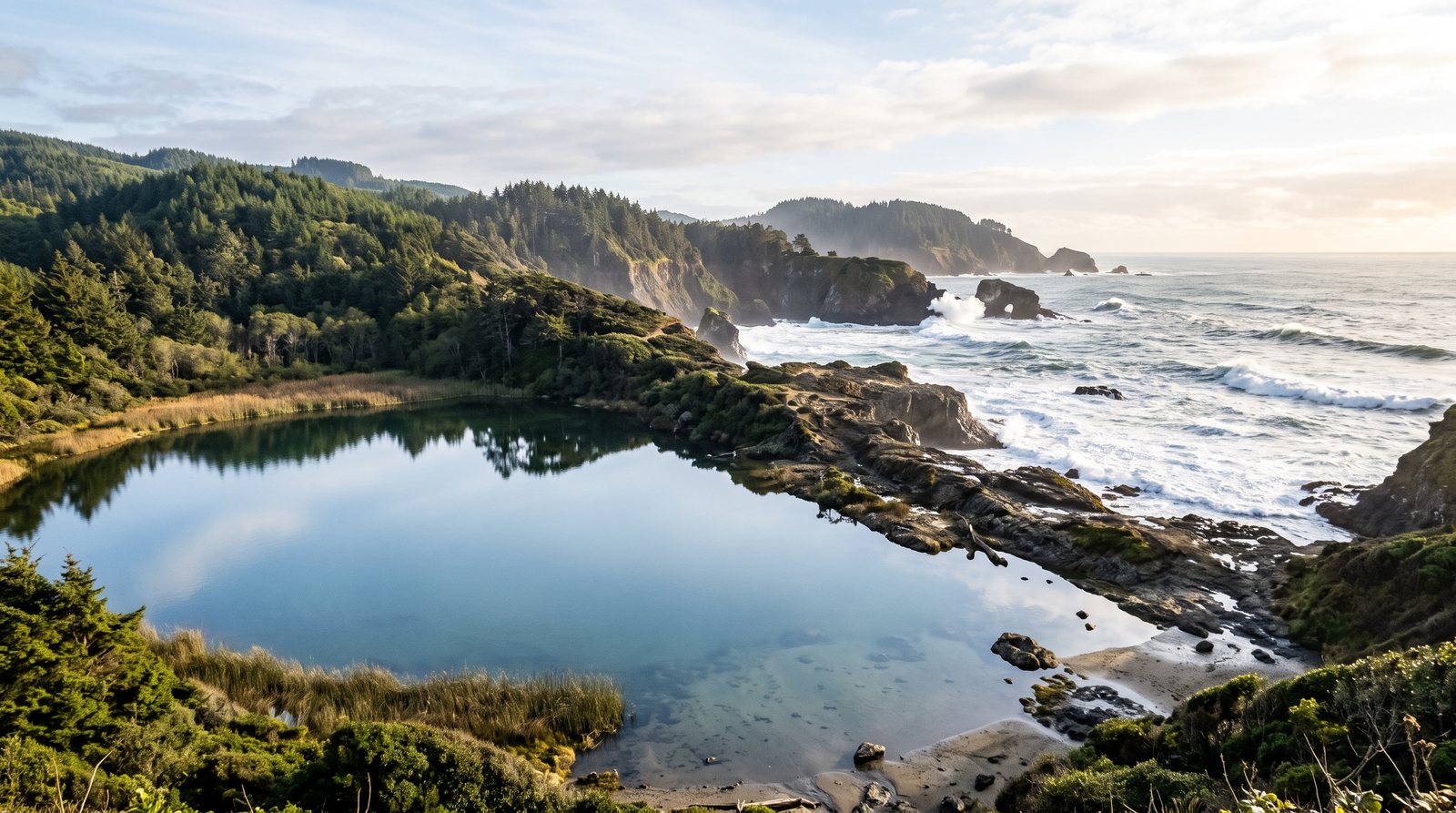
Merimbula occupies a unique geography on the Sapphire Coast of New South Wales, where the distinction between land and water feels less like a boundary and more like a continuous conversation. The town is defined by its namesake lake, a vast tidal expanse that breathes with the Pacific through a narrow, sandy entrance. To arrive here is to notice how the light behaves differently when reflected off both the still estuary and the restless foam of the surf. It is a destination that invites a specific kind of attention—a slow engagement with a landscape that maintains its own rhythm despite seasonal visitation. The air carries the scent of salt and eucalyptus, a reminder that the wilderness is never more than a few steps away from the quiet streets.
The Merimbula Lake is the town’s primary internal organ, a system of shallow channels and deep basins that sustains both a delicate ecosystem and a storied local industry. Along its edges, mangroves stand as silent sentinels, their root systems filtering the tides and providing a nursery for marine life. The water here is often so clear that the sandy bottom remains visible even at depth, revealing the slow movement of rays and small fish. This clarity is the fundamental requirement for the oyster leases that dot the lake’s surface. These wooden structures, weathered by years of immersion, are the physical manifestation of a patient craft, where the quality of the harvest is linked to the health of the water.
Walking the Merimbula Boardwalk offers a transition from the town’s domestic spaces into this aquatic world. The wooden path winds along the northern edge of the lake, elevated just enough to provide a vantage point over the shifting tides without intruding upon the environment. In the late afternoon, the boardwalk becomes a study in changing visual temperatures as the golden light turns the lake into a mirror for the sky. It is a route that encourages slow looking, where the details of a rusted piling or the sudden splash of a cormorant become the primary events of the hour. There is a generosity in this infrastructure; it makes the complexities of the estuary accessible to anyone willing to walk its length.
Beyond the calm of the lake, the Sapphire Coast reveals its more rugged character. The ocean beaches of Merimbula, such as Main Beach and Short Point, face the full force of the Pacific with a stoic, sandstone-backed grace. Here, the turquoise water breaks in consistent, powerful lines, drawing surfers and swimmers into a different kind of physical dialogue with the elements. The sand is fine and golden, a stark contrast to the dark, ancient rocks that frame the headlands. At Short Point, the elevation provides a panoramic view of the coastline, stretching toward the horizon where the blue of the sea meets the sky. This is a landscape of scale, where the individual feels small against the backdrop of the Southern Ocean.
This proximity to the deep ocean makes Merimbula a premier location for witnessing one of the natural world’s most significant migrations. Each year, humpback whales travel along the coast, their massive forms breaching the surface in a display of power and grace that remains profoundly moving. The sapphire waters of the bay become a temporary home for these giants, who use the sheltered areas to rest and nurse their young. From the shore, a keen eye can spot the distant blow of a whale or the sudden slap of a tail against the water. On the boats that venture out into the deeper swells, the encounter becomes even more intimate, a collective recognition of a life that operates on a completely different scale.
The town itself retains the character of an authentic Australian seaside escape, where the architecture and the pace of life are dictated by the environment. There is a lack of pretension in the way Merimbula presents itself; the focus remains firmly on the outdoors, on the quality of the light, and the freshness of the local produce. The seafood, particularly the Sydney Rock Oysters pulled directly from the lake, is treated with a reverence that reflects its origin. To eat an oyster here is to taste the lake itself—the salt, the minerals, and the clarity of the water all contained within a single shell. The connection between the land, the sea, and the table is a defining feature of the coast.
As the day ends in Merimbula, the relationship between the lake and the ocean reaches a quiet equilibrium. The tide turns, the birds return to their roosts in the mangroves, and the lights of the town begin to flicker against the darkening hills. The beauty of this place lies in its balance—the way it offers both the safety of the estuary and the wildness of the sea, the way it supports both a working industry and a place of rest. It is a destination that rewards the patient observer who is willing to stand still long enough to notice the way the water changes color as the clouds pass overhead. Merimbula is a coastal sanctuary where the natural world speaks for itself.
The preservation of this character is a result of the value the community places on its surroundings. The visitor notes and official guides emphasize the importance of checking tide conditions and weather alerts as a way of participating in the local knowledge of the coast. To visit Merimbula is to enter into a contract with the environment, to agree to move at its speed and respect its boundaries. Whether one is exploring the hidden coves of the lake by kayak or hiking the rugged trails that lead along the ocean cliffs, there is a sense of being part of a well-cared-for archive of natural history.
In the end, Merimbula remains a gem because it does not try to be anything other than what it is: a precise intersection of land and sea. It offers a mosaic of experiences that are grounded in the physical reality of the Australian coastline. From the intricate life of the mangroves to the vast migrations in the deep sapphire sea, the town provides a window into a world that is both familiar and infinitely mysterious. It is a place where the wistful ink of memory is written in the patterns of the sand and the reflections on the water, a destination that stays with the traveler long after the salt has been washed from their skin.