Coastal town
Heritage timber wharves meet the rugged turquoise coastline of the Sapphire Coast
Tathra stands as a sentinel of maritime history on the Sapphire Coast, where the last deep-sea timber wharf on the eastern seaboard meets the dramatic basalt cliffs of Mimosa Rocks. It is a place where the rhythm of the tide governs both heritage and wilderness.
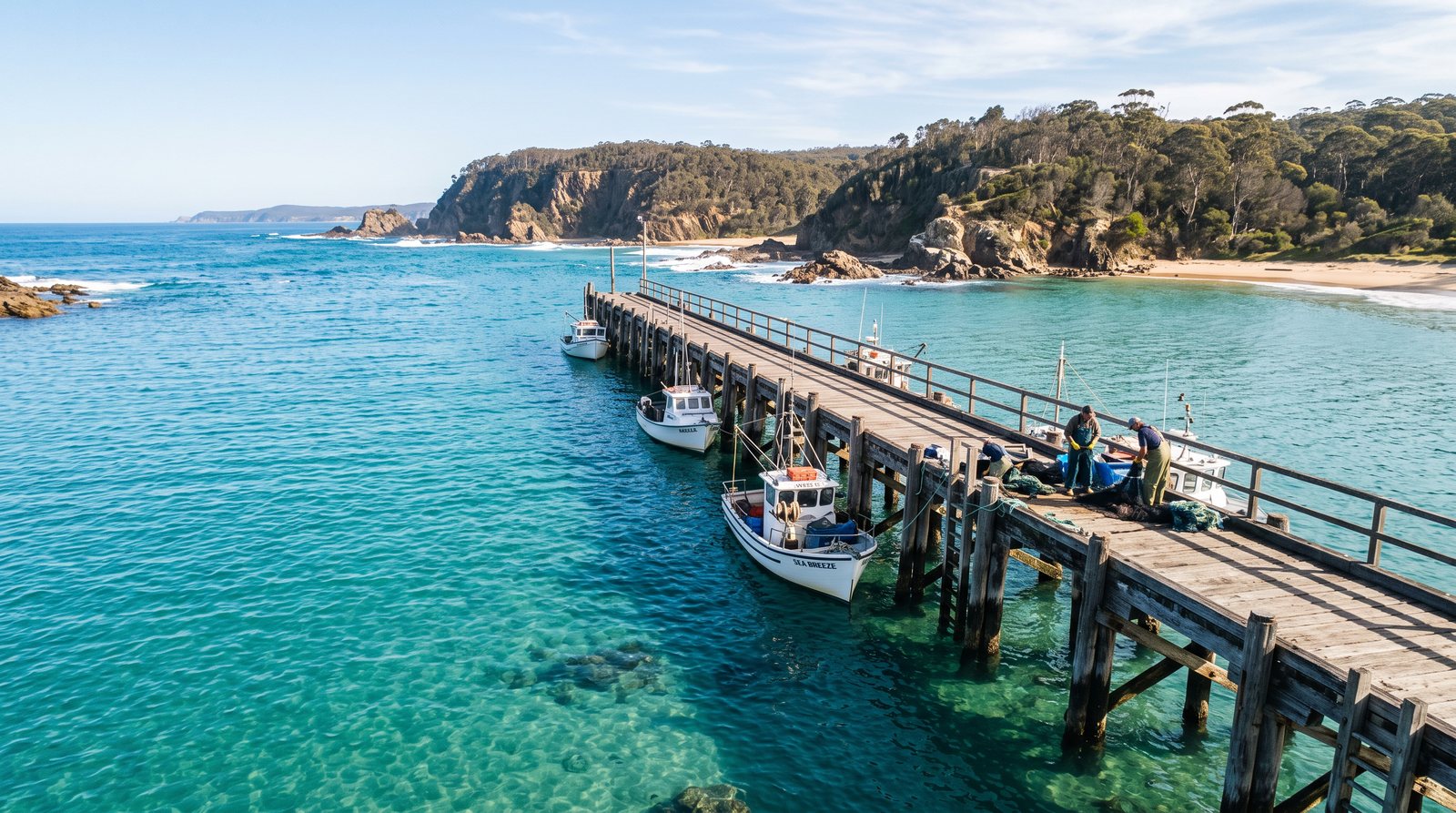
The Sapphire Coast of New South Wales is defined by a particular clarity of light and water, where the Pacific Ocean meets the continent with a force that has carved a landscape of dramatic headlands and hidden, turquoise coves. At the center of this coastal stretch lies Tathra, a town that serves as a living interface between nineteenth-century maritime industry and twenty-first-century wilderness. To stand on the headland at Tathra is to witness a rare convergence: the weathered geometry of the last deep-sea timber wharf on Australia’s eastern seaboard extending into an ocean that remains as untamed as the surrounding national parks. The atmosphere here is one of quiet endurance, where the physical remains of colonial trade continue to function as the social and geographic heart of the community.
The Tathra Wharf, constructed between 1860 and 1861, represents a vital chapter in the history of the South Coast. Originally known as the "Farmer's Sea," the wharf was built to facilitate the export of dairy products from the Bega Valley, connecting the isolated rural hinterland to the markets of Sydney. Its design is characterized by massive timber pilings, hewn from local hardwoods, which have withstood over a century and a half of salt, storm, and tide. The structure is a study in material resilience; the greyed, textured wood of the decking and heavy iron bolts tell a story of labor and necessity. Unlike the concrete structures that replaced most coastal jetties, the Tathra Wharf retains a tactile connection to the forests from which it was born, standing as a monument to a time when the sea was the primary highway for the region’s survival.
As the era of coastal shipping declined, the wharf transitioned from a site of industrial utility to one of heritage and recreation. Today, it houses a museum documenting the maritime history of the Sapphire Coast, including accounts of shipwrecks and the vital role the wharf played during the World Wars. The preservation of the structure has been a labor of community dedication, ensuring that the unique architecture—with its distinctive lower and upper decks designed to accommodate shifting tides—remains accessible. The lower deck, once crowded with butter boxes, is now a favored spot for local fishers, while the upper levels provide a vantage point for observing the seasonal migration of humpback whales, which often pass close to the headland in the deep, clear waters.
Stretching north from the town, Mimosa Rocks National Park offers a stark geological contrast to the ordered lines of the timber wharf. The park takes its name from the SS Mimosa, a paddle steamer that struck a submerged reef and sank nearby in 1863. The landscape is dominated by dramatic basalt columns and intricate rock formations resulting from ancient volcanic activity. These castle-like structures rise abruptly from the turquoise surf, creating a coastline that feels both prehistoric and sculptural. The geological complexity of the park is mirrored in its ecology, where salt-tolerant coastal heaths give way to dense eucalyptus forests and sheltered pockets of temperate rainforest, providing a sanctuary for a diverse range of avian and terrestrial wildlife.
The Kangarutha Walking Track provides an intimate way to experience this rugged intersection of forest and sea. Winding for approximately nine kilometers along the cliff tops and through the gullies of Mimosa Rocks National Park, the track demands an attentive pace. It is a path of constant transition, moving from the open, wind-swept heights of the headlands to the quiet, humid interiors of the coastal valleys. The physical experience of the track is defined by the variety of its terrain: the crunch of dry leaves, the sudden coolness of a shaded creek crossing, and the rhythmic sound of the Pacific breaking against the basalt platforms below. It is a route that reveals the landscape in fragments, rewarding the walker with sudden glimpses of secluded beaches like Boulder Bay, where the shore is composed of smooth, sea-rounded stones.
In recent decades, Tathra has cultivated a new relationship with its environment through an extensive network of mountain biking trails. These trails, largely constructed by the local community, wind through the hills and forests bordering the town, offering a different perspective on the coastal topography. The trail design emphasizes harmony with the natural contours of the land, avoiding the heavy-handed interventions often seen in commercial parks. Cyclists navigate through stands of spotted gum and burrawang palms, experiencing the forest as a dynamic, three-dimensional space. This integration of outdoor sport and environmental appreciation has become a defining characteristic of Tathra’s modern identity, fostering a culture that values the forest as much for its ecological integrity as for its recreational potential.
The water surrounding Tathra is perhaps its most defining element, characterized by a clarity and a vibrant turquoise hue. This clarity is a result of the region’s relative isolation, allowing the complex underwater ecosystems to thrive. The kelp forests and rocky reefs that lie beneath the wharf and along the national park’s coastline are home to a vast array of marine life, from colorful sea tulips to schools of yellowtail kingfish and the occasional fur seal. For the observer on the shore, the water is a shifting canvas of light and color, changing from a deep indigo in the shadows of the cliffs to a bright, translucent aqua where the sand meets the sea. It is a reminder of the fundamental health of this coastal system, where the boundaries between the human-built environment and the wild ocean are kept in a delicate balance.
Living in Tathra requires an acknowledgment of the slow pace of coastal time, a rhythm dictated by the seasons and the sea. The town’s architecture reflects a desire to remain connected to the landscape, with a palpable sense of stewardship defining the community. Whether through the restoration of the wharf or the maintenance of the walking tracks, residents remain deeply invested in the continuity of their environment. This commitment ensures that Tathra remains a place where the history of the coast and the future of its wilderness coexist.
Ultimately, Tathra stands as a testament to the meeting point where forest timber meets the salt of the sea. The historic wharf serves as a bridge, anchoring the town to its maritime heritage while pointing toward the vast Sapphire Coast. As the morning light hits the turquoise water and the mist lifts from Mimosa Rocks, the landscape reveals itself with profound clarity. It is a corner of the world where history and nature are woven together, creating a coastal narrative as deep as the ocean itself.