Historic village
A heritage escape where emerald hills meet the sacred shadows of Mount Gulaga
Nestled at the base of Mount Gulaga, this National Trust-classified village offers a serene step back into the nineteenth century. Visitors can wander through colonial architecture and artisanal galleries that define the timeless beauty of the South Coast.
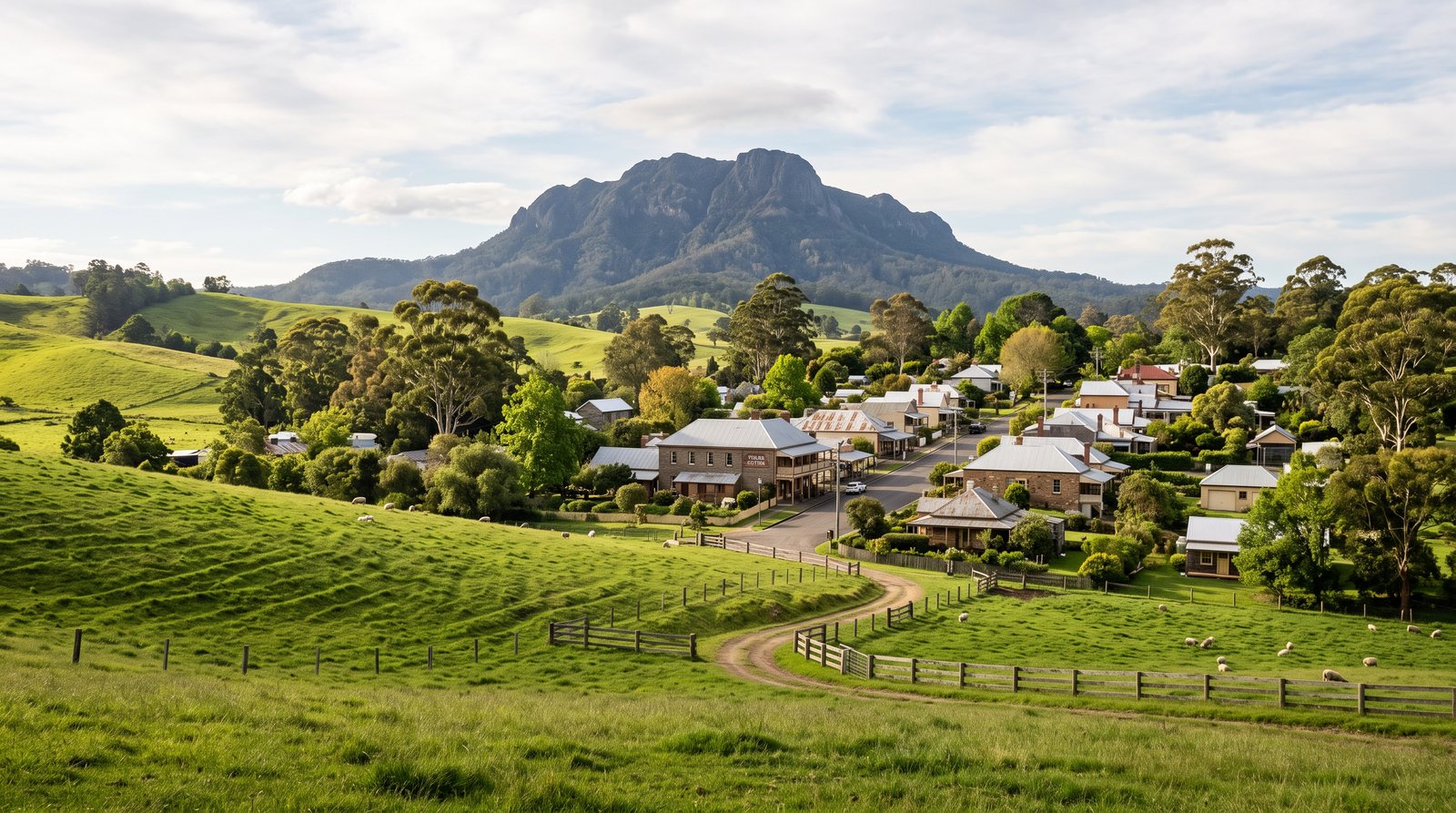
The approach to Tilba Tilba is defined by a sudden shift in the landscape, where the rolling coastal plains of the New South Wales South Coast rise into a series of emerald-green hills. These slopes, often shrouded in a low-hanging mist that clings to the ancient eucalyptus forests, serve as the dramatic pedestal for Mount Gulaga. This dormant volcano dominates the horizon, its dark, forested peaks casting long, sacred shadows over the valley below. The nineteenth century remains the living framework of the community. The air carries a distinct coolness, a result of the elevation and the proximity to the mountain, creating a microclimate that supports the lush, perennial pastures that have sustained the region for generations.
The village itself is a remarkable testament to colonial-era preservation, having earned a rare classification from the National Trust of Australia. The streetscape of Central Tilba is lined with impeccably maintained weatherboard cottages, their timber facades painted in heritage tones that harmonize with the surrounding greenery. These structures, many dating back to the late 1800s, reflect a period of prosperity fueled by agriculture and industry. The architectural consistency is striking; there are no modern intrusions to break the rhythm of gabled roofs, wide verandas, and picket fences. This preservation is not a static museum display but a functional village where historic buildings house active galleries and workshops, ensuring that the heritage of the South Coast remains integrated into daily life.
Rising steeply behind the weatherboard shops is the majestic form of Mount Gulaga, a site of profound spiritual and cultural significance to the Yuin people. The mountain is regarded as a place of ancestral origin, a maternal figure in the landscape that has watched over the coastal plains for millennia. Its geological composition, primarily igneous rock, provides a rugged contrast to the soft contours of the dairy country at its feet. For visitors, the hike to the summit is a demanding physical undertaking, following a trail that winds through temperate rainforest and massive granite tors. The ascent offers a transition through distinct ecological zones, from the dense undergrowth of the lower slopes to the open ridges where views extend across the Sapphire Coast toward the Pacific Ocean.
The economic and social heart of the Tilba region has long been its dairy industry, visible in the sprawling, fence-lined paddocks that surround the villages. The volcanic soil, enriched by the mountain’s ancient eruptions, produces a quality of grass exceptionally suited for grazing. The history of the ABC Cheese Factory, established in 1891, is central to this narrative. Now operating as Tilba Real Dairy, the facility continues to process milk from local Jersey herds, maintaining a connection to the land that predates the modern era of industrial farming. The sight of cattle grazing against the backdrop of Mount Gulaga is a quintessential South Coast image, representing a sustainable continuity of land use that has defined the region’s identity for over a century.
Within the village, a vibrant artisanal culture has taken root, filling the historic storefronts with a diverse array of crafts and local produce. This community values the handmade and the slow-produced, from intricate woodturning and leatherwork to locally harvested honey and preserves. The galleries do not merely sell souvenirs; they showcase the work of residents who have chosen the quietude of the Tilba valley as their creative base. This artisanal focus provides a necessary balance to the heritage tourism that brings visitors to the area, ensuring the village remains a place of production rather than just consumption. The exchange between the maker and the visitor occurs in the same rooms where shopkeepers have stood for over a hundred years, maintaining a human scale of commerce.
While the dairy industry provided long-term stability, a brief and intense gold rush in the 1880s accelerated the village's early development. Gold was discovered on the slopes of Mount Dromedary, leading to a flurry of mining activity that brought wealth and infrastructure to the valley. The remnants of this era are still etched into the landscape, from the old bridle tracks that crisscross the mountain to the sturdy construction of the village’s most prominent buildings. Although the mines have long since closed, the sense of enterprise they fostered remains part of the local character. The wealth generated during the gold years allowed for the construction of the public halls and larger residences that today form the backbone of the National Trust-classified area.
The geography of Tilba Tilba is uniquely situated between the rugged mountain wilderness and the pristine coastline of the South Coast. A short drive from the heritage streets leads to the dramatic shores of Mystery Bay and the expansive waters of Wallaga Lake. This proximity allows for a lifestyle balanced between the forest and the sea, where the morning might be spent in the shadow of the mountain and the afternoon on a secluded beach. The transition between these environments is seamless, with the emerald hills eventually giving way to coastal scrub and ancient spotted gum forests. This geographical diversity is a key component of the Wistful Ink aesthetic, where the precision of the natural world meets the weathered surfaces of human history, creating a sense of place.
For the modern visitor, the experience of Tilba Tilba is one of intentional deceleration. To walk the heritage-listed streets is to adopt a slower pace, dictated by the incline of the road and the invitation to linger at a gallery window or a bakery door. The visitor experience is grounded in a practical reminder that while the village is accessible, the landscape around it remains wild and demanding. The hike up Gulaga requires preparation and respect for the changing weather conditions of the mountain. It is this tension between the refined colonial village and the untamed Australian bush that gives the area its enduring appeal, offering a sense of sanctuary that is grounded in the physical reality of the land and a deeper connection to history.
In conclusion, Tilba Tilba represents a rare alignment of heritage preservation, cultural depth, and natural grandeur. It is a place where the emerald hills are not just a scenic backdrop but a working landscape, and where the sacred shadows of Mount Gulaga provide a constant reminder of a history that extends far beyond the colonial era. The village’s enduring success lies in its ability to remain relevant without sacrificing its character, serving as a model for how historic communities can thrive in the modern world. The timeless quality of the Tilba valley secures its place as one of the most profound destinations on the New South Wales coast.