Beach
Discover the pristine sugar-white sands and turquoise waters of iconic Hyams Beach
Renowned for its sugar-white quartz sands and crystalline turquoise waters, Hyams Beach offers a serene sanctuary on the shores of Jervis Bay. From marine wildlife encounters to vibrant birdwatching trails, this coastal village remains an iconic NSW escape.
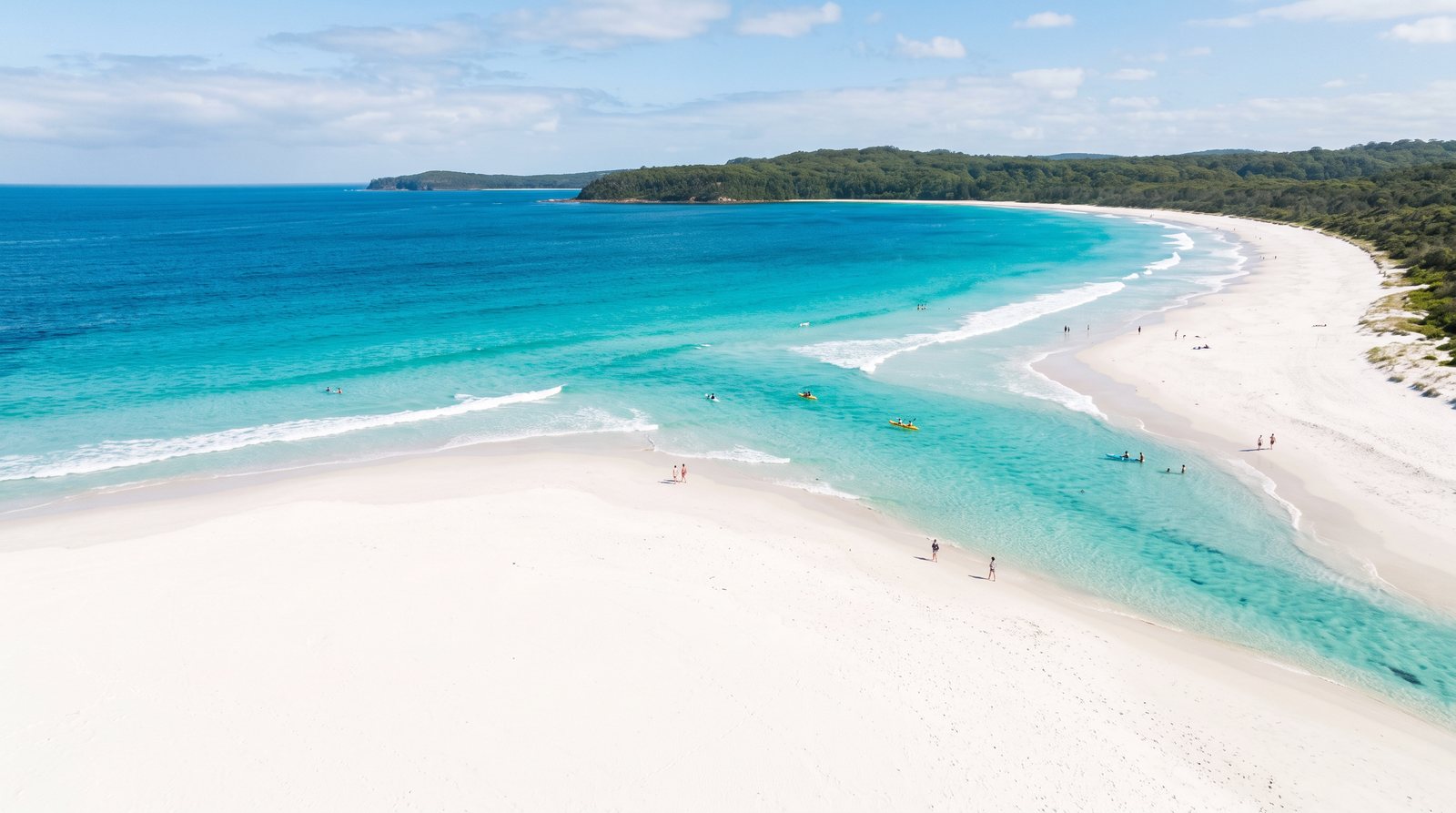
Arriving at Hyams Beach prompts an immediate visual recalibration. The shoreline presents a vast expanse of sand so pale and fine that it is renowned for being among the whitest in the world. Under the midday sun, the beach becomes a radiant boundary between the dark greens of the surrounding bush and the shifting blues of Jervis Bay. The texture is closer to powdered sugar than traditional coastal grit, a softness that squeaks underfoot. Light reflects off the high-purity quartz grains, creating a brilliance that defines the entire Hyams experience. It is a landscape of high-contrast beauty, where a quiet, persistent clarity feels both ancient and remarkably well-preserved.
The geological history of this coastline is written in the purity of its silica. Unlike beaches tinted by crushed shells or volcanic minerals, Hyams is composed almost entirely of fine quartz. This high concentration grants the beach its legendary brilliance, as the grains lack the iron oxides that typically color sand. Jervis Bay acts as a natural filter, allowing these fine white grains to accumulate over millennia within its sheltered basin. For the visitor, standing on this shoreline feels less like a traditional beach and more like a gallery of natural mineralogy. Every grain contributes to a collective glow that distinguishes this sanctuary from the more turbulent stretches of the open Tasman Sea.
Complementing the brilliant sand are the waters of Jervis Bay Marine Park, which exhibit a transparency rivaling remote island atolls. The bay transitions through a spectacular gradient of blues, from pale turquoise in the shallows to deep navy where the seafloor drops away. This clarity makes the bay a primary sanctuary for diverse marine life. Resident pods of bottlenose dolphins are frequently seen surfing the pressure waves near the shore, while the cooler months bring the majestic breaches of migrating humpback whales. Observing these animals against the sapphire water provides a humbling sense of scale, reminding visitors that this beach is merely the terrestrial edge of a vast and vibrant underwater wilderness.
Beyond the shoreline, the inland fringes of Hyams Beach offer an intimate kind of discovery. The Hyams Beach trail skirts the edge of the village and the surrounding national park, serving as a gateway for birdwatchers. Here, the scent of salt spray gives way to the resinous aroma of eucalyptus and banksia. The forest is alive with native birds, their plumage providing flashes of color against the canopy. Crimson rosellas are common sights among the spotted gums, while honeyeaters frequent the nectar-rich blossoms of the coastal heath. Walking this trail allows for slow observation, where the melodic songs of wattlebirds accompany glimpses of the white sand through the dense, green foliage.
The village of Hyams Beach maintains an understated character, reflecting its status as a seasonal sanctuary. Bordered on three sides by Jervis Bay National Park, the settlement has a natural limit to its growth, preserving an intimacy that is rare in coastal destinations. The architecture tends toward functional timber cottages and modern houses designed to frame the view. Even during the height of summer, the core identity remains rooted in the slow rhythms of the coast. It is a community where the daily schedule is dictated by the tides and the light rather than the clock. The most significant activity is often nothing more than watching the water change color from a quiet veranda.
The transition of light across the bay provides a daily spectacle for those who linger. In the early morning, the beach is a study in soft pastels, the sand taking on a cool, pearlescent quality. As the day progresses, the colors sharpen into a crescendo of white and turquoise. However, the late afternoon provides the most wistful moments. As the sun dips behind the western escarpment, the bay is cast into a long, gentle shadow, and the water turns a reflective silver. The white sand becomes a soft, glowing ribbon tracing the curve of the coast. This is when the landscape feels most private, offering a different revelation to those watching the hours pass.
Visiting such a pristine environment carries responsibilities central to the Hyams experience. The beach is unpatrolled, requiring self-reliance and respect for the ocean’s power. Limited parking and narrow access roads are practical reminders of the area's fragility, urging visitors to plan their journeys with care. Official maritime and weather alerts are essential tools for safety, especially for those exploring the deeper reaches of the national park. The preservation of the sugar-white sand and the health of the marine park depend on collective restraint. It is a delicate balance between experiencing this iconic destination and protecting the qualities that make it worth visiting, ensuring the clarity and purity remain for future generations.
Hyams Beach is a vital part of the broader Jervis Bay narrative, connected to Booderee National Park and the village of Huskisson. This region is a mosaic of protected lands and historic settlements, each rooted in natural and cultural heritage. Booderee, meaning 'bay of plenty' in the local Dhurga language, offers further depth with its dramatic cliffs and significant Aboriginal sites. The proximity to these areas allows visitors to see Hyams as part of an interconnected ecosystem. Whether exploring the ruins of the Cape St George Lighthouse or kayaking the calm estuaries, the theme is one of continuity. Hyams is the bright focal point, inviting travelers to appreciate the enduring beauty of the coastline.
Ultimately, the memory of Hyams Beach is distilled into a single impression of color and light. It is the image of impossible white sand meeting vibrant turquoise, a visual shorthand for Australian coastal perfection. Beyond the aesthetic, there is a reflective quality—a sense of being at the edge of something vast. The destination invites a certain wistfulness, a longing to hold onto the clarity of the moment as the tide turns. Hyams reminds us that pristine environments are both resilient and vulnerable, requiring our attention and care. As one leaves, the brightness remains behind the eyes, a luminous standard against which all other coastlines are measured, and a promise that such purity still exists.