Coastal village
The gateway to marine wildlife and white sand beaches on Jervis Bay
Huskisson stands as the historic gateway to Jervis Bay Marine Park, where a legacy of maritime craftsmanship meets the pristine clarity of Australia’s white-sand coastline. The village serves as a vital link between the deep traditions of the South Coast and the vibrant marine life that defines the region’s ecological identity.
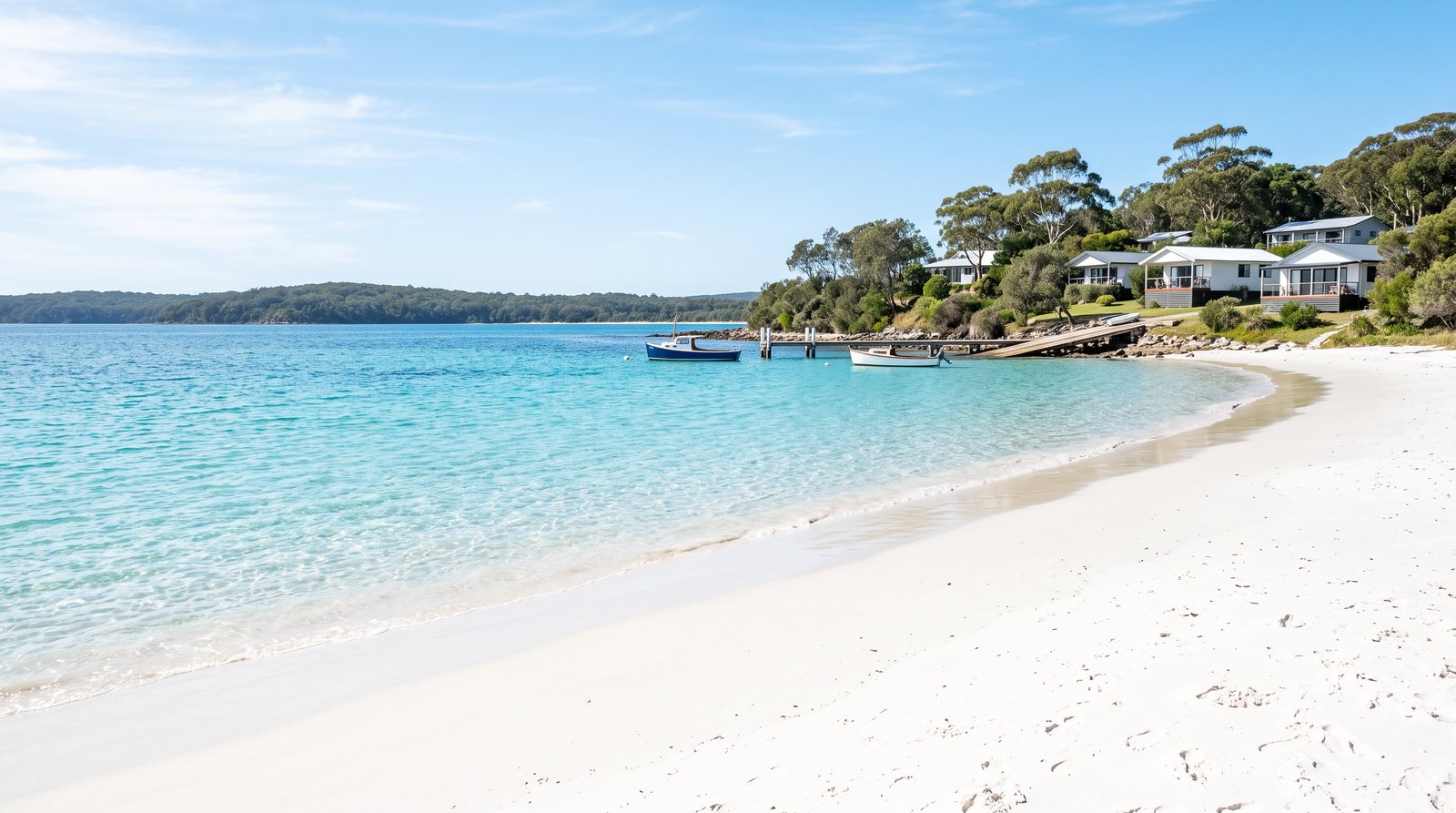
Huskisson occupies a singular position on the western edge of Jervis Bay, serving as a threshold where the terrestrial history of the South Coast meets a protected marine wilderness. The village is defined by its relationship to the water, a connection immediately apparent at the mouth of Currambene Creek. Here, the dark, tannin-stained waters of the estuary dissolve into the startling turquoise of the bay, a color that has become a shorthand for the region’s natural identity. The shoreline is composed of fine, flour-like quartz sand that remains cool under the summer sun, a geological curiosity that has earned the area international recognition. For the visitor, Huskisson is not just a destination but a point of departure, a place where the familiar rhythms of a coastal town give way to the ancient cycles of the sea.
The town’s identity is anchored in a legacy of maritime craftsmanship dating back to the mid-19th century. Long before it was a hub for tourism, Huskisson was a center of industrial necessity, where the dense forests of the hinterland were transformed into the hulls of ships navigating the Australian coastline. Local timber, such as spotted gum and ironbark, provided the structural integrity required for vessels to withstand the unpredictable southern oceans. This history is preserved within the Jervis Bay Maritime Museum, where the Lady Denman, a wooden ferry built in Huskisson in 1911, stands as a monument to local shipwrights. This heritage continues to inform the character of the village, lending it a sense of durability and purpose that persists even as the primary industry has shifted from construction to conservation.
At the heart of Huskisson’s contemporary significance is the Jervis Bay Marine Park, a sanctuary encompassing over 20,000 hectares of water and coastline. The park is a rare ecological intersection where warm northern currents meet cooler southern waters, creating a nutrient-rich environment that supports extraordinary diversity. Beneath the surface, vast meadows of Posidonia seagrass act as carbon sinks and provide essential habitat for species ranging from juvenile fish to delicate seahorses. The clarity of the water, often compared to a tropical lagoon, is a result of the bay’s unique geography and the absence of major river systems discharging sediment. This transparency allows sunlight to penetrate deep into the water column, fueling the growth of complex reef systems. The marine park ensures that the bay remains a functional ecosystem rather than merely a scenic backdrop.
The wildlife of Jervis Bay offers a profound connection to the natural world, with Huskisson serving as the primary gateway for encounters with the bay’s celebrated inhabitants. A resident pod of Indo-Pacific bottlenose dolphins is frequently seen playing in the wake of boats or patrolling the shallows near the village, their presence a constant reminder of the bay’s health. During the winter and spring months, the bay becomes a vital stopover for humpback whales on their annual migration. These massive mammals often enter the sheltered waters to rest and nurse their calves, providing a rare opportunity for close-range observation. Tourism in Huskisson has evolved to prioritize the welfare of these animals, with strict regulations ensuring that encounters are conducted at a respectful distance, fostering a culture of stewardship among both operators and visitors.
The tidal rhythm of Moona Moona Creek provides an intimate perspective on the coastal landscape, illustrating the constant exchange between the land and the sea. As the tide recedes, the creek reveals a complex network of sandbars and shallow channels, creating a playground for both local birdlife and human visitors. The estuary serves as a critical nursery for marine species, where the tangled roots of mangroves provide shelter from predators and a rich source of nutrients. For the community, the creek is a place of transition and recreation, a calm alternative to the open surf of the outer beaches. The way the village clusters around these water bodies reflects a deep-seated understanding of the landscape’s contours, where every street seems to lead back to a view of the horizon.
The cultural landscape of Huskisson is characterized by a deliberate slowness, a quality that distinguishes it from the hurried pace of urban centers. The architecture of the village—a mix of weathered timber cottages, modern low-rise developments, and iconic Norfolk Island pines—creates a visual narrative of growth and continuity. These pines, planted along the foreshore, serve as both a windbreak and a landmark, their symmetrical silhouettes framing the view of the bay. The village center is a place of gathering, where the smell of salt air mingles with the aroma of freshly roasted coffee and local seafood. Despite its popularity, Huskisson has managed to retain a sense of intimacy, where shopkeepers and boat captains are often long-term residents with a deep knowledge of the area’s history and natural environment.
Beyond the village limits, the connection to Booderee National Park adds a layer of spiritual and cultural depth to the region. Booderee, which means "bay of plenty" in the Dhurga language, is managed by the Wreck Bay Aboriginal Community in partnership with the federal government. The park is a repository of ancient knowledge, where the landscape is inscribed with the stories and traditions of the traditional owners. The white sands of the bay are not just a geological feature but a sacred element of the country, requiring care and respect from all who walk upon them. The collaboration between the community and the park authorities serves as a model for Indigenous-led conservation, ensuring that cultural heritage is preserved alongside biological diversity. For the visitor, a journey from Huskisson into Booderee is a transition into a space where the past and present are linked.
In conclusion, Huskisson remains a vital repository of coastal memory and a gateway to one of Australia’s most significant marine environments. It is a place where the industrial echoes of the past meet the urgent conservation needs of the future, and where looking out over the water can provide a profound sense of perspective. The enduring appeal of the village lies in its ability to offer both sanctuary and adventure, a balance that is increasingly rare in a rapidly changing world. By preserving the integrity of its white sands, the health of its marine life, and the richness of its maritime history, Huskisson ensures that Jervis Bay will continue to be a place of wonder. The tides will continue to ebb and flow, and the village will remain a steadfast witness to the power of the sea.