Historic town
Fossils, flight, and frontier history in the winding streets of Canowindra
Canowindra bridges the prehistoric and the pioneering, where Devonian fossils meet the dawn ascent of hot air balloons. This Central West village preserves a heritage-listed frontier charm amidst the fertile vineyards of the Belubula Valley.
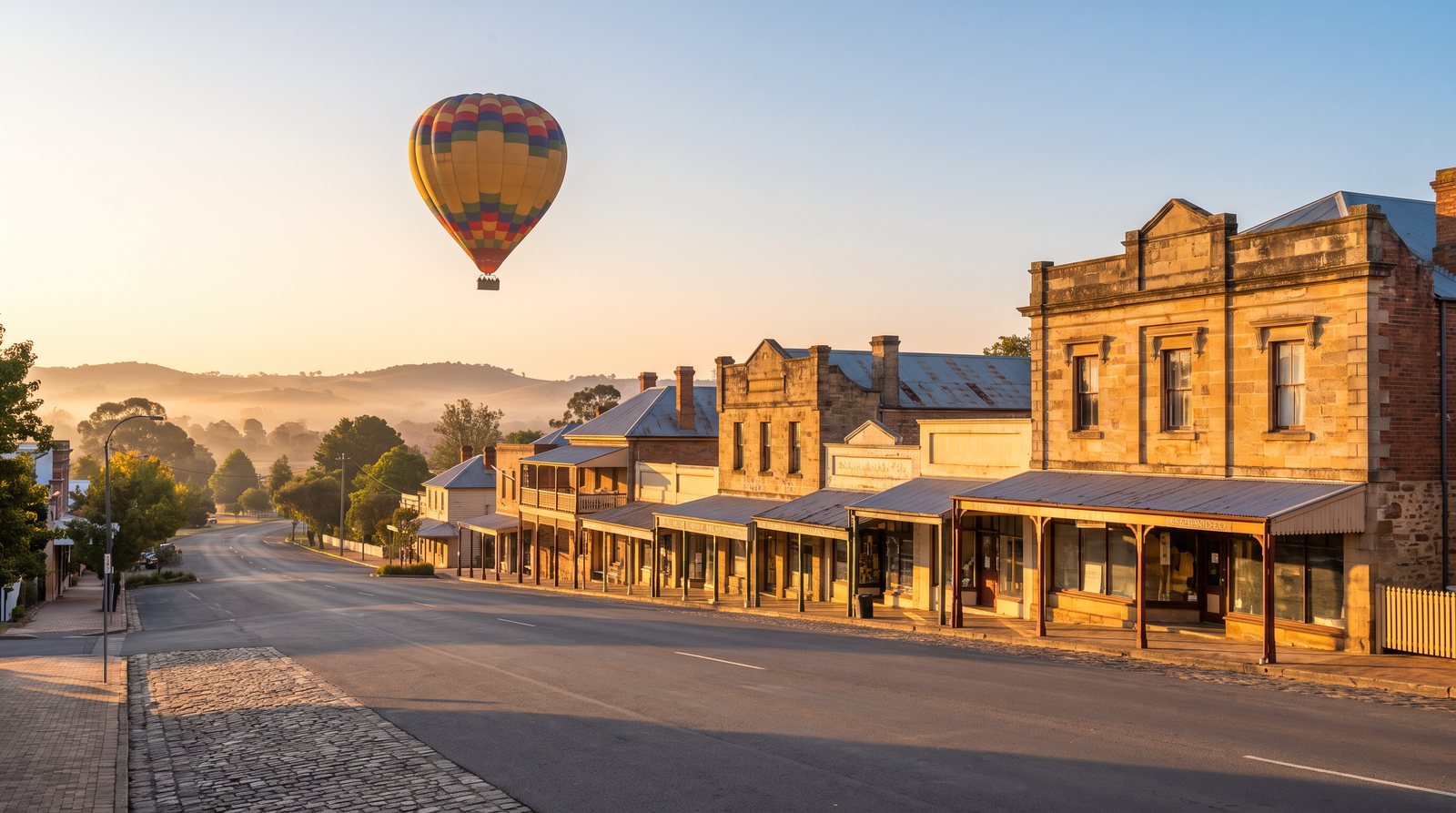
Canowindra sits in a fold of the Belubula Valley, a place where the landscape seems to hold its breath between the ancient past and the modern morning. To arrive here is to enter a town that defines itself through the layers of time, from the red-earth vineyards to the vast skies that have made it the hot air ballooning capital of Australia. The village, located in the Central West region of New South Wales, maintains a quiet, deliberate pace, its winding main street following the natural curve of the land rather than a rigid grid. It is a destination where the ground contains the remnants of a world 360 million years old, while the air above is frequently filled with the silent drift of balloons catching the first light. This duality creates a unique atmosphere that distinguishes Canowindra from its regional neighbors.
The town’s most profound connection to the past is found in the stone. In 1955, a road grader accidentally overturned a slab of rock that revealed a treasure trove of Devonian fossils. This discovery led to the establishment of the Age of Fishes Museum, a facility housing thousands of specimens from a time when the region was a vast inland sea. These are not merely bones, but imprints of armored fish and ancient predators that lived long before the dinosaurs. The fossils provide a rare window into the Devonian period, showing a level of preservation that allows scientists to study the fine details of scales and fins. For the visitor, standing before these slabs is a lesson in perspective, a reminder that these hills were once a vibrant aquatic ecosystem, teeming with life that was suddenly trapped and preserved.
Stepping onto Gaskill Street, the town’s heritage-listed main thoroughfare, one transitions from prehistoric eras to the frontier history of the 19th century. Canowindra’s layout is irregular, with the street bending to follow the path of an old bullock track. The architecture along this stretch is a testament to the town’s endurance, featuring Victorian-era masonry, wide timber verandas, and the sturdy facades of old banks and hotels. These buildings have witnessed the town’s evolution from a vital river crossing to a prosperous agricultural hub. There is a sense of care in the preservation of these structures, which now house galleries and local shops, allowing the history of the frontier to remain a functional part of daily life. The bend in the road creates shifting perspectives, inviting the pedestrian to notice the subtle details of craftsmanship that define the village.
While the fossils anchor Canowindra to the earth, the hot air balloons give it its modern identity. The Belubula Valley provides a nearly perfect environment for ballooning, with stable air currents and a landscape that is as beautiful from above as it is from the ground. Every year, the town hosts the Canowindra International Balloon Challenge, an event that draws pilots and spectators from across the globe to witness the spectacle of dozens of balloons rising in unison. Even outside of festival times, the sight of a lone balloon drifting over the vineyards at sunrise is common. The experience of flight here is one of profound silence, offering a panoramic view of the red-earth vineyards and the winding river. It is a form of travel that matches the town’s temperament—slow, observant, and entirely dependent on the whims of the natural world.
The lifeblood of Canowindra is the Belubula River, which winds through the valley, depositing the rich soil that has made the region an agricultural powerhouse. The land is a patchwork of productivity, where orderly rows of grapevines stand alongside orchards and broadacre crops. The vineyards are known for producing wines with a distinct regional character, shaped by the high altitude and unique mineral composition of the soil. This agricultural heritage is not just an industry but a way of life, dictated by the cycles of rain and harvest. The community fosters a culture deeply rooted in this landscape, with a growing movement of artisans and growers revitalizing the town’s heritage spaces. Local markets and galleries serve as meeting points, ensuring that the town’s unique character is not lost to the rush of modern development.
In Canowindra, the bridge between the ancient and the modern is surprisingly short. A visitor can spend the morning looking at fossils that are hundreds of millions of years old and the afternoon watching a high-tech balloon navigate the breeze. This juxtaposition highlights the town’s role as a keeper of records, both geological and cultural. The red earth that nourishes the vines is the same earth that preserved the Devonian fish, and the winds that carry the balloons are the same ones that have shaped the valley over millennia. This continuity provides a sense of stability, a feeling that Canowindra is a place where time is measured in more than just hours and days. It is a town that invites a deeper kind of engagement, asking the visitor to consider their own place in the long history of the landscape.
For those who travel to Canowindra, the journey rewards the patient observer who is willing to walk the length of Gaskill Street, sit by the river, or wait for the perfect light at dawn. It is important for visitors to engage with the local resources, checking the schedules of the Age of Fishes Museum and the conditions for balloon flights, as the town’s attractions are often tied to the seasons and the weather. Whether exploring the prehistoric displays or sampling the regional produce, there is a requirement for factual restraint—appreciating the town for what it is rather than what one might imagine it to be. The experience is grounded in the reality of the frontier, the science of the fossils, and the physics of flight, providing a travel experience that is both educational and restorative.
As the sun sets over the Belubula Valley, the true essence of Canowindra becomes clear. It is a place where the horizon is a meeting point for all the stories the town has to tell. From the silent, stone-cold fish of the Devonian to the vibrant, air-filled balloons of the present, Canowindra remains a steadfast witness to the changing world. It is a village that has learned how to hold its history without being weighed down by it, offering a space where the past is always present and the future is open. To leave Canowindra is to carry away a piece of that perspective, a reminder that even in a world of constant motion, there are places where time slows down just enough to let the most important stories be heard.