Show caves
Ancient megafauna fossils and towering crystal formations hidden within a subterranean limestone labyrinth
Beneath the sun-scorched plains of Country New South Wales lies the Wellington Caves, a subterranean limestone labyrinth where 400-million-year-old marine history meets the world’s most significant megafauna fossil site and towering crystal spires.
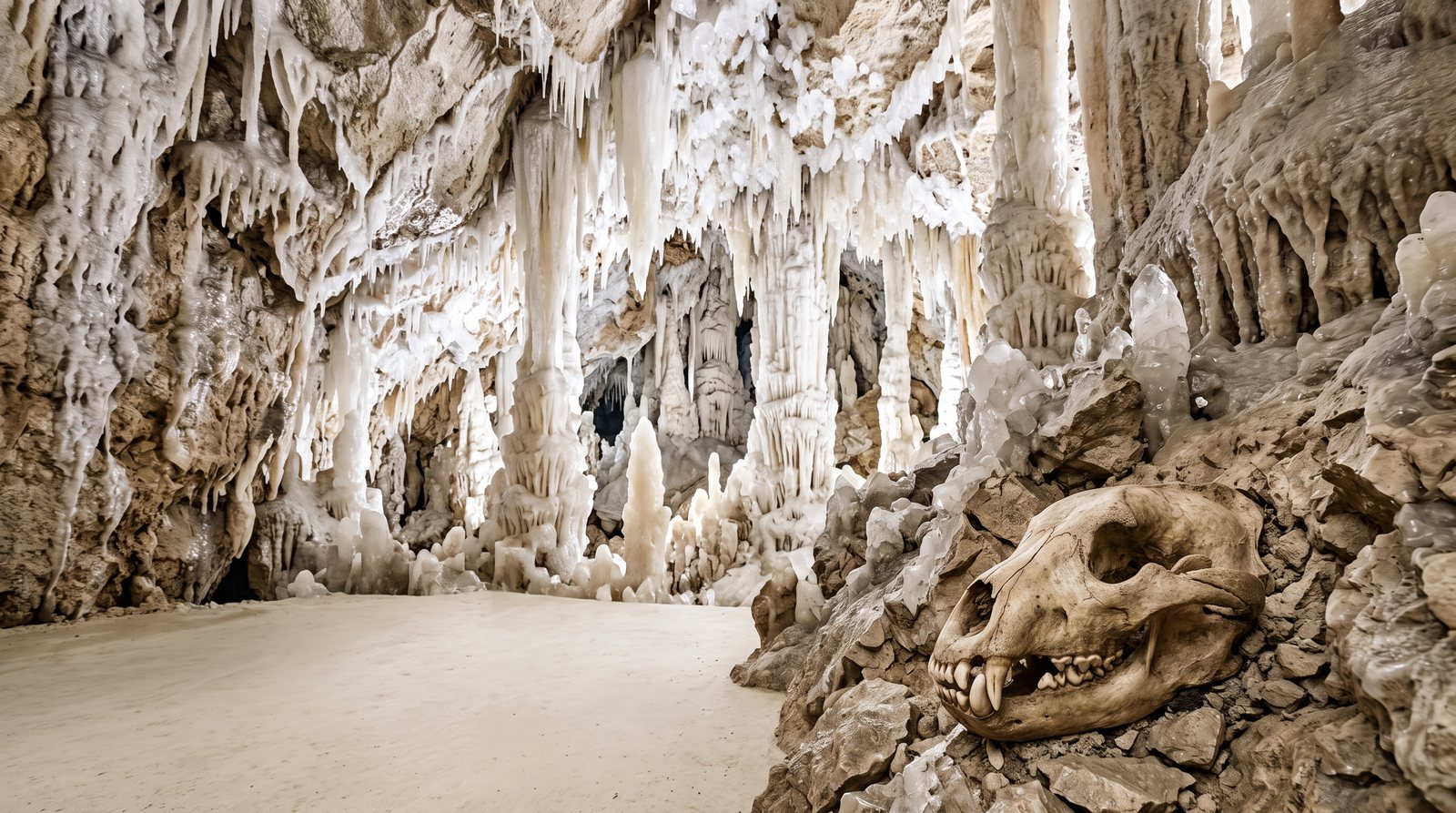
The transition from the expansive, horizontal landscape of regional New South Wales to the vertical reality of the Wellington Caves marks a profound shift in sensory experience. Above ground, the environment is defined by the open light of the Country NSW plains, where the horizon is a distant, shimmering line. However, stepping into the mouth of the Cathedral Cave introduces a different kind of scale—one measured not in kilometres, but in the slow, rhythmic accumulation of limestone over hundreds of millions of years. This subterranean labyrinth offers a rare opportunity to witness the physical evidence of deep time, where the air grows cool and the sound of the surface world is replaced by the heavy, expectant silence of the earth. It is a place where the geological history of the continent is not merely recorded in text, but carved into the very walls and ceilings of the limestone chambers.
The foundation of the Wellington Caves dates back approximately 400 million years to the Devonian period, a time when this part of Australia was submerged beneath a warm, shallow sea. The limestone that now forms the cave walls is composed of the remains of ancient marine life—corals, shells, and crinoids that settled on the ocean floor and were compressed over eons into solid rock. Walking through these passages is, in a literal sense, walking through the interior of an ancient reef. The textures of the walls still bear the subtle imprints of this marine heritage, offering a tactile connection to a world that existed long before the rise of the dinosaurs. This geological legacy provides the framework for the caves, creating the stage upon which subsequent millennia of water and chemical action would sculpt the dramatic formations that visitors see today.
Among the various chambers, the Cathedral Cave stands as the most architecturally significant, dominated by the massive Altar Rock stalagmite. This towering formation, reaching toward the vaulted ceiling, is a testament to the patient work of water. For thousands of years, mineral-rich droplets have fallen from the ceiling, each leaving behind a microscopic layer of calcite. The resulting structure is not merely a geological feature but a vertical archive of the cave’s internal climate and chemical history. The scale of the Altar Rock provides a necessary anchor for the eye within the cavernous space, illustrating how small, repetitive actions can eventually result in a monument of immense proportions. The lighting within the cave is carefully managed to highlight these textures, turning the chamber into a gallery where the primary medium is the interaction between stone and shadow.
Beyond its aesthetic appeal, the Wellington Caves hold a singular place in the history of Australian science as the site where the continent’s megafauna fossils were first recognized by Western researchers. The bones embedded in the red cave earth were unlike anything known to the scientific community at the time of their discovery. These remains belonged to giant marsupials that once roamed the landscape—creatures that stood metres tall or weighed as much as a small vehicle. This realization was a pivotal moment, providing the first evidence that Australia’s wildlife had a deep and distinct evolutionary history. The caves acted as a natural trap, preserving these remains in a stable environment that shielded them from the erosion and decay that claimed their counterparts on the surface, creating a biological time capsule of the Pleistocene epoch.
The fossil beds of Wellington Caves are essential data points for understanding the ecology of ancient Australia. By studying the composition and distribution of these bones, researchers can reconstruct the vegetation, climate, and predator-prey dynamics of the region from thousands of years ago. The presence of these fossils within the limestone labyrinth allows for a detailed look back into a world where the Australian bush was populated by creatures of mythic proportions, such as giant short-faced kangaroos and the Diprotodon. This scientific heritage elevates the caves from a mere destination to a site of global significance, where the records of a vanished fauna are held in trust by the earth itself, offering a profound connection to the continent’s biological evolution.
The human history of the Wellington Caves is as layered as its geology, encompassing both the traditional knowledge of the Wiradjuri people and the later industrial interventions of European settlers. During the early 20th century, parts of the cave system were utilized as a phosphate mine, with the nutrient-rich cave earth being extracted for use as fertilizer. This period of industrial activity left its own mark on the caves, creating new tunnels and exposing fossil-bearing strata that might otherwise have remained hidden. While the mining operations eventually ceased, they added a layer of social history to the site, reminding visitors that these subterranean spaces have long been viewed through the lens of utility as well as wonder. Today, the mine serves as a historical exhibit, illustrating the changing ways in which people have interacted with the earth’s hidden resources.
In contrast to the grand scale of the Cathedral Cave, the Gaden Cave offers a more intimate encounter with the delicate side of limestone decoration. Here, the formations are smaller and more intricate, featuring rare helictites—distorted, gravity-defying straws that twist and turn in unexpected directions. These formations occur when water pressure and air currents override the simple downward pull of gravity, resulting in a complex geometry that seems almost organic. The Gaden Cave is also known for its "coral" formations, where the limestone takes on the appearance of underwater life, further reinforcing the connection to the site’s ancient marine origins. This chamber requires a slower pace of observation, inviting visitors to notice the fine details of mineral growth that occur at a rate almost imperceptible to the human lifespan.
Ultimately, the Wellington Caves serve as a subterranean repository of memory, holding the records of an ocean that dried up, a climate that shifted, and a fauna that disappeared. They are a reminder that the surface of the earth is only the most recent layer of a much deeper story. By preserving both the 400-million-year-old limestone and the Pleistocene fossils, the caves offer a comprehensive view of the continent’s physical and biological evolution. For the visitor, the experience is one of "slow looking," an exercise in respecting the immense duration required to create a single stalactite or to fossilize a bone. As one emerges back into the bright light of Country NSW, the landscape above ground feels different, informed by the knowledge of the silent, crystalline world that lies just beneath the surface.