Historic town
Discover the rugged industrial heart and wild sandstone valleys of the Blue Mountains edge
Nestled in a dramatic valley at the western edge of the Blue Mountains, Lithgow serves as a powerful junction where Australia’s industrial history meets a vast, prehistoric wilderness of sandstone pagodas and sweeping escarpments.
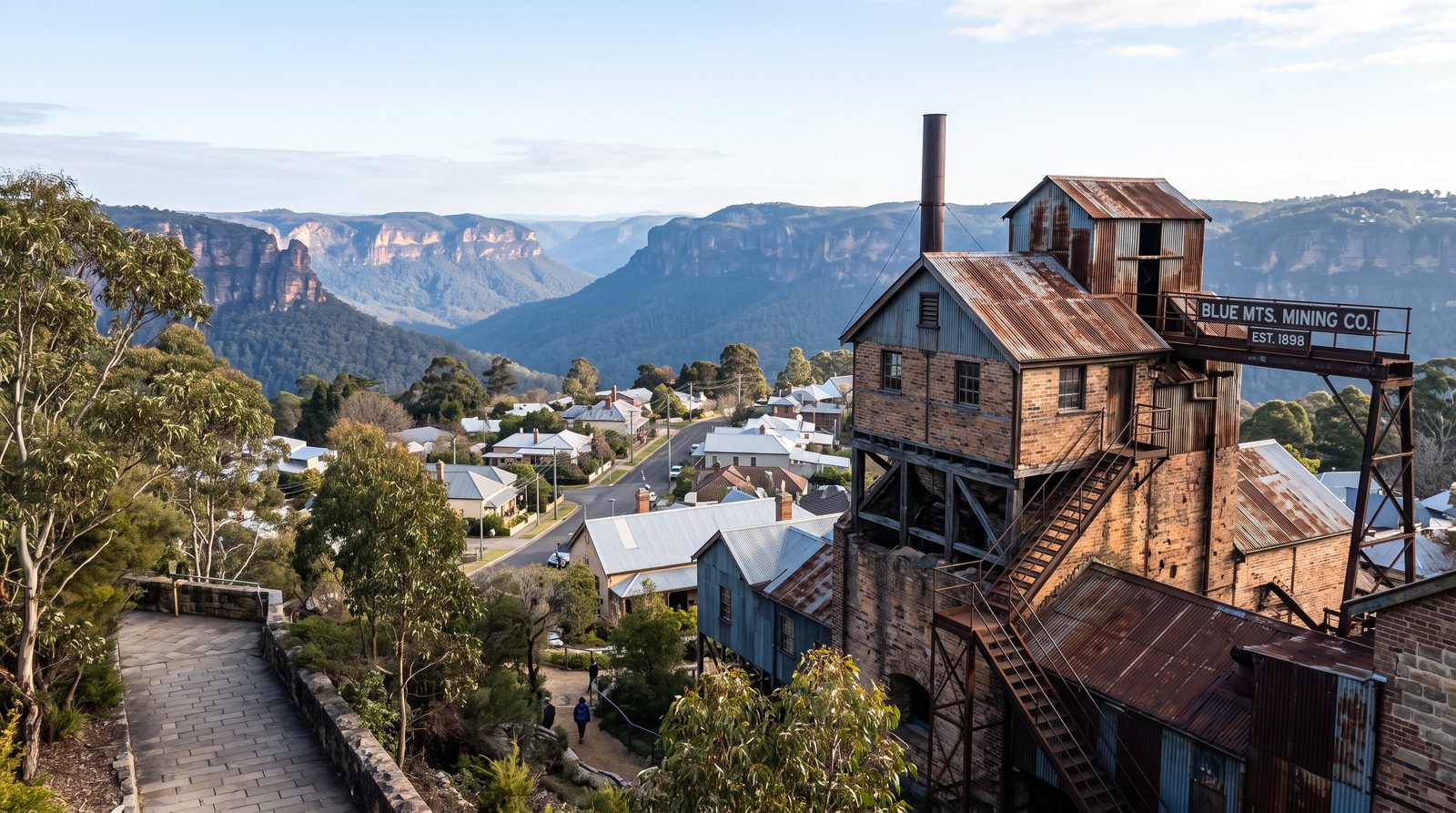
The descent into the Lithgow valley from the high ridges of the Blue Mountains marks a shift in the Australian landscape, where the soft blue haze of eucalypts gives way to a sharper, industrial geometry. Situated at the western base of the Great Dividing Range, the town occupies a deep natural bowl that has functioned as the engine room of New South Wales for over a century. It is a place defined by its edges: the hard sandstone cliffs that ring the horizon and the gritty, weathered edge of a town built on coal, iron, and steam. Unlike the tourist villages of the upper mountains, Lithgow retains a raw character that speaks to its history of primary production and engineering defiance. The geography here is a participant in the town’s identity, where the steep valley walls provided both the mineral wealth and the physical constraints that forced its builders to innovate.
At the heart of this industrial narrative lies the Blast Furnace Park, a sprawling site of weathered brickwork and rusted iron that serves as a silent monument to the birth of the Australian steel industry. It was here, in the early twentieth century, that William Sandford oversaw the construction of the nation’s first modern blast furnace, which began production in 1907. The ruins that remain today—soaring arches and the skeletal remains of the foundations—possess a cathedral-like quality, where the scale of human ambition is matched by the patient reclamation of the site by the surrounding scrub. For decades, this furnace was the center of a bustling complex that produced the pig iron and steel required for the young nation’s expanding infrastructure. The closure of the site in 1928 left behind a landscape of industrial archaeology that remains one of the most evocative heritage sites in the country, offering a tactile connection to the labor and heat that once defined the valley.
The sheer difficulty of the terrain surrounding Lithgow necessitated engineering feats that remain breathtaking, most notably the Great Zig Zag Railway. Constructed in the 1860s to solve the problem of descending the sheer sandstone escarpment of the Blue Mountains into the valley, the railway utilized a series of switchbacks and massive stone viaducts to navigate the impossible gradients. This configuration allowed steam locomotives to traverse the vertical drop by reversing direction at specific points, a solution that was as elegant as it was labor-intensive. Today, the heritage railway continues to operate as a living museum, where the smell of coal smoke and the rhythmic chuff of steam engines provide a sensory bridge to the nineteenth century. Traveling along these tracks offers a unique perspective on the landscape, revealing the immense scale of the sandstone cuttings and the precision of the hand-hewn stone blocks that have supported the weight of iron and commerce for generations.
Beyond the brick and iron of the town center, the landscape transforms into a surreal geological gallery known as the Gardens of Stone. This region is defined by its unique sandstone pagodas—towering, tiered rock formations that have been sculpted by millions of years of wind and water erosion into shapes that resemble ancient, weathered temples. These pagodas are often banded with ironstone, giving them a distinct orange and red hue that glows with particular intensity during the late afternoon. The Gardens of Stone National Park protects a labyrinth of slot canyons, sheer cliffs, and high plateaus that remain largely untouched by development. For the hiker, the experience is one of constant discovery, where a narrow gap between two stone pillars might lead to a hidden amphitheater of ferns or a panoramic view over the "Lost City," a dense cluster of pagodas that reminds visitors that the natural architecture of the valley far predates the industrial structures of the town.
To truly comprehend the scale of the Lithgow valley, one must stand at the summit of Hassan’s Walls Lookout, the highest scenic point in the entire Blue Mountains region. At approximately 1,100 meters above sea level, the lookout provides a 360-degree panorama that encompasses the Hartley Valley to the east and the rolling plains of the Central Tablelands to the west. From this vantage point, the sheer verticality of the landscape becomes apparent, as the sandstone cliffs drop away into deep, forested ravines. The view toward Mount Wilson and the Grose Valley highlights the complex network of ridges and valleys that make up this part of the Great Dividing Range. The lookout itself is a testament to the region's accessibility; a short walk from the car park leads to a series of boardwalks and viewing platforms that hang over the edge of the precipice, offering a dizzying sense of space that contrasts sharply with the enclosed, protected feeling of the town floor below.
The wilderness surrounding Lithgow extends into two of the state’s most dramatic valley systems: the Wolgan Valley and the Capertee Valley. The Capertee Valley is recognized as the widest canyon in the world—even wider, though not as deep, as the Grand Canyon. Enclosed by the towering escarpments of the Wollemi and Gardens of Stone National Parks, the valley floor is a mosaic of farmland and woodland that provides a critical habitat for a vast array of bird species. The Wolgan Valley, located to the north of Lithgow, offers an equally spectacular experience, with the ruins of the Newnes Shale Oil Works providing another layer of industrial history set deep within a narrow, cliff-bound canyon. These valleys serve as gateways to the true wilderness of the Wollemi, a vast area of rugged peaks and hidden valleys that remains one of the most inaccessible and mysterious regions in Australia, home to the ancient and prehistoric Wollemi Pine.
Ultimately, Lithgow stands as a reminder that the Australian landscape is a place of human effort and transformation. The town’s identity is forged in the intersection of the two—the permanence of the sandstone pagodas and the transience of the industrial era. For the traveler, it offers a complex experience, providing a window into the labor and engineering that shaped the nation. Whether one is exploring the silent ruins of the blast furnace, riding the steam-powered switchbacks of the Zig Zag Railway, or standing on the edge of the Capertee Valley, the sensation is one of being at the heart of something significant. Lithgow is a place where the rugged industrial heart and the wild sandstone valleys are two halves of a single, powerful story that continues to unfold on the edge of the Blue Mountains, where the spirit of innovation and the connection to the land remain strong.