Valley
The world’s widest canyon carved into the heart of the Blue Mountains
Stretching wider than the Grand Canyon, the Capertee Valley is a monumental landscape of ancient sandstone cliffs and rare biodiversity. From the ruins of Glen Davis to the soaring Pantoneys Crown, it offers a profound encounter with the Blue Mountains.
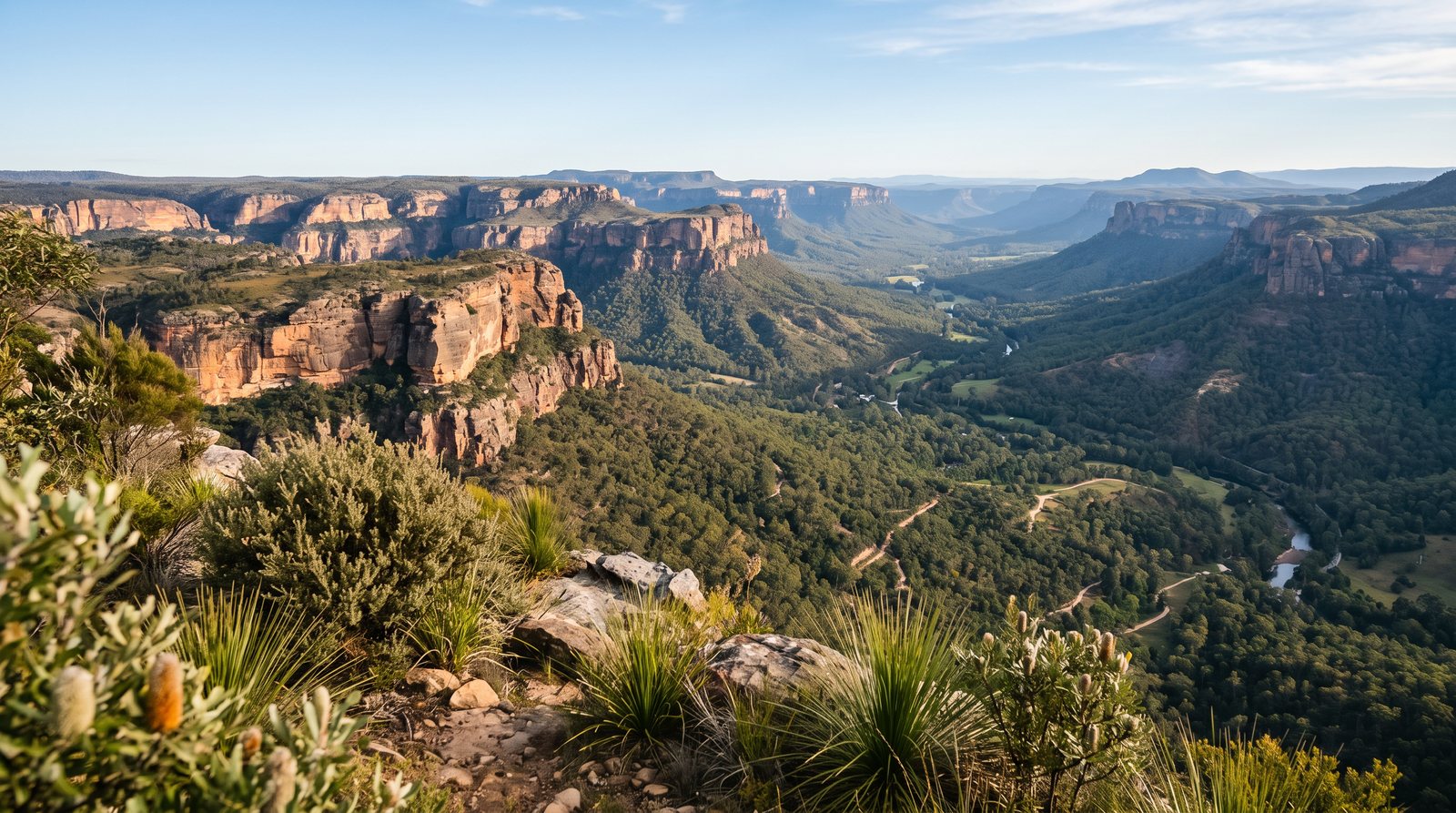
The Capertee Valley, located on the western edge of the Blue Mountains in New South Wales, is a premier geological feature of the Australian continent. While the Grand Canyon is the global benchmark for scale, the Capertee Valley holds the title of the world’s widest canyon, spanning approximately 30 kilometers from rim to rim. This immense basin was carved over millions of years into Triassic sandstone by the Capertee River. For travelers on the Castlereagh Highway, the first view is overwhelming; the horizontal expanse challenges the eye as distant escarpments fade into a blue haze. It is a landscape demanding a recalibration of distance, where the sky feels larger and the earth more ancient than in the enclosed valleys of the central Blue Mountains.
The geological narrative of the valley is written in the towering sandstone cliffs flanking its perimeter. These vertical walls, composed of Triassic sediment, stand as silent witnesses to the slow retreat of the landscape. Over eons, water has dismantled the plateau, carrying away rock to reveal the vast basin seen today. The result is a complex topography of deep gorges and isolated mesas rising abruptly from the valley floor. The sandstone displays a palette of ochre, cream, and grey, colors shifting in intensity with the light. This transformation has created a sanctuary where the interior's harshness is softened by the protective embrace of the surrounding heights, allowing a unique microclimate to persist within the valley's depths.
Dominating the central skyline is Pantoneys Crown, a massive sandstone mesa and the valley’s most iconic landmark. Rising sharply from the floor, this flat-topped formation acts as a natural anchor for the landscape, its rugged profile contrasting with the wider slopes. For many, Pantoneys Crown is the spiritual heart of the Capertee, a destination for experienced hikers seeking to survey the canyon's vastness. The climb is a challenging ascent through steep slopes and narrow chimneys, but the reward is a panoramic view encompassing the entire valley. From this vantage point, the scale of the canyon becomes apparent, revealing the intricate network of watercourses and forest patches that sustain the valley’s life.
Beyond geological grandeur, the Capertee Valley is a vital sanctuary for biodiversity, particularly for woodland bird populations. The valley’s fertile soils and varied topography provide critical habitat for species with diminished ranges elsewhere. Most notably, the valley is a final stronghold for the critically endangered Regent Honeyeater, whose survival is linked to the local ironbark and box-gum woodlands. Ornithologists from around the world visit the Capertee to experience one of the most intact woodland ecosystems in southeastern Australia. The morning chorus is a dense tapestry of sound, a reminder that this landscape is a living environment where every tree plays a role in a complex ecological drama, maintaining a balance that has existed for thousands of years.
The human history of the valley is as layered as its sandstone walls, with the ruins of Glen Davis offering a glimpse into its industrial past. Nestled at the foot of the cliffs, Glen Davis was a center for shale oil production during the mid-20th century. Today, the skeletal remains of retorts and workshops stand in silent decay, slowly being reclaimed by the bushland. These ruins provide a juxtaposition to the natural beauty, serving as a reminder of the fleeting nature of human endeavor against geological time. Wandering through the site, visitors can sense the scale of the machinery that once defined life in this remote outpost. The preservation of these ruins ensures the industrial heritage of the Capertee is not forgotten.
For those wishing to experience the valley’s scale without venturing into remote corners, Pearsons Lookout provides an unparalleled perspective. Located along the Castlereagh Highway, this vantage point captures the full breadth of the canyon in a single frame. From here, the relationship between the sandstone escarpments and the valley floor is visible, as is the way light interacts with the landscape. In the early morning, the valley is often filled with mist, with mesa tops appearing like islands in a white sea. As the sun rises, the colors of the cliffs burnish, shifting from deep reds to brilliant golds. The lookout serves as a gateway, inviting travelers to descend from the plateau and explore the secrets hidden below the rim.
The sense of wilderness and isolation in the Capertee Valley is its most enduring quality. Despite its proximity to urban centers, the valley remains a place where one can truly escape the modern world. The lack of large-scale development and the rugged terrain have preserved a feeling of frontier solitude. Exploration often involves navigating unmarked trails and traversing stretches of open woodland, where the only company is local wildlife and the wind rustling through the eucalypts. This isolation is not merely physical but psychological; the scale of the landscape silences the noise of daily life. Whether camping under the stars or hiking the remote ridges of the Wollemi boundary, the visitor is reminded of their own smallness in the face of such overwhelming natural beauty.
Light plays a transformative role in the valley, acting as a second material that shapes the perception of the landscape. Because of the canyon’s width and the height of its cliffs, the interplay of light and shadow is exceptionally dramatic. The golden hour, just before sunset, is particularly significant, as the low-angled sun hits the sandstone escarpments directly, causing them to glow with an intensity that seems supernatural. During these moments, the textures of the rock and vegetation are highlighted with startling clarity. The shadows of the mesas stretch long across the valley floor, creating a dynamic map of light that changes by the minute. For photographers and artists, this period is a fleeting window into the valley’s soul, revealing a depth often hidden during the harsh glare of midday.
In conclusion, the Capertee Valley stands as a monumental intersection of geology, ecology, and history. It is a place that defies easy categorization, being both a site of scientific importance and a landscape of profound aesthetic beauty. Its status as the world’s widest canyon is a point of geographic pride, but its true value lies in how it preserves a sense of the ancient Australian wilderness. From the heights of Pantoneys Crown to the industrial silence of Glen Davis, the valley offers a journey through time, inviting visitors to consider the forces that have shaped the earth. As a sanctuary for rare species and a testament to the power of the natural world, the Capertee Valley remains a cornerstone of the Blue Mountains region.