Limestone caves
The subterranean majesty of the world's oldest discovered open cave system
Hidden within the Greater Blue Mountains, the Jenolan Caves represent the world's oldest discovered open cave system. These Silurian limestone formations and subterranean rivers offer a profound encounter with 340 million years of geological history.
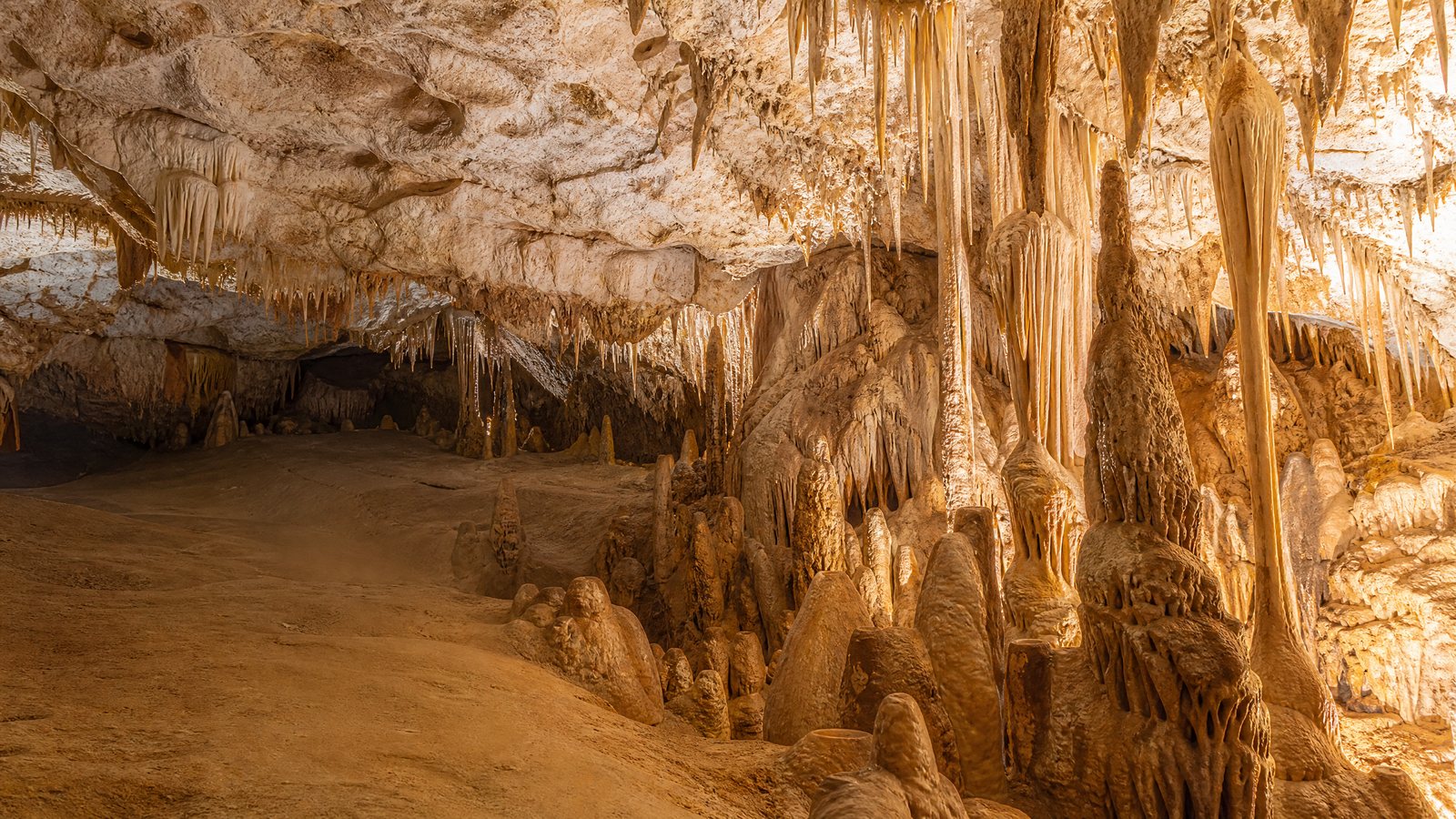
To enter the Jenolan Caves is to step out of the frantic pace of the human present and into a register of time that is profound. Located within the rugged folds of the Greater Blue Mountains World Heritage Area, this subterranean labyrinth is not merely a collection of limestone chambers; it is the oldest discovered open cave system on Earth. While the surface world undergoes rapid cycles of growth and decay, the caves maintain a patient, mineral silence that has endured for hundreds of millions of years. This sheer scale of chronology reframes the Australian landscape, shifting it from a colonial history into a deep-time narrative where entire mountain ranges are but temporary features. Visitors who descend into these depths are greeted by a stillness that feels heavy with the weight of eras, where every drip of water carries the potential to add a microscopic layer to a stalactite that may not be finished for another millennium.
The geological foundations of Jenolan were laid down during the Silurian period, approximately 430 million years ago. Over eons, the remains of marine organisms—corals, crinoids, and mollusks—accumulated on the ocean floor, eventually compressing into thick beds of limestone. It was not until much later, roughly 340 million years ago, that the process of cave formation truly began, as acidic groundwater started to dissolve the rock along fractures. This specific dating, confirmed by advanced potassium-argon testing of clay minerals, distinguishes Jenolan as a true geological elder. Many famous cave systems are significantly younger, often by hundreds of millions of years. This antiquity means that the formations at Jenolan have had a vastly longer period to develop their complexity, resulting in a density and variety of calcite structures that are rarely matched elsewhere on the planet.
Within the darkness, the caves reveal an architectural complexity that rivals any man-made cathedral. The Lucas Cave is defined by its immense scale, particularly the Cathedral Chamber, which has long been used for its exceptional acoustics. Here, the limestone walls soar upward, draped in massive "shawls" of calcite that appear as delicate as fabric despite their stony weight. In contrast, the Orient Cave offers a more intimate and ornate experience, where the concentration of iron and other minerals has tinted the formations in rich shades of amber, red, and cream. The Temple of Baal is another highlight, named for its beauty, featuring the "Angel’s Wing," a nine-meter-long shawl of pure white calcite that seems to defy gravity. These spaces are the result of a continuous, slow-motion choreography of water and mineral, where the environment is constantly, if imperceptibly, being reshaped by the elements.
The experience of navigating these subterranean passages is as much sensory as it is visual. Beyond the reach of natural light, the air takes on a consistent, cool temperature and a distinct scent of damp earth and ancient stone. The sound of the underground rivers, such as the Jenolan River which still flows through the lower levels of the system, provides a rhythmic backdrop to the exploration. These pure, crystalline waters are responsible for the ongoing creation of the caves, carving out new paths and nourishing the growth of new formations. The silence in the deeper, more remote chambers is absolute. It is a reminder that the majority of the Earth's history has occurred in the dark, away from the eyes of any observer, driven by the patient laws of chemistry and physics over biology.
Above ground, the transition back to the light is mediated by the historic Caves House and the surrounding wilderness. Constructed starting in 1897, Caves House stands as a testament to the late Victorian fascination with wilderness tourism. Its grand, multi-gabled facade and dark timber interiors reflect a period when a trip to Jenolan was a major expedition, requiring days of travel by horse and carriage. The building serves as a cultural anchor for the reserve, providing a bridge between the raw geological power of the caves and the refined comfort of early 20th-century hospitality. The surrounding gardens and the nearby Blue Lake, which owes its striking vivid color to the high concentration of dissolved limestone minerals, offer a picturesque contrast to the rugged karst landscape. Here, the Brush-tailed rock-wallabies and the elusive platypus find a sanctuary, coexisting with the visitors who pass through the Grand Arch.
The discovery of the caves by Europeans is traditionally attributed to James Whalan around 1838, though the local Gundungurra and Darug peoples have known of the site for thousands of generations, referring to it as 'Binoomea,' or 'Dark Places.' By 1866, the New South Wales government recognized the unique value of the area and set it aside as a reserve for public recreation, one of the earliest examples of environmental protection in the country. This foresight allowed the caves to be preserved during a time when many other natural wonders were being exploited for their resources. The subsequent development of paths, stairs, and eventually electric lighting transformed the caves into a premier tourist destination, allowing visitors to witness the subterranean majesty for themselves.
In recent years, the relationship between the caves and the surface world has been tested by the forces of nature. Major flooding and landslides have caused significant damage to the access roads, leading to a necessary but prolonged closure of the reserve. Since March 2024, the site has been largely inaccessible to the public as Transport for NSW undertakes complex restoration work to stabilize the slopes and rebuild the infrastructure. This period of closure, while challenging for local tourism, has provided a rare opportunity for the caves themselves to rest. The restoration project, which is targeted for completion in early 2027, is not just about repairing a road; it is about ensuring that the world's oldest cave system remains safe and accessible for future generations.
As we wait for the gates to reopen, the Jenolan Caves continue their slow, internal work, indifferent to the absence of human observers. The World Heritage status of the Greater Blue Mountains Area underscores the global significance of this site. Preservation at Jenolan is a multi-faceted effort, involving geologists, biologists, and historians who work to protect the delicate balance of the cave environment. The restriction of access serves as a potent metaphor for our relationship with the natural world—a reminder that these spaces are not merely commodities for our enjoyment, but precious archives of a history that predates us by millions of years. When visitors return in 2027, they will find the caves as they have always been: majestic, silent, and profoundly ancient, offering a perspective on time that only the deepest places on Earth can provide.