National park
Witness the tiered grandeur of Wentworth Falls in the Blue Mountains
Tracing the weathered sandstone edges of the Blue Mountains, the path to Wentworth Falls remains a profound encounter with the scale of the Australian wilderness. Here, the historic footsteps of naturalists meet the eternal, tiered descent of Jamison Creek.
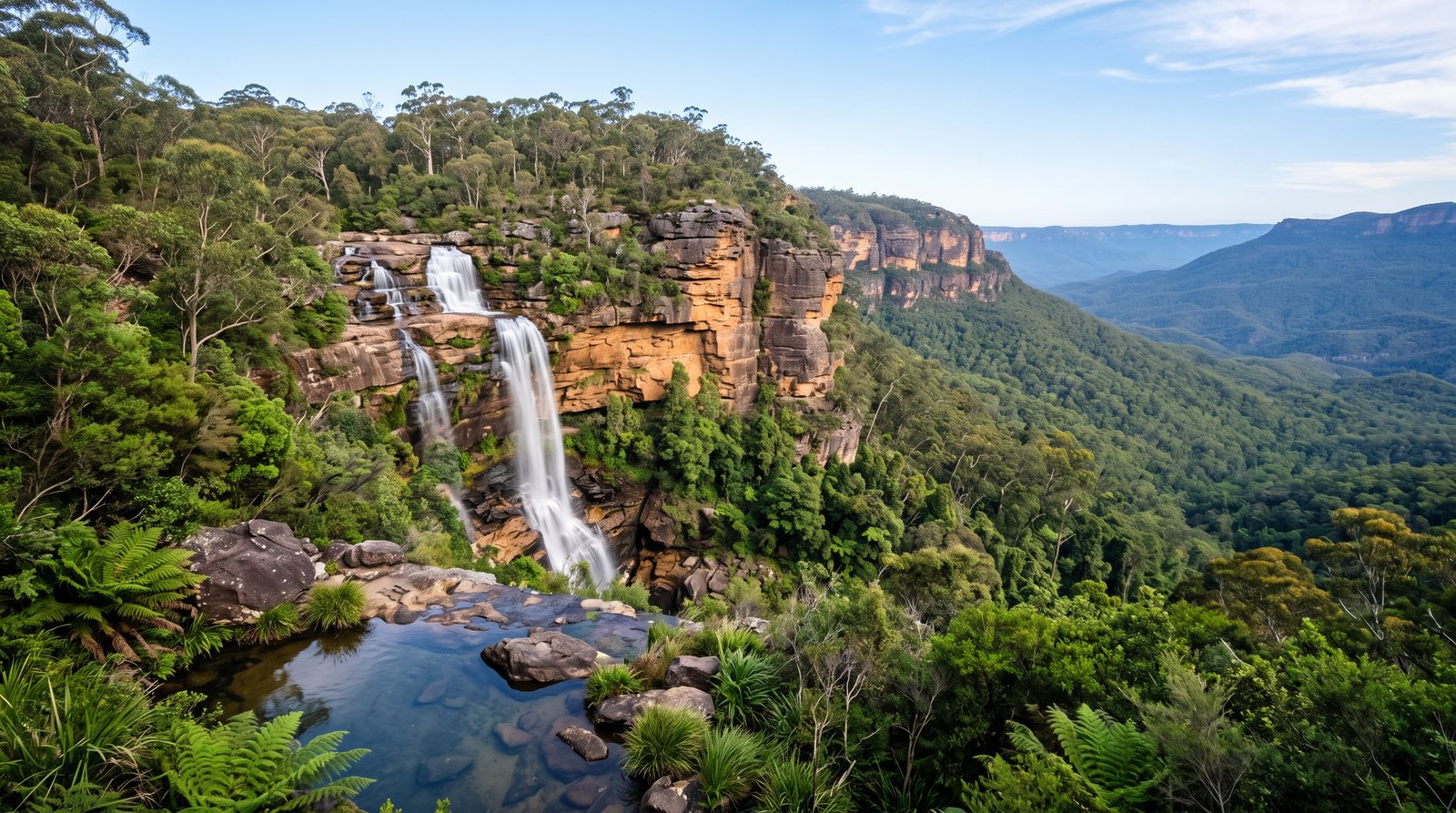
The descent toward the lip of Wentworth Falls begins with the sudden silence of the Jamison Valley. Standing at the edge of the sandstone escarpment, the world drops away in dramatic, blue-hued tiers, revealing a wilderness indifferent to the passage of centuries. The air carries the scent of eucalyptus and damp earth, a sensory signature of the Blue Mountains National Park that grows potent as one nears the cliff’s edge. It is a place where the geological clock slows down, and modern concerns are swallowed by the verticality of the landscape. The falls reveal their grandeur in stages, a three-tiered symphony of water and stone that has carved through the ancient plateau with patient persistence.
History occupies these tracks as surely as the mist that clings to the valley floor. In January 1836, a young Charles Darwin walked these same cliff edges, pausing to marvel at the "stupendous" scale of the sandstone amphitheatres. His observations were not merely those of a traveler but of a man attempting to reconcile the vastness of deep time with the physical reality of the Australian continent. Today, the Wentworth Falls track follows much of the route Darwin took, offering visitors a tangible link to the dawn of evolutionary thought. To walk this path is to engage in chronological layering, where 19th-century curiosity meets a contemporary desire for reconnection. The sandstone underfoot, weathered by millennia of rain, serves as a silent witness to the fleeting passage of human history.
The physical journey along the falls is an exercise in perspective, shifting between the intimate details of the bush and the vistas of the valley. As the track winds past Fletchers Lookout, the full scale of the three-tiered waterfall becomes visible, a silver thread plunging one hundred metres into the lush canopy below. The Jamison Creek, having gathered strength from the high plateaus, makes its final leap into the abyss, creating a microclimate of spray and shadow that supports a delicate array of ferns. This vertical world is one of constant transition, where the dry heath of the upper ridges gives way to the temperate rainforest of the valley floor. Every turn in the path offers a new vantage point, a different way to read the relationship between the permanence of the cliffs and the falling water.
The geology of the Blue Mountains is written in the horizontal bands of the sandstone cliffs, each layer representing a different epoch in the continent’s long memory. At Wentworth Falls, this vertical record is exposed with startling clarity. The red and ochre hues of the stone change with the movement of the sun, deepening into rich violets as the afternoon light begins to fade. This is a landscape defined by erosion and resilience; the very features that draw visitors today—the deep canyons and tiered falls—are the results of millions of years of patient carving by wind and water. There is a quiet power in recognizing that the spectacular view across the Jamison Valley is not a static picture, but a single frame in an ongoing geological process that continues to shape the heart of New South Wales.
The flora and fauna of the Wentworth Falls area are as much a part of its character as the stone and water. High above, the majestic wedge-tailed eagles often catch the thermals rising from the valley, their shadows drifting across the cliff faces like ghosts of the ancient sky. Along the tracks, the hardy banksias and vibrant waratahs cling to the thin soil of the sandstone ridges, their forms twisted by the mountain winds. In the more sheltered gullies, the ancient tree ferns reach toward the light, their fronds creating a prehistoric canopy that filters the sun into a soft, emerald glow. This ecosystem is a testament to the adaptability of Australian life, thriving in an environment of extremes where fire, flood, and drought are all part of the natural cycle. To observe these details is to understand that the beauty of the falls is not just in the grand gesture of the plunge.
In recent years, the fragility of this ancient landscape has become more apparent, as shifting weather patterns and the inherent instability of the sandstone cliffs necessitate constant vigilance. Landslides and rockfalls are natural parts of the mountain’s evolution, yet they serve as stark reminders of the restraint one must exercise when moving through such a dynamic environment. The closure of certain track sections is not merely a logistical inconvenience but a mark of respect for the power of the natural world. It reinforces the idea that we are guests in this wilderness, permitted to witness its grandeur only so long as we acknowledge its volatility. This sense of uncertainty adds a layer of poignancy to every visit, a realization that the view we see today may be subtly different tomorrow, reshaped by the forces that created it.
As the late afternoon sun begins its descent, the soft golden light transforms the entire Jamison Valley into a cathedral of light and shadow. The mist that often gathers at the base of the falls begins to glow, catching the last rays of the sun and turning the falling water into a column of molten gold. This is the hour of the wistful ink, when the landscape seems to hold its breath and the connection between the observer and the observed becomes most profound. There is a deep, resonant peace in watching the shadows stretch across the valley floor, a sense of belonging to something much larger and more enduring than the individual self. The falls continue their patient descent into the dark, a silver thread in the gathering twilight, carrying the memory of the day into the silence of the mountain night.
Wentworth Falls offers both spectacle and sanctuary. Visitors can stand at the edge of the world to feel the pulse of the continent, or find a quiet corner to listen to the drip of water on stone. The historic footsteps of Darwin and the countless others who have walked these paths are not just echoes of the past, but invitations to look more closely at the world around us. In the tiered grandeur of the falls, we find a reflection of our own desire for perspective, for a way to understand our place in the long, unfolding story of the earth. As the stars begin to appear over the dark silhouettes of the Blue Mountains, the falls remain a constant, a silver line of continuity in a world of change.