National park
The weathered sandstone spires and deep wilderness valleys of historic Katoomba
Katoomba stands as the historic heart of the Blue Mountains, where weathered sandstone spires overlook the vast, eucalyptus-scented Jamison Valley. Its network of cliff-side trails and iconic lookouts offer a profound connection to this ancient wilderness.
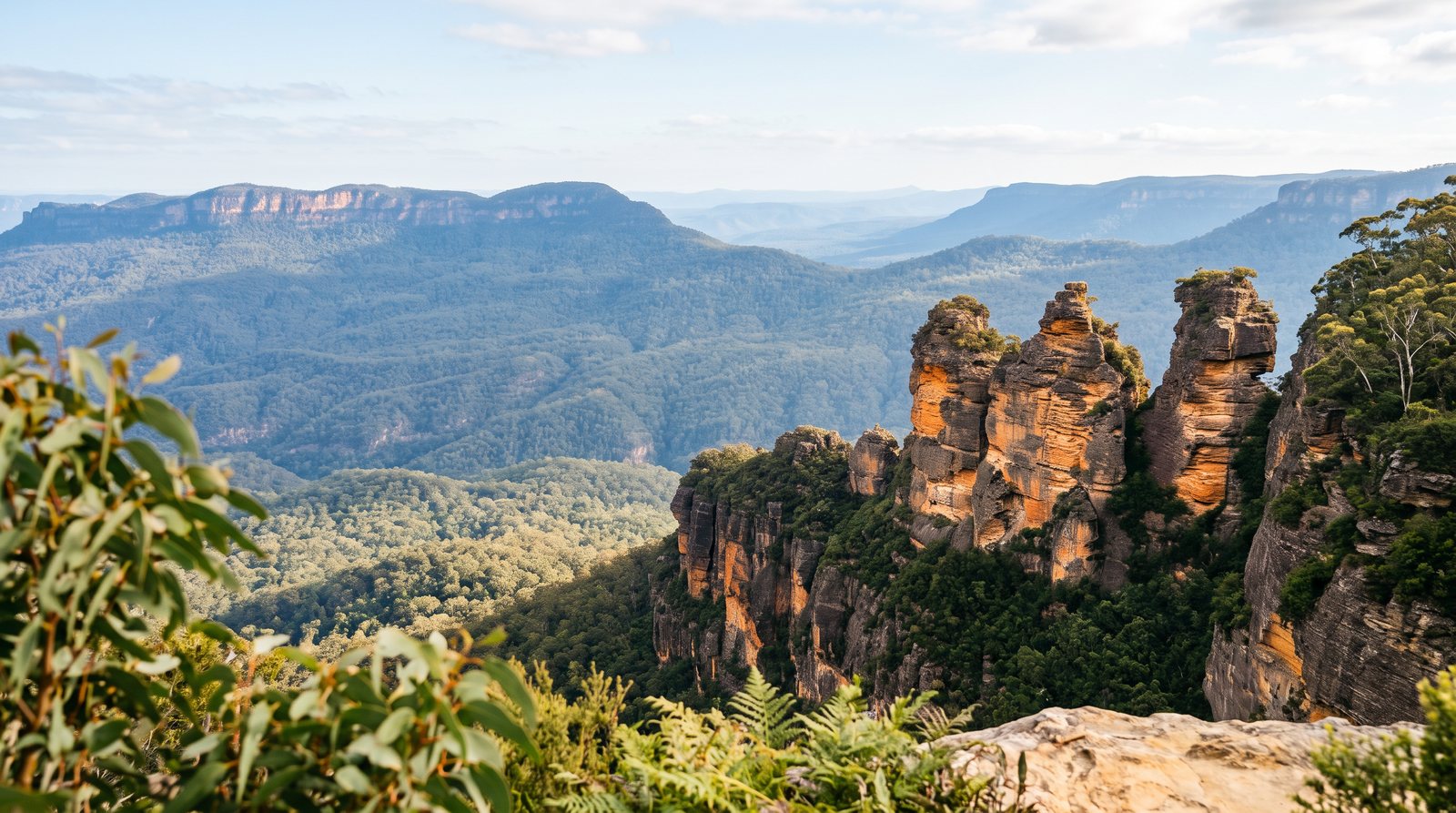
Katoomba stands as the definitive anchor of the Blue Mountains, a town whose identity is linked to the sheer drop of the sandstone escarpment defining its southern edge. While it began as a modest coal and oil shale mining settlement, its trajectory was permanently altered by the scale of the landscape. The transition from industrial utility to a place of global wilderness significance recognized the profound atmospheric quality of this high-altitude region. Today, the town serves as a threshold where historic streets give way to the immense silence of the Jamison Valley. It is a place where the air feels thinner and colder, carrying the sharp, medicinal scent of eucalyptus that has become the hallmark of the Great Dividing Range.
The character of Katoomba is defined by the Jamison Valley, a vast sandstone basin stretching toward the horizon in receding blue ridges. This characteristic blue haze is a physical phenomenon caused by light scattering through fine oil droplets released by the dense eucalyptus forest. The result is a landscape that often feels like a painting, where depth is measured in shades of cobalt and indigo. The sandstone walls, weathered by millions of years of erosion, stand as vertical sentinels that catch the changing light, turning from cream in the morning to a deep ochre at sunset. This geological scale humbles the human presence, reminding every visitor that the town is merely a guest on the edge of an ancient wilderness.
At the heart of this landscape are the Three Sisters, the most iconic geological formation in the Australian interior. These three weathered sandstone pillars—Meehni, Wimlah, and Gunnedoo—stand on the edge of the escarpment, separated from the main cliff by the patient work of wind and water. Their presence illustrates how soft sedimentary rock is slowly reclaimed by the valley. While they are a focal point for visitors to Echo Point, their power is best understood in the quiet moments of the early morning when the valley is filled with mist. In these hours, the pillars seem to float above a white sea of cloud, existing in a state of ethereal suspension. They are the visual shorthand for the majesty of the Blue Mountains, representing a landscape in constant transition.
The connection between town and valley is maintained through a network of historic walking trails carved into the cliff faces over a century. The Prince Henry Cliff Walk, skirting the escarpment from Katoomba Falls to Gordon Falls, offers lookouts that reveal the valley from shifting angles. These paths are engineering feats that allow the human body to navigate a landscape never intended for easy passage. Descending into the valley via the Giant Stairway or Furber Steps involves a physical commitment to the verticality of the terrain, moving through distinct layers of vegetation from dry sclerophyll forest to lush, temperate rainforest. Each step down is a step back in time, as the air grows damp and the sound of the wind is replaced by the drip of water and the call of the lyrebird.
Echo Point serves as the primary interface between the modern world and the ancient valley, a viewing platform that draws global visitors to witness the scale of the Australian wilderness. There is a strange tension here, where the noise of a busy tourist destination meets the absolute stillness of the Jamison Valley. To stand at the railing is to look out over a million hectares of World Heritage-listed wilderness, a view that has remained largely unchanged for millennia. The platform provides a safe vantage point to contemplate the abyss, offering a sense of perspective difficult to find in urban life. For many, this is their first encounter with the true scale of the Australian bush, where horizontal forest meets the vertical drama of sandstone cliffs.
The atmosphere of Katoomba is dictated by a climate distinct from the coastal plains. In winter, the town is frequently shrouded in a thick mountain mist that reduces visibility, turning familiar streets into a spectral landscape. This "mountain gloom" is a cherished part of local identity, bringing an intimacy that contrasts with the expansive views of clear days. Snow is an occasional visitor, dusting the Three Sisters in white and silencing the forest. In summer, the mountains offer a cool refuge from the heat, though the threat of bushfire remains a constant presence in the collective memory. The landscape is a living system that responds to the rhythms of the weather, changing its color, scent, and sound with the passing hours.
Katoomba is a gateway to the Greater Blue Mountains World Heritage Area. To the east, the cascades of Wentworth Falls offer a different drama, where water plunges over three tiers of sandstone. To the west, the high-altitude plateau of Blackheath provides even deeper views into the Grose Valley. This interconnected web of canyons and forests represents one of the most significant botanical and geological regions globally. The diversity of eucalyptus species is of global importance, but the sheer continuity of the wilderness is most impressive. From the lookouts at Katoomba, one can see for miles without a sign of human habitation, a rare and precious sight in the twenty-first century.
Ultimately, the appeal of Katoomba lies in its position on the edge. It is a town that lives on the brink of something much larger than itself, a community that respects the power and silence of the wilderness. The historic architecture—the grand hotels, weathered cottages, and art deco storefronts—reflects a long history of people seeking solace in the mountains. Whether it is the artist looking for light, the hiker seeking a challenge, or the traveler looking for quiet, Katoomba provides a space where the human spirit can expand to match the scale of the horizon. It remains a place of profound connection, where weathered sandstone spires and deep valleys continue to tell a story of time, resilience, and the enduring beauty of the natural world.