UNESCO World Heritage Site
A storied industrial sanctuary adrift in the heart of Sydney Harbour
A UNESCO-listed sanctuary in Sydney Harbour, Cockatoo Island preserves a haunting history of convict labor and naval industry. Its rusted workshops and sandstone ruins offer a quiet, industrial perspective on the city’s evolving maritime identity.
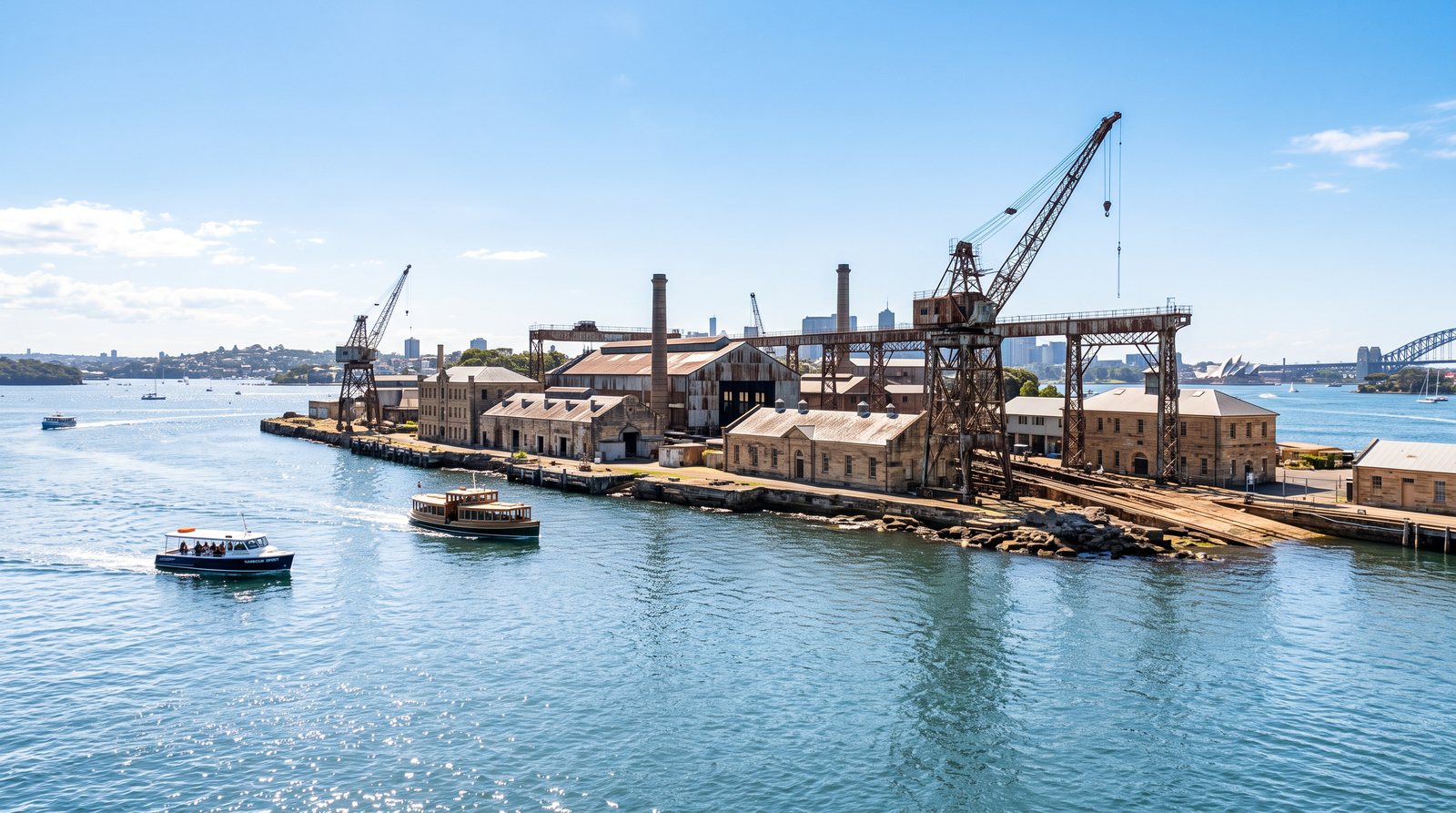
Cockatoo Island, known as Wareamah, remains a singular historical feature of Sydney Harbour. Positioned within the city's central waterway, this sandstone outcrop has observed Sydney's transformation from a colonial outpost into a global metropolis. Unlike the manicured lawns of the mainland, the island retains a rugged, weathered quality that resists constant renewal. Defined by steep sandstone cliffs that once acted as natural prison walls and deep-water berths that welcomed massive naval vessels, the island functions today as a storied industrial sanctuary. It offers a rare sense of stillness amidst the constant motion of the harbour's ferries and private yachts, preserving a complex history that spans nearly two centuries.
The island’s colonial history began in 1839 when it was established as a penal establishment. The location was pragmatic; deep water and sheer cliffs made escape nearly impossible for convicts tasked with quarrying sandstone. These prisoners carved the foundations of the island’s future, including massive grain silos cut directly into the rock. The ruins of the convict precinct, with their heavy iron doors and narrow cells, stand as a stark reminder of the island’s origins as a place of confinement. This architectural legacy reflects a period of extreme physical hardship and rigid social control within the broader convict system of New South Wales, where labor was used to build the infrastructure of a nascent colony [1].
As the convict era ended in the mid-19th century, the island’s purpose shifted toward the maritime needs of the British Empire. In 1857, the completion of the Fitzroy Dock marked its transition into a major naval shipyard. As the first dry dock in Australia, it allowed for the maintenance of the Royal Navy’s ships, ensuring Sydney remained a vital strategic hub in the Pacific. The engineering required for this project was unprecedented, involving the excavation of thousands of tons of sandstone. This transition from a prison to a place of industry layered new structures upon the old, creating the complex architectural palimpsest visitors encounter today. The docks became the centerpiece of an industrial landscape that would dominate the island for the next century.
The 20th century saw Cockatoo Island reach its industrial peak as the primary shipyard for the Royal Australian Navy. During both World Wars, the island operated around the clock to build and repair vessels essential to the war effort. The infrastructure grew to include massive workshops and power stations designed to support modern shipbuilding. The sound of hammering and welding became the island’s constant soundtrack, a sharp contrast to the quiet isolation of its earlier years. Thousands of workers commuted to the island daily, creating a vibrant community that left a lasting mark on its social history. The sheer volume of production during this period solidified the island’s reputation as the heart of Australia’s maritime industry [1].
One of the most imposing structures remaining is the Turbine Shop. As one of the largest industrial buildings in the Southern Hemisphere, its cavernous interior and rusted iron framework provide a visceral sense of the scale of work once performed here. The shop was designed to house the massive machinery required for turbine assembly, and its form follows the strict requirements of heavy industry. Walking through the space today, one is struck by the play of light through high windows and the way rusted surfaces catch the afternoon sun. It is a cathedral of industry, where the silence of the present is amplified by the memory of the noise that once filled the room. The contrast between weathered ironwork and the sparkling harbour outside serves as a powerful metaphor for the island’s dual identity.
The closure of the shipyard in 1991 marked the beginning of a period of uncertainty. For several years, the site lay dormant as the city debated the future of this prime real estate. The decision to preserve the island’s heritage rather than redevelop it for commercial use was a significant turning point in Sydney’s approach to its history. In 2001, the Sydney Harbour Federation Trust was established to manage the island and other former military sites. The Trust’s mission was to restore the island’s heritage and open it to the public, transforming a once-forbidden territory into a major cultural destination. This transition required extensive remediation to ensure the site was safe for visitors while preserving its authentic industrial character [1].
In 2010, Cockatoo Island was inscribed on the UNESCO World Heritage List as part of the Australian Convict Sites property. This listing acknowledges the island’s global significance as one of the best-preserved examples of large-scale convict transportation and forced labor used to build a colonial nation. Its inclusion alongside sites like Port Arthur highlights its unique contribution to the history of the British Empire and the development of modern Australia. World Heritage status has brought international attention to the island, ensuring its history is protected for future generations. It also places the island within a broader context of global heritage, emphasizing the shared history of industry and incarceration that has shaped the modern world.
Today, Cockatoo Island offers a multi-layered experience reflecting its complex history. Visitors can explore haunting sandstone ruins, wander through vast industrial workshops, or enjoy the tranquility of the waterfront. The island has also become a major venue for contemporary art, most notably as a primary site for the Biennale of Sydney. The juxtaposition of cutting-edge art installations with the weathered industrial backdrop creates a unique dialogue between the past and the present. For those seeking a more immersive experience, the island hosts an urban waterfront campground, allowing visitors to experience the atmosphere after the last ferry has departed. The view of the city skyline at night, framed by rusted cranes, provides a perspective on Sydney that is both intimate and expansive.
In conclusion, Cockatoo Island stands as a testament to the enduring power of place and the layers of history that define the Australian landscape. It is a site where the brutal realities of the convict system, the monumental achievements of the industrial age, and the creative possibilities of the present all coexist. The island’s preservation as a public sanctuary ensures these stories remain accessible, offering a space for reflection and discovery in the heart of a busy city. As Sydney continues to evolve, Cockatoo Island remains a vital anchor to the past, a weathered and storied sanctuary that continues to reveal new facets of its character. Its rusted iron and carved stone are not merely relics of a bygone era but active participants in the ongoing narrative of the harbour.